Alycia Pirmohamed on her debut memoir Shorelines
Ahead of the release of her memoir and her appearance at Edinburgh International Book Festival, we speak to Edinburgh-based author Alycia Pirmohamed on how fragmentation can capture what narrative cannot
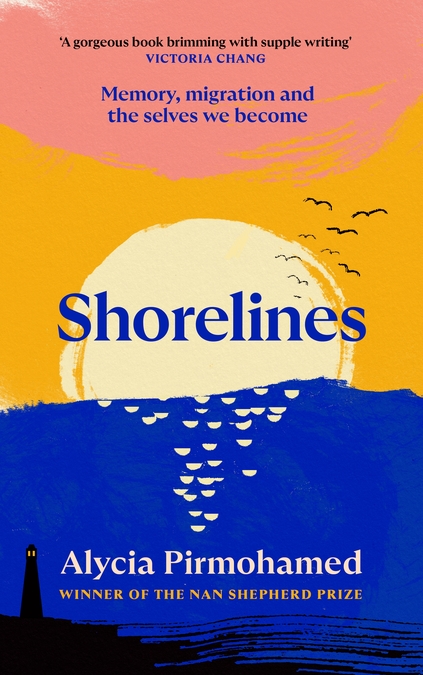
Alycia Pirmohamed’s memoir Shorelines begins cleaved in half. Across two columns, the prologue follows the Canadian poet in two different bodies of water: the Indian Ocean on the coast of Tanzania, from where her parents emigrated before she was born, and a lake she cannot quite remember in rural Alberta. From the very start, Pirmohamed eschews any pretence towards cohesion, certainty, or linearity; Shorelines is defined by its fragmentation – narratively, geographically, and formally. It is, she explains, how she understands herself, and is the only way she could imagine setting herself out in language.
Now based in Edinburgh, Pirmohamed intended to write Shorelines as a traditional memoir, recounting her experience of migration and memory in chronological order and tracing a childhood living as the only Muslim family in rural Alberta and her subsequent movements to Oregon, Scotland and beyond. Yet halfway through writing, Pirmohamed came to realise that it was the very rigidity of narrative – particularly narratives of identity, belonging and nature – that she wanted to break.
“The way I've been perceived as a nature writer or a queer writer or a Muslim writer, and questioned about how those things can coexist… How can you write a linear narrative about something that people project as not coherent?” Pirmohamed explains. “The fragment gives you room to coalesce it. It’s so freeing to allow the structure to do that rather than the linguistic articulation – to cue the reader that this is something that feels shaky.”
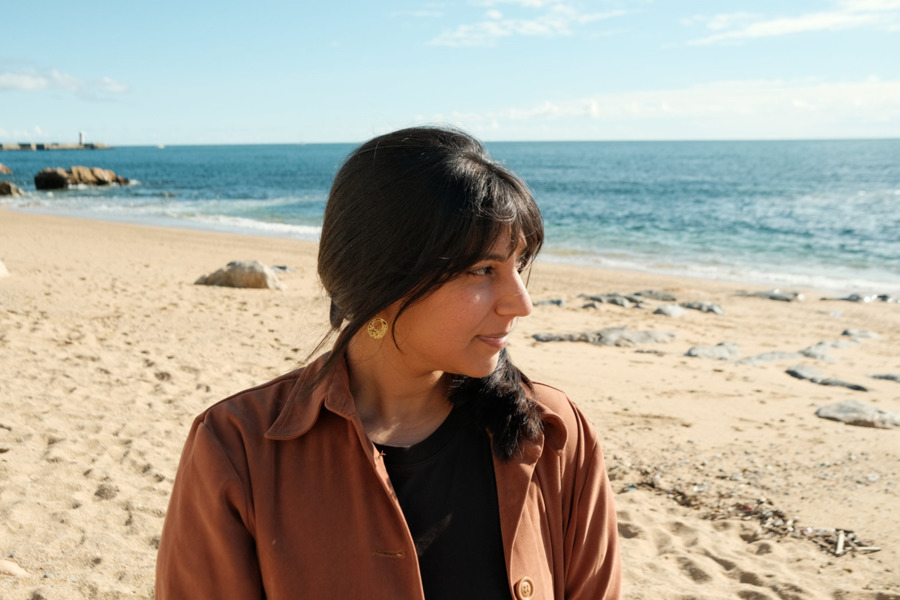
Photo: Tim Phillips.
Shorelines is distinctly a prose work written by a poet; a text fascinated by the malleability of time and language, and the concrete possibilities of the page. Split into three parts, it follows an imagined movement from land to shoreline to water, mimicking the increasing fluidity of these states through Pirmohamed’s own sense of belonging and unbelonging in the world, the gaps in her personal and familial memory, and the parts of herself she does not want to share. “As I was writing, I realised I actually didn't want to tell everything,” she explains. “The process of withholding was really important, and when I start to want to withhold deliberately, I end up moving towards space and fragment. It is a way of articulating silence, or articulating something really difficult or troubling.”
And so Shorelines unravels in fragments: some, particularly in the land section, told through more traditional narrative essays; others, particularly as the book moves towards water, told through questions and answers, audio transcriptions or stanza-like vignettes. If certain bodies and identities are always held prisoner to states of alienation, Pirmohamed wanted to interrogate how writing might articulate the erasures that result from this. In one section, her questioning of belonging in a world now marked by the genocide in Palestine features entire paragraphs stricken through, censored in the way that Pirmohamed has experienced her own anxieties as a Muslim woman being repressed.
“The essay about the genocide, a lot of it was written in early 2024. There was so much that I was feeling and wanting to say, but it felt like every time I tried, it was being erased or pulled back,” she explains. “The strike through was so fascinating to write because, knowing the aesthetic quality that would be placed on that text, it changed what comes out. Playing with these typographical features [and] structure... it opens up a valve.”
For Pirmohamed, these kinds of experiments and disruptions allow for the crafting of a new literary archive that mirrors the new personal archive created through writing by marginalised people: after all, what is memoir writing, if not an archiving of the self. There is a politics, she explains, to the act of archiving that has preoccupied her for a long time, and that she wanted to trouble through her work.
“Archives can be so violent, the way that they're given to us in such institutionally adjacent ways: museums full of stolen material, or even libraries and universities,” she explains. “We think of archives as ways of preserving material, but actually they are there for consumption, they preserve dominant narratives. As writers, we are contributing to the archive. We're deciding what to keep, what’s not important, what's going to be in the margins. I've been questioning my own sense of why I want to know the story, and why I want to write it down.”
Shorelines is an archive of Pirmohamed’s own imperfect memories; it is also an archive of memories that extend beyond herself. Woven into her personal record are her family’s intergenerational stories, their imagined relationship to places they once belonged, and broader histories of displacement and preservation. Ultimately, Shorelines reminds us that these acts of imagination are no less real than what we remember, and no less entangled in the weave of our collective lives. “That sort of imagining can be really important when our memories are so fallible and the history itself is so multiple,” Pirmohamed says. “I really love the idea that the figurative can be a way of preserving – a way of retrieving or self-understanding. That feels really important to me.”
Shorelines is out with Canongate on 13 Aug
Alycia Pirmohamed & Ece Temelkuran: Hope when Home is Lost, Edinburgh International Book Festival, 27 Aug, 5:30pm