Climbing the Walls: Eva Rothschild on her new Edinburgh exhibition
At Fruitmarket, Edinburgh Art Festival Emerging Writer Mayson Taylor speaks with Irish artist Eva Rothschild about activating sculpture through play
I stand before a giant pyramid of irregular cubes, coated in resin and washed in spray paint. Their chalky texture and rough graffiti blend classroom with underpass. Bound by gallery etiquette, I keep a respectful distance, tilting my head left to right, willing profound thoughts to arrive about the meaning of this artwork. Eva Rothschild, creator of Amphi (2019) and a London-based Irish sculptor, sweeps past me and perches on a cube. Elected to the Royal Academy in 2014, she represented Ireland in the Venice Biennale in 2019 and has spent thirty years pushing the limits of Minimalism. She pats the edge of a block nearby, and we talk about her current exhibition at the Fruitmarket in Edinburgh: The Void Presses the Wall.
Sitting on the structure, it opens up: the white gallery recedes. I’m chatting with Rothschild like we just met at a playground; her sculpture becomes a portal to my childhood. I resist the urge to climb higher. Rothschild explains. "If you sit on one, you start to think, 'oh, this isn't what I thought it was,' … which I think is the way you want to come to art: a kind of searching way." Untitled Stools are dotted throughout the exhibition, tucked into its corners. I ask the curators whether they are "part of the work." Nobody gives a straight answer. It feels like exactly the point.
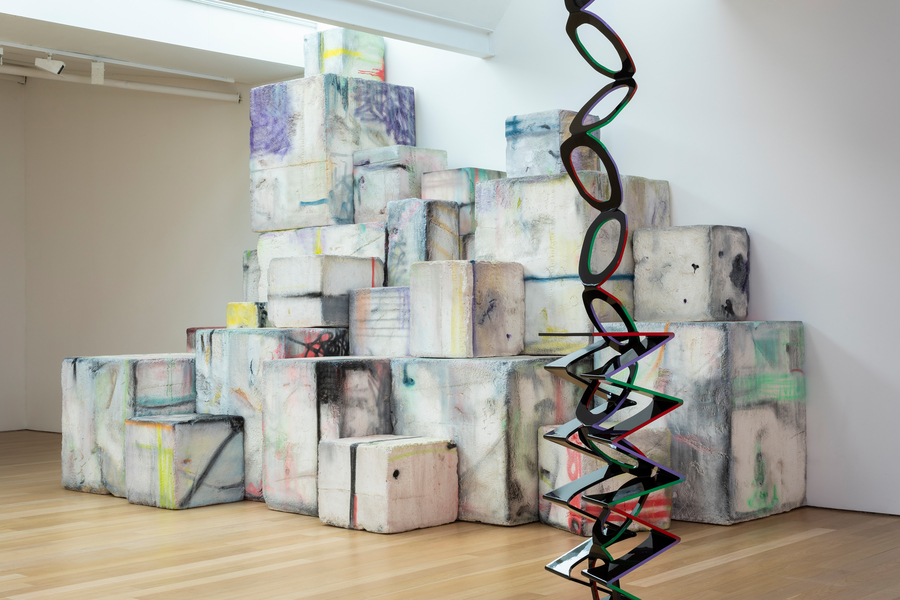
Amphi (2019) and Folded Eye (2026) by Eva Rothschild. Courtesy the artist, Modern Art and The Modern Institute/Toby Webster Ltd., Glasgow. Photo: Ruth Clark.
Searching turns out to be more method than mood for Rothschild. She does not fix meaning; she creates "an expanded view of materials and the possibilities of making." It's an idea rooted, partially, in her education. Reflecting on childhood art classes at an all-girls school in Ireland, she describes how a lack of hands-on material engagement created a "real kind of imbalance". She sensed an unspoken rule about "who would take up space, who would commandeer the workshop, who would feel they could engage." This realisation crystallised into a part of her practice and speaks to a wider question: who feels entitled to make, touch and interpret art, and whose relationship to materials has historically been encouraged?
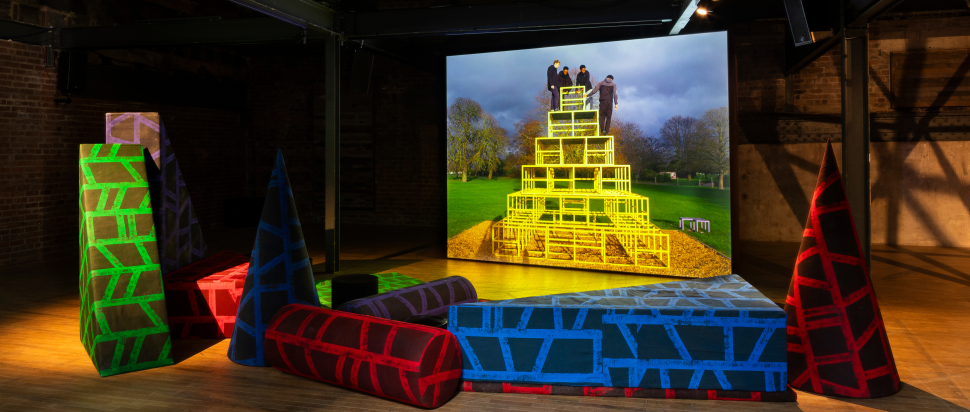
As an antidote, The Void Presses the Wall invites: “ultimate engagement.” She presents an environment made of art where people come and go, move, use their bodies, negotiate space and explore what they can do. This invitation is most evident one floor below us in the Warehouse, where Rothschild's new film SAFE plays. It follows a group of boys navigating another pyramid-like structure, this one yellow and transparent. They hang, sit, dance, crouch and call to one another, working out what their bodies can do. The sculpture becomes a social space shaped through movement and encounter.
The work echoes her 2012 Whitechapel Children’s Commission, titled Boys and Sculpture, in which Rothschild gave free rein to another group of younger boys to interact with, and ultimately dismantle, a room full of her sculptures. Rather than reading destruction as ending, she sees reuse. “The boys in that video were really transforming those artworks,” she says. Her choice of subject was a deliberate response to the gendered attitude that boys lack restraint, which spells trouble for galleries. Whereas girls are perceived as pliant people pleasers. Like Rothschild, I attended an all-girls school. I wonder if gender segregated education shaped my capacity for physical engagement. There’s a question Rothschild's work leads me to: what transformations become possible when we fully occupy a space with our bodies?
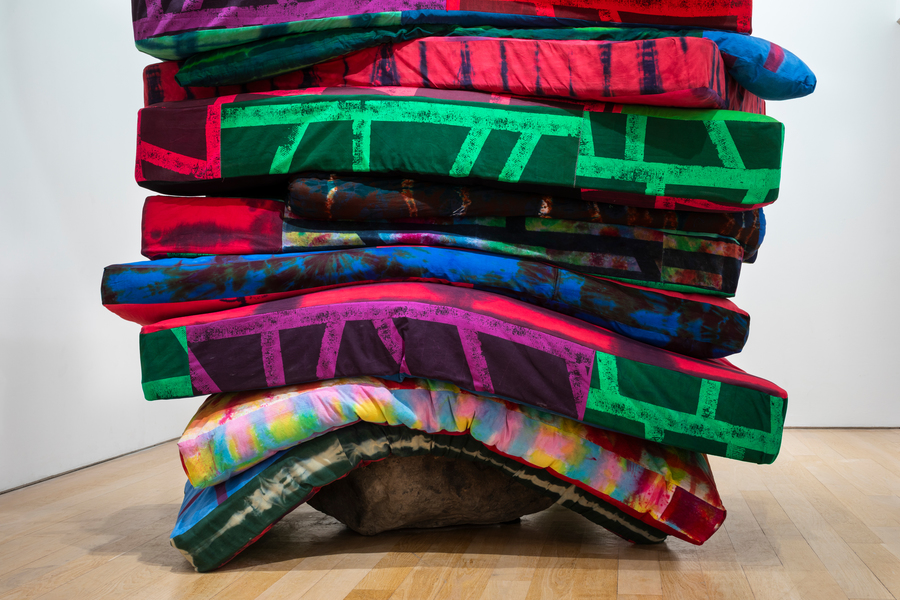
The Grit (2026) by Eva Rothschild. Courtesy the artist, Modern Art and The Modern Institute/Toby Webster Ltd., Glasgow. Photo: Ruth Clark.
Like the boys, Rothschild reuses her own sculptures; they transform to enter new spaces. Pointing nearby in the upstairs gallery at Sphinx (Night), she says, "I wanted it in this show, but I didn't want it to be light green, so I repainted it." Downstairs, a huge stack of mattresses in hand-dyed fabric balances on a boulder. The Grit is built from cloth pulled from her studio, "bits and pieces" of other things, repurposed. Rothschild lets materials accumulate histories, sculptures becoming living archives of decisions, possibilities and learning from engagement.
We laugh over her slippery meaning-making when I mention Madonna from her website. It’s baby pink, I thought the Like A Virgin pop star; she meant Virgin Mary. Though neither of us is wrong, the gap between associations surfaces as a reminder of how thin the threads of meaning are. Through shared engagement, we stumble onto something unintended.
The Void Presses the Wall asks participants to move within uncertainty, leaving behind what they think they know and entering a space built for searching. These sculptures resist fixity, remaining open to reinterpretation, reuse and collective experience. Stepping into Rothschild's abstraction offers materials to think with and sculptures that shift depending on how, and whether, you engage with them.
That's the thing about a void: it's both empty and full of possibility. And the thing about walls, perhaps, is that they're meant to be climbed.
Eva Rothschild: The Void Presses The Wall, Fruitmarket, Edinburgh, until 11 Oct
Edinburgh Art Festival, 14-30 Aug