Get to the Root: Esther Castle's EAF exhibition Abundant Parts
Esther Castle's installation at Edinburgh Sculpture Workshop prompts us to consider the hidden politics of gardening, observes EAF26 Emerging Writer Khadea Santi
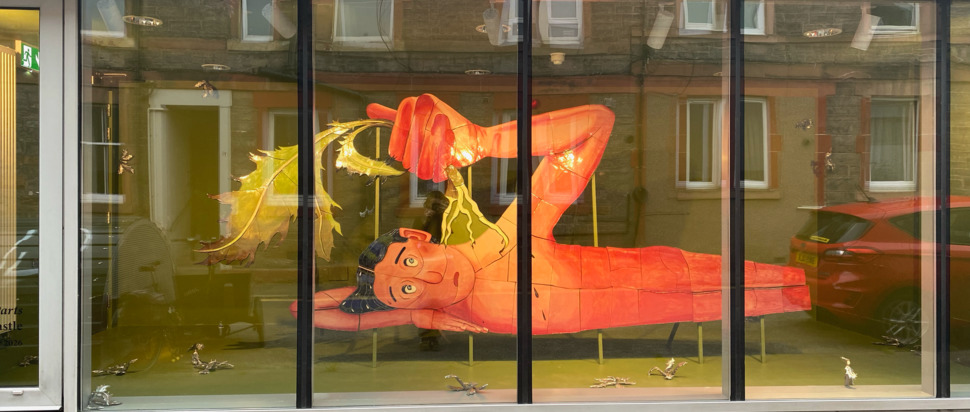
I meet Esther Castle in her studio at Edinburgh Sculpture Workshop, a short distance from her new window installation at Hawthornvale Space. The Edinburgh-based artist often draws from her childhood experiences of illness, and explores what it means to occupy a disabled body. Her installation Abundant Parts is a glass house of sorts, displaying a ceramic tiled figure pulling a weed from within, taking a closer look at the roots. Castle uses the garden as a metaphor for the connection between the non-normative body and weeds: “A weed is only a weed because it's in a place it's not supposed to be. There's nothing weedy about weed. They're very, like, as we were talking about, very strong forces.”
Inside her studio, by contrast, the walls are covered in charcoal sketches, tacit acknowledgements of the strangeness of interacting with cultivated environments designed for able-bodied people in a non-normative body. They remind me of comic strips. When I mention this, Castle lights up and says that the white space that separates images in a comic strip is called the gutter, "Maybe these figures kind of fell into the gutter and they’re coming back out... they’re not supposed to be there,” but grow anyway, like weeds in manicured gardens and concrete pavement cracks – abundant, defiant.
Visible at street level, blending ceramics, painting and sculpture, Castle’s Abundant Parts installation catches the eyes of passerbys. A reclining figure made out of red glazed tiles stands out against the matte green, all encased behind glass. There’s an initial unease when you first look at the figure, how it feels contained and uncomfortable in the space, and then I see a momentary reflection of myself in the glass. Aluminium cast weeds flit around it, playfully conveying resistance and persistence, muscly and in abundance. The central figure pulls at a giant weed, seemingly plucked from within, having a closer look. Surprised shock at the roots – the roots that are alive.
The work reminds me of the teachings of historian and activist Barbara Ransby, who proclaimed that to get radical means “to get to the root.” How we tend a garden is more political than we think. Mainstream British gardening coincided with the height of 19th-century imperialism, as the expanding empire scoured the world for exotic species of plants. The idea of gardens shaped by control and dominance is linked to that colonial past. Roots can help us get to a place where we can address the past.
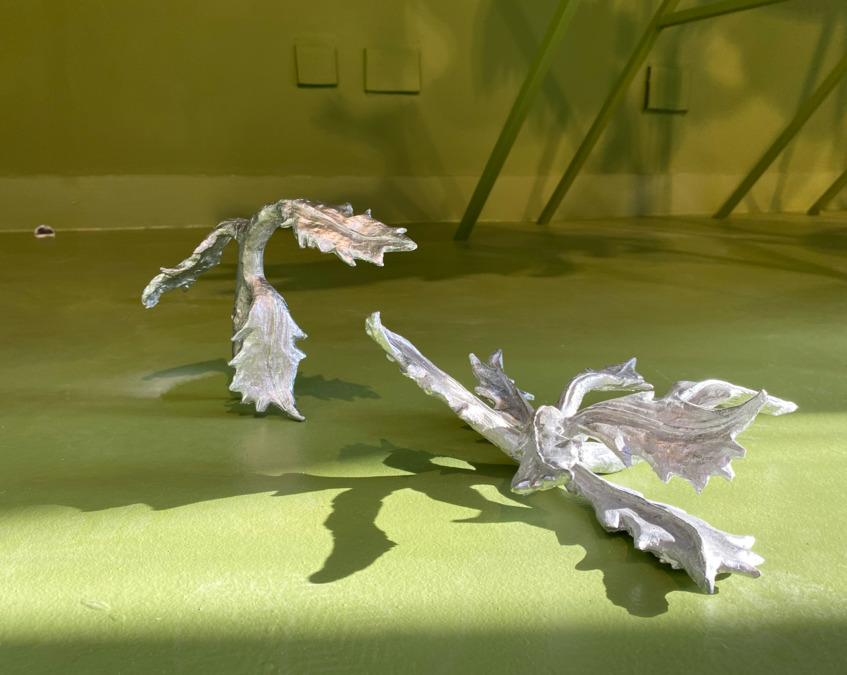
Abundant Parts by Esther Castle.
On display during the Edinburgh Art Festival, Abundant Parts chimes with the Festival’s ongoing curatorial exploration of interspecies connection. During the 2024 iteration, Más Arte Más Accion: Around a Tree offered a space to gather and explore human–plant interconnections and biodiversity loss. In the 2026 EAF edition, Effervescent! with artist Katucha Bento presents a participatory performance that is grounded in an embodied anti-racist practice, inviting us to think beyond human hierarchy and think with plants. Meanwhile, it feels more important than ever to think globally about the effects of biodiversity loss. Castle’s work opens up similar dialogues and from afar, within its own metaphors.
In Castle’s studio, I’m reminded of how sharp and sensitive artists can be in their observations of the world around them; what they take in and fictionalise through materials, through metaphor, making us see again. Castle and I talk about the weeds growing along a nearby path, and that we all in a sense act like gardeners when we go about our life pruning and presenting a manicured self to the world, while being unruly is a marginal position. Pristine gardens are ways to signal to people we are upholding the ideal. But what if that idea of control is just an illusion? From my experience of living in a body that is disabled compared to what is expected of it, I am not disillusioned. It’s the red, raw, soreness of trying to keep up that falls to the side and you have to find new ways of understanding yourself in relation to the world.
Society serves the privileged few, while everyone else has to contort themselves to fit in. But what about those of us with disabilities, shaped differently, unable to conform if we tried? With an unruly body it feels like you’re looking onto society, not from within society – out of place – weedy. Abundant Parts recognises that feeling intimately, magnifying it and displaying. We must recognise the ableist systems that control and dominate our bodies; Castle’s other-worldly garden weeds offer ways to reframe and slowly unravel fixed social constructions, giving us space to imagine otherwise. We are, each of us, prone to illness and harm, yet we all too often ignore these things and the people experiencing them. This work points to that softness, that vulnerability, to difficult emotions, and how we can reframe weeds as beautiful, playful, unexpected and welcomed flora.
Esther Castle: Abundant Parts, Edinburgh Sculpture Workshop, until 27 Sep
Edinburgh Art Festival 2026, 14-30 Aug