Emii Alrai’s Guardian and Edinburgh’s Disgrace
On Calton Hill, Edinburgh Art Festival Emerging Writer Eve Whittle brings a new sculpture into dialogue with the unfinished National Monument of Scotland
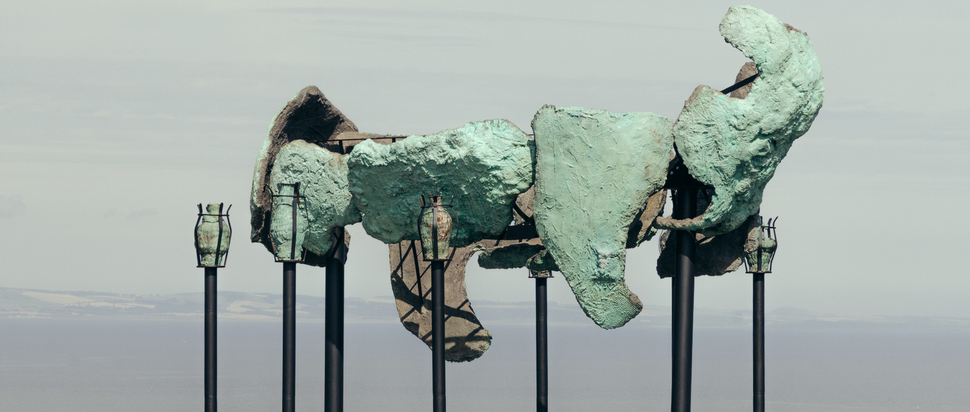
It was the day of the solar eclipse. Over in Glasgow, the cloud covered any hope of seeing this once-in-a-lifetime event – classic Glasgow. I opened Instagram to experience it through other people’s images, and this was my first glimpse of Emii Alrai’s Guardian. As the light dimmed over Edinburgh and the crowds gathered atop Calton Hill to catch a glimpse, Guardian stood just above, also experiencing this phenomenon. This first sighting of Guardian taught me about the work before I’d even seen the piece in person. It watches over the city, over conversations, over you.
After experiencing the once-in-a-generation phenomenon via stories and grid posts, I make the journey to see Guardian in the flesh. The climb to Calton Hill has always been a negotiation with Edinburgh: a slow, deliberate rise out of that Georgian grid, past tourists looking slightly lost, past joggers who know the hill as part of their daily routine. At the summit, the city reveals itself: spires, cranes, that distant shimmer of water. And it is here, amongst some of the city's most self-conscious monuments, Alrai’s Guardian takes its position.
I find it side-on and alone, there is something both reflective and insular about it. Up close, the blue is not one colour but several; a chalky, weathered surface that catches differently depending on where the cloud breaks. Alrai’s sculpture stands opposite the National Monument, a half-built Parthenon attempt whose incompleteness has been folded into city lore. Known as Edinburgh’s Disgrace, its unfinished structure speaks of the city’s colonial ambition: an imperial gesture that never quite achieved its intended grandeur. It is a site that performs its own failure, and it is into this arena of thwarted ambition that Alrai’s sculpture arrives, commissioned by Edinburgh Art Festival as a new iteration of the work first shown at Bold Tendencies, on the roof of a Peckham carpark. In an environment we have all come to associate with low-grade stress of honking horns and drivers squeezing into spaces, Guardian reads as a meditation on the frictions of contemporary urban life. On Calton Hill, that reading falls away. This is a stage that demands monumental logic and national adulation; Guardian rejects this ideology.
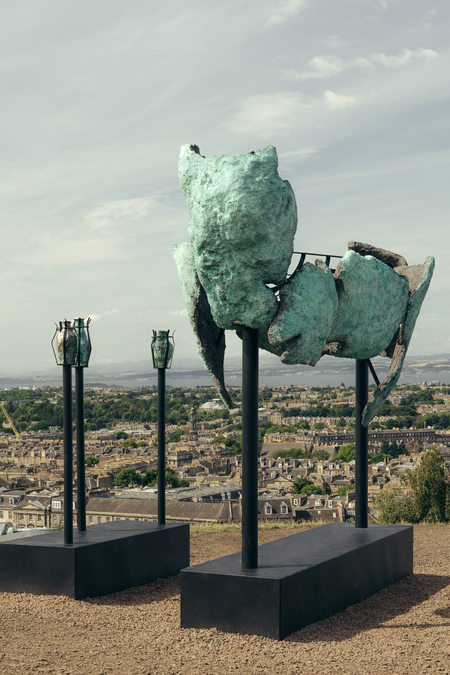
Guardian by Emii Alrai. Photo provided by Edinburgh Art Festival
Its reference point is a Lamassu, an Assyrian protective deity that flanked the gates of ancient cities. Some ‘live’ in the British Museum, their displacement framed as preservation, their fragmentation masked by the museum’s authoritative veneer. I have never encountered a Lamassu before this meeting; they made up no part of my schooling, nor the British historical narrative I have inevitably absorbed and inherited. This absence speaks to the selective violence of cultural education in the UK, enshrining certain histories and burying others. Sitting opposite Calton Hill’s National Monument, history stops being an abstraction and becomes something seated deep within Guardian.
Eroded body, visible joints, and exposed museological armature give the piece an unsettling charge. This is not a monument so much as a reconstruction that cannot hide its own violence; a counter-monument, in effect, sitting within abrasion, displacement and contested memory rather than asserting the permanence a traditional monument demands. It does not stand as a symbol of Assyrian grandeur, but as a reminder of how it was extracted, dismantled, and Frankensteined together in Western institutions.
The material language is inseparable from its site. Its metal armature was built by the same hands that make the industrial wind turbines you can see on Leith's docks. A sculpture about imperial extraction is literally constructed from the infrastructure of the green energy transition, one history of resource and power quietly welded onto another. Calton Hill is wind-whipped and rain-polished; its monuments weather in real time, and Alrai lets Guardian weather with them. That erosion is part of its argument: a rejection of monumental timelessness and an embrace of the fact that history is continually revised and contested.
By placing Guardian into a landscape that has long celebrated Western colonialism, Alrai forces a conversation about what the city chooses to memorialise and what it lets fade. The sculpture doesn’t tell us what to remember, it asks what’s already been forgotten. As the wind catches its surface, it looks less like a finished project than something still deciding what it will be.
Emii Alrai: Guardian, Calton Hill, Edinburgh, until 30 Aug
Edinburgh Art Festival, 14-30 Aug