Davi Pontes + Sebastião Abreu @ Royal Botanic Garden, Edinburgh
At the Royal Botanic Garden Edinburgh, a choreographed performance subverts the codes inherited from Western dance tradition, writes Edinburgh Art Festival Emerging Writer Khadea Santi
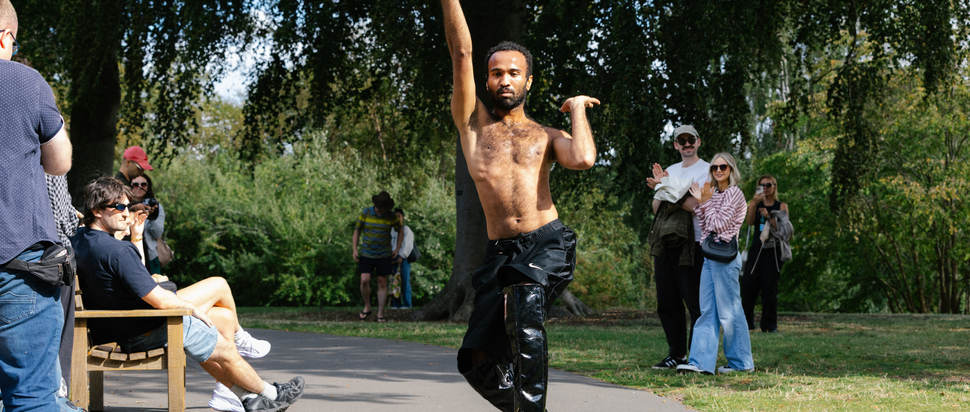
Brazilian artist Davi Pontes’ Serial Component is a choreographic research project unfolding across three episodes. Each performance develops a bodily vocabulary through collaboration with invited performers and this third episode, performed with Sebastião Abreu at the Royal Botanic Garden Edinburgh, questions choreography and subverts the codes inherited from Western dance traditions. Rather than treating choreography as fixed, the work approaches it as a flow: energy transferred between bodies, histories, environments and audiences.
Collaboration and trust are key throughout. Abreu tells us about how they meet, in front of the sea. As a diasporic person, I feel the symbolism of this deeply: water holds memory. I meet them a day before the performance and get a sense of how important it is to be surrounded by the elements and in the city of Edinburgh for the first time, this work developed as part of their residency (a collaboration with Edinburgh Art Festival and Pinacoteca de São Paulo) at the Botanics over several days. The city and location affect what the performance becomes.
The project is connected to Pontes’s research with philosopher Denise Ferreira da Silva around Black Ecologies and heat transfer. Ferreira da Silva’s thinking brings together questions of ecology, decolonisation, energy and the lasting structures of colonial violence. Heat never disappears. It accumulates, transfers and changes the things it touches without requiring one thing to become another or lose its attributes.
This is the third of three performances; the serial component of the title means movements, gestures and memories from previous episodes are carried into each new work. They use movements from previous dances, bringing something new into each part. Previous elements disappear to make space for new ones while remaining in the body as memory. As the project progresses, the performers move from the indoors to the outdoors. The first performance took place inside a museum, the second was semi-outside, and this third episode is completely outdoors. The work is calling to be outside; it has moved from the controlled space of the museum into the weather, grass and open air.
At the Royal Botanic Garden Edinburgh, colonial histories are built into botany. The location is not simply scenery. Its histories are embedded in the reading of the work, questioning who is in the space, who has historically been permitted to move freely, and how plants and knowledge have been collected and classified.
The work feels like a procession: organic and in the moment. On a busy Sunday, families and audiences gather. There is no prime seating position, the audience surrounds the performance from 360 degrees. We sit or stand on the same grass where Abreu performs. We are connected to the work, and to Pontes and Abreu, through the ground beneath us. Emerging from the trees and moving across the hills, Abreu struts through the garden. The suspense builds. Stretching. Walking. Thrashing. Posing. Holding, then releasing, transferring.
I feel the heat on my shoulders from the sun. Abreu is glistening with sweat as the movements, poses and gestures require precision, strength and endurance. Holding his weight in his latex, thigh-high heels with red soles on the grass. His movements carry confidence and personality. Children begin following Abreu. I am struck by how moving this becomes and how moved he appears. He later speaks tenderly about feeling less alone in the performance; they evoked belief and curiosity, and in turn transformed into self-belief.
The movement holds references to Capoeira, an Afro-Brazilian practice bringing together martial arts, dance, rhythm and resistance. The body becomes a site of self-defence, capable of absorbing and transforming historical trauma into new forms of expression. There are also movements recalling dancehall: the tick-tock of hips moving with precision. Voguing appears through the garden, carrying the history of Black and Latino LGBTQ+ communities being able to become what could not always be expressed in everyday life, rooted in survival.
Serial Component refuses fixed definitions of dance. Movements appear, disappear and return transformed. Memory is not held as an unmoving archive but brought back to earth through the body. Pontes and Abreu begin with memory without being entirely sure where it will lead.
The work asks what it means to be with people in a space, gathered out around a tree. It creates a temporary place for bodies, memories and energies to meet. What we are left with is presence: how we make a difference through being here, how we change the things around us, and how they change us.
Serial Component was performed at the Royal Botanic Garden Edinburgh on 23 Aug as part of EAF26
Edinburgh Art Festival, 14-30 Aug