Future Vision: Catherine Opie on her first Scottish solo exhibition
Photographer Catherine Opie speaks to Edinburgh Art Festival 2026 Emerging Writer Anna Olivia Riley about capturing a hopeful portrait of humanity
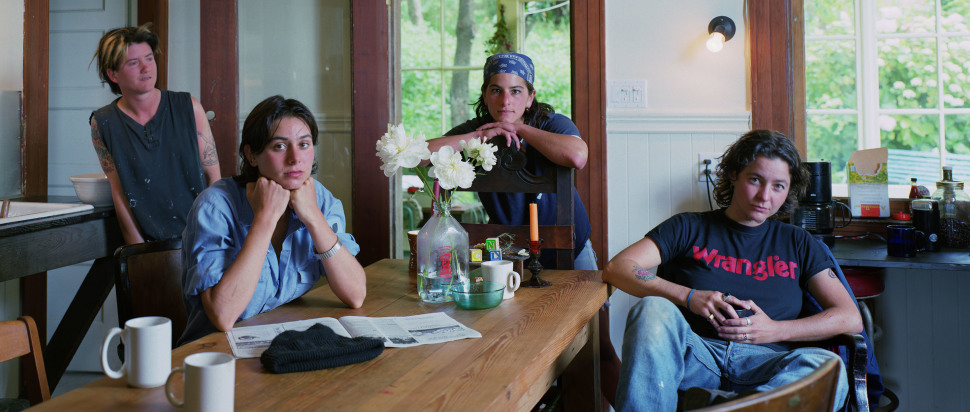
The American photographer Catherine Opie and I speak over a call while she sits in her Los Angeles studio. She is kind and generous; she says nothing is off limits. To Be Seen, her first solo show in Scotland, will be her fifth and final exhibition of the last two years. Touring from the National Portrait Gallery, To Be Seen includes nearly 80 portraits by Opie alongside 13 paintings by a range of artists from the National Galleries of Scotland’s collection. Her portraits are displayed across seven rooms, showing various images, ranging from her family and queer community to Barack Obama’s presidential inauguration and high school footballers. Opie approaches every museum site intentionally: “I plan every exhibition very carefully; the architecture and the installation has to work with the meaning of the show. Nothing is ever random in my exhibitions.”
From her fine-art portraits of queer subcultures in Los Angeles, to her never-ending American landscapes, Opie has taken some of the most striking and important photographs of the last 35 years. For Opie, this exhibition’s installation is in conversation with a broad history of portraiture. While the 13 selected works from Scotland’s national collection use paint to map culture and time, Opie uses the camera to create a detailed map of skin.
Museums and their collections are in a very interesting and fraught place today; they are the meeting place between a public and their history. With the surge in right-wing politics across the globe, the museum must decide whose history gets told and how. For Opie, art and activism are intertwined. She asks, “How can we imbue this moment with actual criticality, where we can invite people to look at history in a different way?”
There is power in portraits; a directness and stillness in the subject’s gaze that reaches all the way into us. To Be Seen is a personal show “that is still about the political as well, because that’s never separated far from me”. By staging images of her community, family and herself alongside the collection’s historical paintings, Opie shows us what we have in common and asks us, how are we the same? In Self-Portrait Nursing (2004), Opie poses breastfeeding her son, with the word 'pervert' scarred and scribed on her chest. Picasso’s Mère et enfant [Mother and Child] (1902) will sit nearby, a painting from a century prior; a mother’s back, her head tilted as she holds her baby in her arms.
Opie’s portrait of Divinity Fudge (1997), in her leopard print two-piece, converses with the elaborate gown of Benedetto Gennari’s portrait of Elizabeth Murray, Duchess of Lauderdale (1679). This is what we do as humans; we have signifiers that represent our culture, history and identity. For us dykes, Opie’s work shows us people that look like us; it represents our past and our potential futures. For those who have national and Scottish pride, a 15th-century portrait of Scottish tartan sinks into the body in the same way. This shared humanity is what Opie wants us to see.
Stereotypes are mean and the world is often cruel, but Opie’s lens is a kind one. In documenting 'the skin' of her family and friends across their lifetimes, she generously maps the future and shows us what is possible. She invites us to have hope! When I look at Flipper, Tanya, Chloe & Harriet (1995), I see my friends in each figure.
To Be Seen is about “trying to get to a greater place of humanity.” Opie looks at elaborate 15th-century clothing and asks: “why can’t that be queering as well?” This exhibition shows us a common language that belongs to us all. Opie says: “all of this is a larger ecosystem of all of us.” This is why, when you come to this exhibition, you may well see yourself. You might also see people whom you dislike or people you love. All these people are given the same attention because every single person has the right to be seen.
Opie’s empathetic gaze reaches through her portraits and all the way into us. In meeting every single person and past with such kindness, she extends her empathy from yesterday into tomorrow and offers us a possible vision of our world; a kinder future.
Catherine Opie: To Be Seen, Royal Scottish Academy, Edinburgh, 8 Aug-1 Nov
Edinburgh Art Festival, 14-30 Aug