Sensations of Power: Anne Hardy transforms Talbot Rice for EAF
Edinburgh Art Festival Emerging Writer Eve Whittle follows her intuition at Talbot Rice Gallery, where British artist Anne Hardy has transformed the Georgian Gallery through sculpture
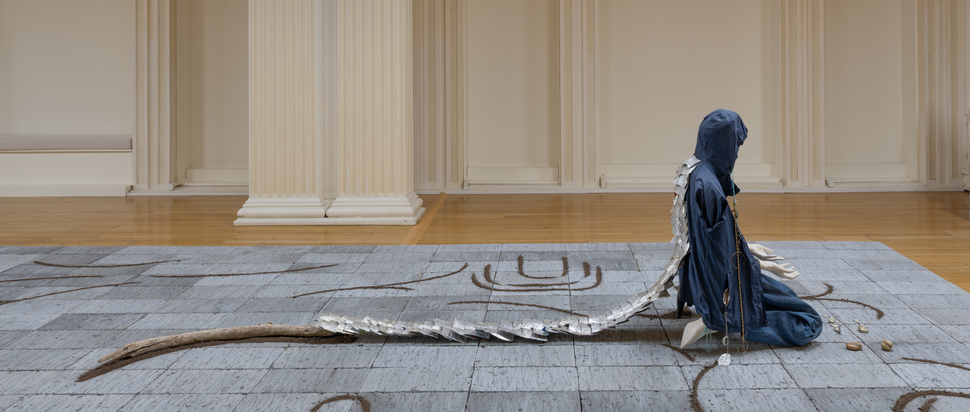
I start with my feet. Before the work comes into focus, and before the exhibition’s logic reveals itself, the room meets me at a corporeal level. The gallery feels grounded, as if it has been asked to hold more than the literal works themselves. Anne Hardy’s Feelings at the Talbot Rice Gallery is a show that starts in the body, in the soles, in the breath. Before I fully enter the space, before I understand anything, I feel it. And maybe that is the point.
Only after sensation does the exhibition’s structure begin to emerge. Three sculptural beings occupy the Georgian Gallery, each assembled from cast metals, worn fabrics, ceramic fragments, and studio remnants. A flickering light system responds to distant weather data, pulling external conditions into the gallery. A sonic field, part environmental and part technological, threads throughout the space, shaping how the room is navigated. These elements, these constellations of materials and signals, guide the visitor through Hardy’s world of embodied futures.
Hardy’s practice is rooted in intuition, embodied knowledge, and listening to materials. Here, intuition becomes a methodology rather than a mood. The show proposes a mode of knowledge that precedes language, unsettling the gallery’s usual demand for clarity. In the context of the University of Edinburgh’s gallery space, a place built on the belief that knowledge can be acquired, articulated, and assessed, Feelings feels quietly radical. Hardy suggests that knowledge might be something we sense before we understand.
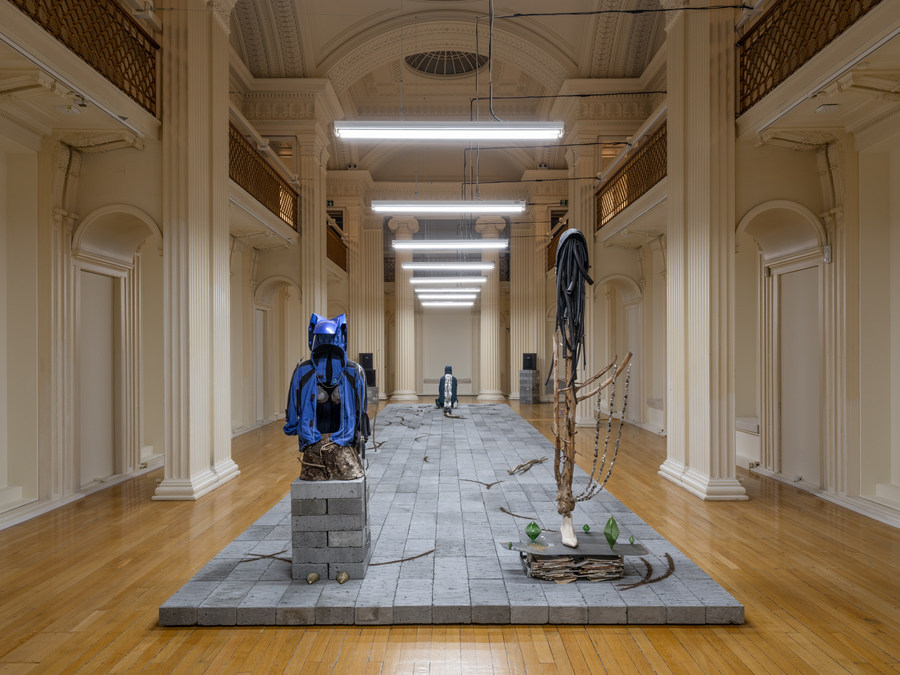
Feelings, installation view at Talbot Rice Gallery, the University of Edinburgh by Anne Hardy. Photo: Angus Mill.
As the room continues to shift around me, lights flickering and sound folding into itself, Hardy’s conceptual terrain feels clearer. In her exhibition pamphlet she speaks about 'the evolving infiltration of artificial intelligence into our daily lives, and the future of our biological selves that have evolved over millennia to give us complex, embedded, intuitive knowledge and instincts.' This tension, between ancient embodied intelligence and accelerating technological systems, becomes the exhibition’s deeper engine. Rather than depicting AI or futurity, the installation performs a kind of temporal grafting: past, present, and speculative future pressed into the same atmospheric field. These collisions don’t simply expand the work’s material vocabulary, they propose a future archaeology in which incompatible contexts exist together, refusing to resolve into a single narrative of what comes next.
I am pulled towards the sculptural beings. They kneel, lean, and hover. It feels as if you have caught them mid-gesture, as if they have been interrupted by my arrival. Their postures are ambiguous: ritual, exhaustion or emergence? They are not human or stable, but they feel grounded. There is a sense of being watched, but not judged. The beings feel attentive, as if they are listening to the room, to the visitors, to the institution itself. Their materials carry traces of labour, ritual, environmental remnants, and technological signals. They feel like future artefacts, objects that know something about what comes next.
One figure, The Interloper, acts as a fulcrum; the other beings seem to orbit it, drawn to its gravitational field. I glance at the visitor book on my way out: 'I loved it! And I was scared of The Interloper' – Nia, six years old. In this moment, the installation becomes a proposition about power; who holds it, who resists it, and who rewrites it. A question about knowledge, power, and the future. Children often sense atmospheres before adults name them. Hardy’s work seems to trust that.
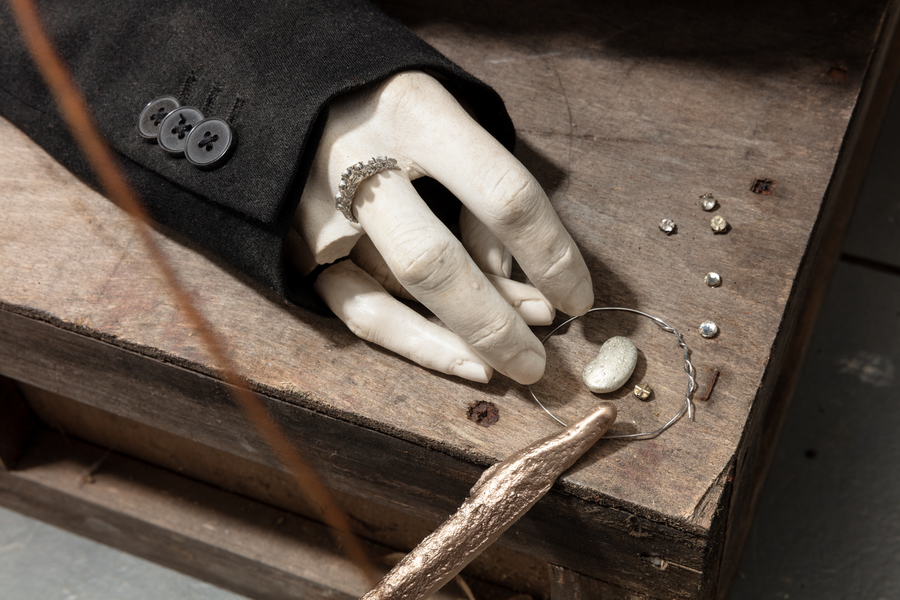
Detail of Being (Immaterial) (2023-2024) by Anne Hardy. Image courtesy of Maureen Pale.
Moving through the space, I notice how the building itself responds to Hardy’s work. The sound travels differently across its surfaces. The flickering light reveals architectural details normally overlooked; the beings cast shadows that feel older than they are. The installation performs the building, activating it, unsettling it, turning the gallery into something porous. Talbot Rice becomes a membrane rather than a container; Talbot Rice becomes a site of negotiation between past and future, clarity and intuition, academic authority and embodied knowledge.
What hangs most is the sense that the exhibition is not asking to be understood, but absorbed. It offers sensations rather than statements, atmospheres rather than arguments. It invites a mode of attention that is slower, quieter, more attuned to the body’s intelligence. In a moment where it seems institutions are preoccupied with legibility, Hardy proposes opacity as a form of knowledge – not obscurity, but depth.
As I leave, my feet feel different. The building exhales. The atmosphere settles, but not completely.
Something lingers, a residue of sensation, a feeling that the institution has been subtly rewritten. Feelings does not simply occupy the Talbot Rice Gallery. It infiltrates and unsettles it. It invites a new mode of knowing – one rooted in intuition, material intelligence, and embodied futures.
And I find myself thinking:
Everything you need to know is in the space.
Everything you need to know is in you.
Anne Hardy: Feelings, Talbot Rice Gallery, Edinburgh, until 27 Sep
Edinburgh Art Festival, 14-30 Aug