Taking a Stand: Why we should all like stand-up comedy
An article by our new Comedy editor on why we should all like stand-up comedy – even if we don't really like it
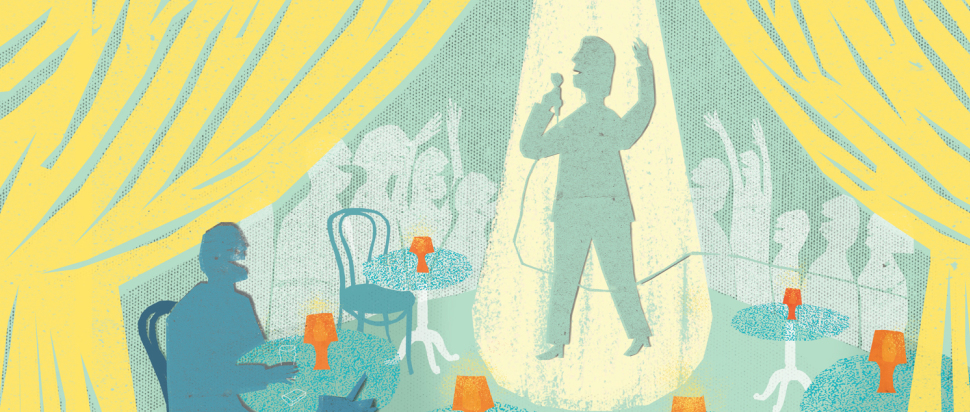
As Fringe season approaches with the might of ten thousand hungry bears, we prepare ourselves for a new dawn of fresh comedy shows. From up-and-coming talent to established voices on the scene, from straight-up stand-up, improv and clowning to a guy singing the same song over and over again for an entire hour (yes, that is listed as an official act to look out for), there’s surely something for everyone, right? Right?
Wrong. To this day, despite its best efforts, stand-up still doesn’t seem to be everyone’s cup of tea. Arguably more so than other art forms, there remains a strange dislike, and dare I say, lack of respect, for laughing in a room with other people who are also laughing. As your new Comedy editor at The Skinny, I’d like to embark on this role by asking why this is, and what is currently being done on the scene in Scotland to challenge the stigma of stand-up.
Arguably, one of the main reasons people tend to avert their eyes from live comedy is because of a fear of the discomfort of being observed and perceived. Indeed, watching stand-up CAN be uncomfortable, and, at times, excruciating. It forces us to confront those parts of ourselves we try so desperately to hide, but for some reason, comedians can sniff out from a mile off.
Those who are adept at their craft, though, can alleviate the pressures and challenges of our daily lives by revealing the humour that lies within. The world we live in is tough, but by relating to audiences through a shared commonality – be it failure, embarrassment, delusion, and so on – comedians hold the rare ability to place our lived experiences in a completely different light, and to remind us to not take ourselves and the world around us quite so seriously.
Another reason some people unwittingly roll their eyes at the mention of stand-up is that it is inherently unpredictable, and therefore, frightening. You can see why it is a widely misunderstood genre. Stand-up is disruptive and moving, so is it Art? Yet it engages with television and media, so is it Entertainment? But it happens on a stage, is often performed, and produces catharsis, so, then, is it Theatre?
Perhaps, in a society that loves to categorise, we don’t like stand-up comedy because we simply don’t know where to place it. And what do we do with things we don’t understand and can’t place? Say it with me, we dislike them! (sigh).
Scotland has always been at the forefront of the comedy world, particularly when we think of observational humour, dark wit and inventive, self-deprecating storytelling. The contributions of trailblazers like Billy Connolly, Frankie Boyle and Susie McCabe to the Scottish comedy scene are undeniable, establishing a strong voice and character which is recognised internationally. But there’s also a real shift occurring in the comedy scene, which has been slowly growing over the last few years. Humour is creeping more and more into art discourse to reflect an increasingly ridiculous world. With that, people are finally turning to comedy for answers, with those operating on the fringes experimenting with new ideas and pushing the boundaries of what comedy can be – not all of them necessarily identifying as comedians either.
Here’s an example. Very recently, I marvelled at Glasgow's effortless flair for comedy, having unexpectedly revelled in its full spectrum on a Saturday evening out. I began with Jamie Crewe’s performance at the Southside’s Tramway to watch a live performance of an ongoing artwork Defiling Rain. Though this wasn’t a comedy event per-se, humour certainly held an invaluable presence in the room. References to fantastical fables and deranged headless creatures suspended reality, quickly dissolved by the artist’s quick-witted one-liners. The audience collectively delighted in these punctuated moments of the set where time seemingly stood still, a *chef’s kiss* blend of surrealism and sincerity.
Immediately afterwards, I was whisked away to the Clutha Bar in the city centre. Instantly, I was thrust into the absurdist madness of Glasgow band Hugh Reed and the Velvet Underpants, in which no prop was too ridiculous, nay, too much of a health and safety risk, to use. It’s quite hard to get your head around being in a room full of philosophising artists one minute, and then being in a room of expectant football fans chanting ‘BARRS, BARRS, BARRS IRN BRU!!!’ while the lead singer swings a toy monkey on a string around his head.
Neither of those events were categorised as comedy, yet here we all were, laughing away. It seems obvious that stand-up played a part in both of these performances, with quippy one-liners, self-referential humour, world-making and anecdotes all vital to the material. I had enjoyed many aspects of stand-up without going to a stand-up gig! Who’d have thought it!
Once you start to see its influence, you’ll see it everywhere. So many genres borrow from the stand-up framework without even realising it, whether it’s the onstage chatter in between songs at a music gig, or the offhand, conversational comic relief at an otherwise earnest exhibition opening. When you think of it like this, can you honestly still say something as flippant as you “don’t like” stand-up? Instead, maybe we can ask, what do we owe to stand-up? (And… who do I need to apologise to?)
Man Sings the Same Song Over and Over Again for an Hour, Summerhall (Red Lecture Theatre), 6-31 Aug (not 17, 24), 7.45pm, £16-18.50
@jamiecrewe
@hughreedandthevelvetunderpants