Curated Environments: Edinburgh's nightclubs and the Fringe
If clubs are vital to Edinburgh’s culture, then why do they feel overlooked during the Fringe? One writer considers where clubs sit in our cultural landscape, in discussion with the cast and crew of the city’s nightlife venues
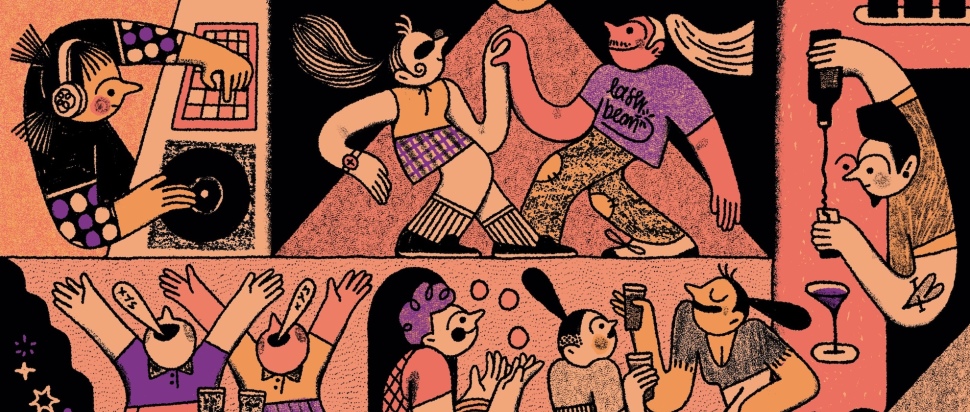
In August, Edinburgh's pavements are heaving, parks turn into beer gardens and the city morphs into one of the world's largest festival grounds without ever really building one. Our bars become somewhere to wait before a spectacle and half of the festival happens on the walk between venues anyway. By midnight, the city feels less like a collection of postcodes, becoming one enormous building with different rooms pulling you between them.
Every performance comes with a programme, a critic and a language for describing how it was made. Lighting, sound, stage management, costume and direction are all understood as part of the artwork itself. Nobody leaves a play believing the actor built the set alone. Club nights are collaborative too, but we tend to describe them differently: the DJ gets named, while everything else is absorbed into the atmosphere. Venues like Sneaky Pete’s and People's Leisure Club seamlessly shuffle between Fringe and late-night club programming. Yet, somewhere between the theatre and dancefloor, our language changes. One arrives with reviews, awards and attention. And another is described as somewhere to lose yourself after. So, what counts as culture during August?
I asked four of the institutional backbones of Edinburgh’s club circuit the same question: when does a club night really begin?
For Finn Koren, PR and Venues Manager across Gilded Saloon, People's Leisure Club and Gilded Balloon, that's not a metaphor. "It starts on Monday," he says. Programming meetings, ticket sales, flyering, reassuring nervous promoters and sending a team of PR staff back out into the city – not simply to advertise a night, but to start gathering one.
His description of PR feels less like marketing and more like artful matchmaking. The perfect candidate, according to Koren, “is a sponge for the atmosphere.” Not someone to sell a room, but someone who understands it well enough to find the people who belong there.
Eight minutes away, down the iconic Cowgate, Monica Sgouros, Venue Manager at Sneaky Pete's, gives me a completely different answer: "It starts when the gig finishes."
As folk shift through the bottleneck of the venue, the room is reshaped by the whole team. The stage disappears, the DJ booth rolls into place and with it, the focus shifts from a single performer to the dancefloor itself. Cables are gathered, bar restocked, lights reset. Within an hour, the venue has transformed from a gig space into a club.
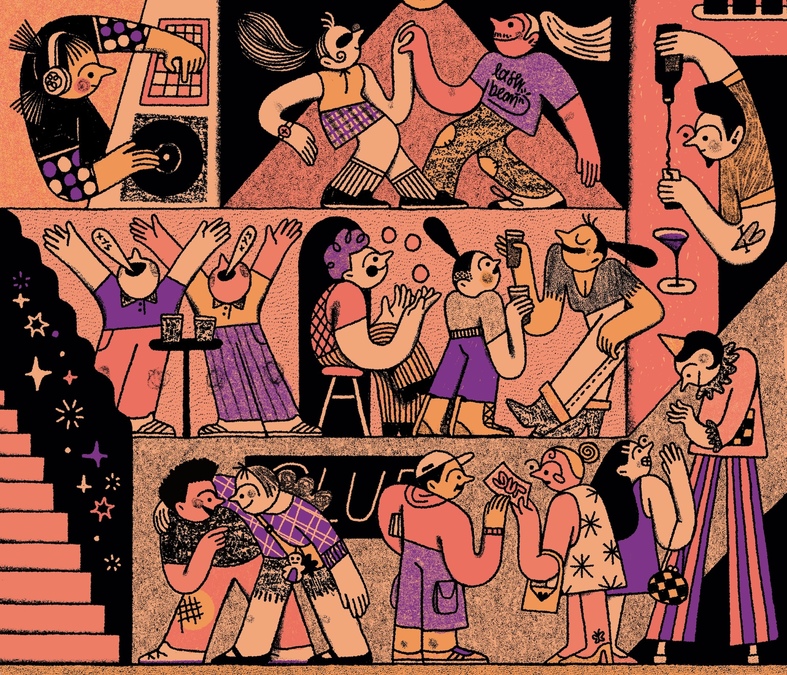
Illustration by Vaso Michailidou (@squidstew)
Can the bar change the atmosphere of a club night? "One hundred per cent," Sgouros says. She's not talking about the drinks. She's talking about recognising regulars before they've reached the bar. Students who become familiar faces over four years. Staff who genuinely enjoy working together. "The beauty of Sneaks," she tells me, "is that it's our home as well as our workplace." Community is one of those words nightlife throws around a lot. Listening to Sgouros, it feels less like branding and more like architecture. Rooms don't become welcoming by accident.
I squeeze in a quick chat with freelance sound and lighting technicians Sweet Philly and Millie MacKenzie. MacKenzie reckons it starts somewhere in between: on the bus into town, mentally preparing for the room before she's even behind the lighting desk. Philly laughs, “I have two answers. Neither is really about lighting.” The first begins when the shutters lift at Sneaky's: "That's when the bar's open. Things are moving. You don't really have a club until then." The second starts much earlier.
"The club's the destination, but it isn't the start of the journey. It starts when you leave the house, meet your pals [and] when your energy changes from, 'I'm not going out,' to, 'I'm going out.' Even if you've already done three pubs, the energy's already building towards the room. When everyone comes together there, that's when it's released." That’s the moment the non-verbal conversation starts with the DJ; each responding to each other in real time.
It’s somewhere around this point I realise nobody is answering the same question. Koren thinks in weeks. Sgouros thinks in rooms. Sweet Philly and MacKenzie think in energy. The club doesn't create that energy. It gathers and holds it.
Once the doors open, neither Sweet Philly nor MacKenzie really talks about operating lights. They talk about listening. About reacting. About having a conversation with the DJ. "The lighting meets the music in the middle," Sweet Philly explains.
It's a strange way of describing the job until you realise that's exactly what everyone I've spoken to has been describing. Nobody is working in isolation. The promoter responds to the city. The venue responds to the promoter. Lighting responds to music. Staff respond to the crowd. The crowd responds to itself.
By the time the DJ presses play, the room is already in conversation. Maybe that's what makes August feel so different. The theatre doesn't empty before the club begins. The city simply changes rooms. Performers become punters. Hospitality workers finish one shift and start another. A conversation started over post-show drinks continues on a dancefloor off the public plaza. The same energy moves through the city, gathering people as it goes.
Perhaps that's why nobody could agree when a club night begins. I think it’s because they weren't describing a moment. They were describing how a room, a party, a community comes into being. Which leaves one last question: during August, why are some of our most collaborative performances still treated as what happens afterward?