Writing from the in-between: Celebrating the Centenary of Agnes Owens
Marking the centenary of one of Scotland's most unique and forgotten voices, a new programme of events celebrates the life and work of Milngavie author Agnes Owens
Take a train fifteen minutes west of Glasgow and you’ll end up in Milngavie; a semi-rural suburb whose ageing population is hardly stirred by the turtle-back tourists who turn up at the train station often, waving their walking sticks like blind men looking for the Highlands. Above the station, up a sloping path and across a narrow road, the town hall stands self-consciously grand. When I go, one Saturday in early May, its flesh-coloured bricks seem burnt by the anxious sun and streaks of black rain. A flower bed by the entrance is planted in concrete. The steps up to it are shallow. It is an odd place for a book launch, though less so when the author is Agnes Owens, whose contribution to the second Scottish literary renaissance is obscured by the indefinability of her stories.
Owens was born in Milngavie, “the ordinary bit, not the posh end,” as she told Herald journalist Ann Shaw in 1984. When Shaw interviewed Owens about the publication of her first book, Gentlemen of the West, she described the struggle to locate Owens’ home in nearby Vale of Leven since, as her accompanying photographer put it, “we don’t expect authors to live on council estates.” It’s unclear whether the pair were surprised by the fact that someone living on a council estate could write as well as Owens, that a novel does not pay enough for a house in the posh end or that, even if it did, Owens would have chosen to stay in the ordinary bit.
If the first, their short-sighted assumption aligned with Owens’ publicly accepted origin tale – of a ‘natural’ writer ‘discovered’ against all odds in an Alexandria writing group led by Alasdair Gray, James Kelman and Liz Lochhead. If the second, it highlighted the gap between the cultural and little economic capital afforded an author. If the third, then they underestimated the potential stories that abound from ordinary life when people are granted the time and energy to imagine them.
Owens published her first story, A Hopeless Case, in The Scotsman when she was 32. Before that, she was a typist, a factory worker, a mother of four, a wife and a voracious reader. After, she was a cleaner, a secretary, a mother of seven, a widow, a wife again, a reader still and a novelist. By the time she died in 2014, her published oeuvre consisted of six short novels and 35 short stories, though only when the latter were bound together in a chunky collection did Owens, at 81, say she felt like a novelist for the first time.
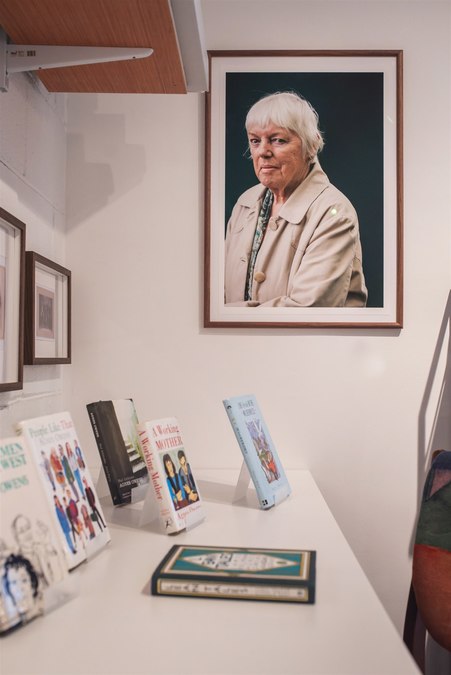
Agnes Owens Archive. Image: Alasdair Watson.
Her lack of ego owes more to the social, literary and media landscape into which her stories were received rather than any lack of writerly conviction. In a short film made by the Agnes Owens Archive, Owens’ editor Peter Kravitz describes how little he had to amend her work, given its carefully wrought precision. He suggests that, “had she been born in a different place, a different time, a different class, she’d have won prizes… everyone would know about her and she’d be a Penguin modern classic.”
Though, of course, had she been born in a different place, time and class, her writing would not have been the same. One of the greatest peculiarities of Owens’ writing is a sense of ambiguity that derives from a lack of any clear setting, akin to the edgelands of Milngavie or a Vale of Leven council estate. Unlike her contemporaries – often explicitly Glaswegian, working class and male – Owens’ work does not fit neatly into any genre of national, classed or gendered literature. Her writing is rich by virtue of that dislocation.
Though she wrote from a box bedroom in an estate on the edge of Loch Lomond, Owens’ writing pushes against provincial borders of nation and a sentimentalised and nostalgic Scotland; of class and the romanticised image of the heavy-drinking, Socialist proletarian hard man; and of gender, both sanitised womanhood and perfect feminism. Milngavie’s incongruous Soviet-style town hall feels, then, a fitting place to celebrate Owens’ centenary.
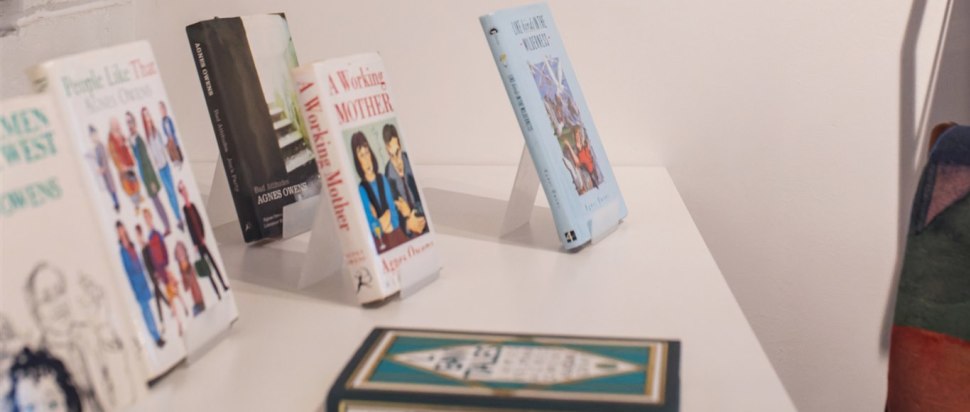
To mark the occasion, Polygon and the Agnes Owens Archive are publishing seven new editions of her novels and short stories, with introductions by contemporary Scottish writers and cover designs featuring Joan Eardley paintings. The first four, launched in early May, include Owens’ debut as well as her novels, A Working Mother, Like Birds in the Wilderness and For the Love of Willie. The final three will be launched in September, after a summer of events including archival and art exhibitions at Alexandria Library and The Lillie Art Gallery in Milngavie.
When Owens published her first book, her local paper, the Lennox Herald, described it as ‘a remarkable achievement for a 57-year-old grandmother’. One can only wonder what that journalist might say now of the fresh care and admiration her writing is attracting over 40 years later.
The new editions of Agnes Owens' work have been published by Polygon in contract with the Agnes Owens Literary Estate. The Agnes Owens centenary programme is curated by Sorcha Dallas and The Agnes Owens Archive. Agnes Owens: Out of the Margins is at the Lillie Art Gallery, Milngavie, until 18 Jun