Roxy Dunn on her new novel Wants and Needs
This year, relying on relationships to fix us is out. We talk to author Roxy Dunn about her smart and sexy new novel Wants and Needs, and how we figure out who we are outside of our desire for love
When the newly dumped Misty meets Christopher on a dating app, she is immediately smitten. He is funny, he is charming, he is attractive, and he… seems to be into some cool new genre of music called ENM? Emotional intelligence, sexual chemistry and his own hobbies and interests – she has, she is convinced, hit the jackpot.
This is how Roxy Dunn’s incredibly clever and funny relationship novel Wants and Needs begins: with a woman desperately looking for love and lacking the knowledge basis to go about it in the modern world. Because, as it turns out, ENM is not some niche subgenre of techno but a whole world of ethical non-monogamy and polyamory that Christopher has been exploring alongside his wife of several years. He is available, but also not available. He is made for Misty, but also for someone else. She is absolutely fine with it, but also not.
It is a sticky paradoxical quagmire, but Dunn is less interested in either venerating or damning polyamory than in exploring the ways in which we lean on relationships to fix us, whatever the cost. “No form of love can offer security,” Dunn explains. “It sounds bleak, but actually it's liberating, because if you can get rid of want[ing] it to offer you security, you can allow it to do all these other things: growth and fulfilment and excitement.”
Dunn began writing Wants and Needs at a crossroads in her own life, having recently met her now-partner and caught between her single life and the new promise of a ‘settled’ life. She was struck, she explains, by the rhetoric that separated the two: the supposed stability of monogamy and marriage, and the supposed insecurity of polyamory and dating. “It got me thinking, is there a guarantee to monogamy? Does any form of love offer safety?” she explains. “I didn't set out to write about non-monogamy, but I quickly realised that was going to be the framework, because if you start with a character who wants security and goes to the opposite end of the scale [with] non-monogamy and the uncertainty that provides, you realise the two are much closer than you think, because neither is offering a guarantee.”
If no form of love offers a guarantee, then does it matter which we feel safest in? Misty spends much of the novel trying to disentangle her deep attachment to Christopher from the anxiety not being his primary partner causes, caught – eponymously – between her wants and her needs, and deeply uncertain of which either is anyway. “Yes, I would choose to live with the bitty, rich uncertainty of being with him, because what was the point of choosing safety and security when they were only fallacies anyway?” Misty asks. Yet while they may be fallacies, there is only so much, Misty comes to realise, that you can rationalise away your need for them. Throughout the novel, Dunn pays tender care to Misty’s desires, and the often non-sensible direction they take: it is a question, she explains, of reconciling these slipperier urges with our fundamental needs.
“[There’s] this screenwriting device,” Dunn says, “where a character sets out at the start of a story with a very clear objective, and it's what they want. But of course, the thing they need is the thing they're going to discover over the course of the story. And sometimes they get the thing they want and the thing they need, but very often they have to sacrifice the thing they want in order to get the thing they need. However, that's relatively simplistic and Misty even makes that point, about why wanting is seen as inferior to needing, its dirty degenerate sibling.”
Dunn doesn’t quite have the answer to this, but it is the lack of answers that is the point. If monogamy offers an illusion of security, and polyamory an illusion of freedom, then perhaps the only solution is to dispense with the illusion and realise that no relationship structure can offer anything that you do not already hold yourself. It is difficult, however, to fully rely on yourself and your own needs, Dunn points out, when the social structures around relationships remain so prevalent, and the narratives around them so narrow.
“I think this is why there's such a conversation around non-monogamy right now, because people are querying the status quo,” she says. “We've all been told that we're meant to want to get engaged at 28, get married at 30, move into our house, have two children, get a dog. And people are beginning to say, hang on, is this the setup that's going to fulfil me? Sometimes we've got to question whether what society is telling us to want actually has our interests at heart, or whether it's the interests of a capitalist economic working model. There’s an assumption that people in long-term monogamous relationships put on people who are non-monogamous, that ‘yeah, you still want what I want ultimately’. And I do wonder if that comes from a place of fear.”

Ultimately it is this pressure, and the concomitant fear of being alone, from which Misty has to disentangle herself. Her relationship with Christopher, sweet and sexy though it is, is also marked by the kind of anxiety that speaks to a need to be in a relationship more than it does with a particular person. “I remember going in to meet my editor and she said, ‘but why is Misty scared of being alone?' And I said, ‘I don’t think that needs dissecting, that’s just the human condition, isn’t it?’ And my editor said, ‘no, no, most people don’t fear that,’” Dunn laughs. “It’s interesting because a healthy attachment is a positive thing. It’s the dependent strand of attachment that Misty has that we are told is unhealthy.”
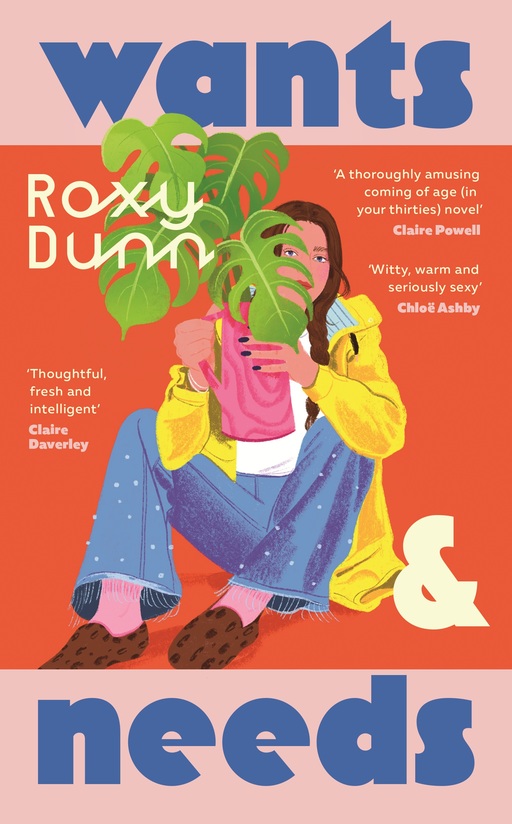
It is telling, she continues, that the original cover draft for Wants and Needs featured both Christopher and Misty on the front, the two interlocked but staring away from each other. But the final cover features Misty on her own, contained within the boundaries of the page. “On the surface, it's a book about a woman entering into a non-monogamous relationship, but on a deeper level, it's a woman trying to work out who she is and what she wants,” Dunn explains. “And it may be that she ends up with somebody, but she's got to learn to be independent and accountable for herself in a way that she never has been before.”
It's a new kind of happy ending, one that is entirely independent from another person – whether you end up with them or not. Inherently temporary though it may be, Misty’s relationship with Christopher holds enormous weight, the kind of weight that only an entire novel can confer. Maybe Christopher isn’t the great love of Misty’s life, but her desire for him, and what she learns from it, becomes the story. “To say he’s inconsequential is an understatement,” Dunn laughs, “but it’s not actually a novel about them. It’s a novel about her. Her journey, and he’s a huge part in it. But ultimately it starts and ends with her.”
Wants and Needs is out on 29 Jan with Penguin Books