Lucia Odoom on her novella Cosmos
We speak to Ghanaian-Danish writer Lucia Odoom about her novella Cosmos, and how the contemporary epistolary form can allow for an interrogation of belonging and intimacy

“Falling in love is the biggest escapist trick,” declares Lucia Odoom over our video call. And in Cosmos, her debut work of fiction, the Danish-Ghanaian journalist and author deftly incorporates some of this escapist energy into a thoughtful epistolary novella that transports its reader between the streets of Denmark’s capital and the fisheries of Ghana’s coast.
These agile pivots in setting are braced by a love story charting a few short months from the height of summer. Through the eyes of its titular protagonist – a young Ghanaian migrant on a worker’s permit attempting to forge his own path in Copenhagen – Cosmos compels its reader to consider what it really means to belong.
As for the novella’s form: Cosmos’ epistles are, in fact, WhatsApp messages addressed to his family back home in the Ghanaian town of Woe, who he is supporting financially. Odoom lends Cosmos a way with words that invites and a way with images that intrigues. The piquancy of his reflections only intensifies once he embarks upon a relationship with his love interest, Elizabeth. It is she – a winsome, socially-minded photographer of Tanzanian heritage – who gives Copenhagen new dimensions and shepherds Cosmos in from the city’s margins. And it is in her company that Cosmos feels ‘the wonderful sensation of actually being in the place [he had] always dreamed of being.’
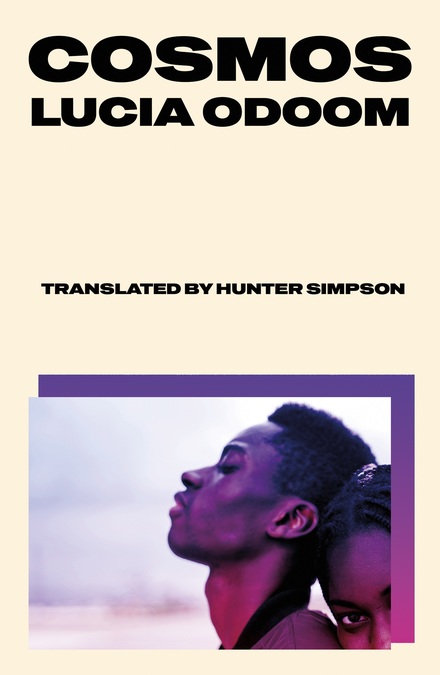
Cosmos pulses with both desire and denial: our protagonist is not ready to tell Elizabeth about his harrowing passage to Europe, nor is he prepared to disclose certain things about himself. At times, Cosmos pulls away from Elizabeth almost entirely, an instinct with which Odoom sympathises. “I'm a very escapist person and I'm very bad at solving my problems!” she laughs. “I usually solve my problems by just going someplace else, you know?” Odoom, a lifelong Copenhagener, did write Cosmos close to home though: specifically among the stacks in the Royal Danish Library, a landmark of the city centre.
“I was just captivated by the everyday scenes of people having a break from life, figuring out life, or hacking life,” Odoom says. Having previously frequented the library whilst on maternity leave, she knew she could expect a degree of calm within its walls. “But chaos is also there, which actually made it a very nice environment for me to write, because I don't want to write in a monastery.” Notably, Cosmos opens with a decidedly non-monastic tableau set at the Royal Danish Library: as he and his friends – fellow migrant workers, Odofu, Femi and Kofi – recharge their electronics and regale each other with silly TikToks, Cosmos ruminates on the impulse to ‘seek refuge in other people’s heavens.’
Yet what does this heaven mean? Over the past decade, Denmark has developed one of the most restrictive and punitive immigration systems in Europe. In 2018, its centre-left government passed legislation – widely known as the ‘ghetto law’ – which permits the state to surveil, sell off and demolish public housing in areas where the majority of residents are of a ‘non-Western’ background. In 2020, the Council of Europe's Committee on Torture found Ellebæk, an immigration detention centre just north of Copenhagen, to be among the continent’s most inhumane. And according to several policy experts featured in a 2025 BBC report, a hostile environment is actively being created nationwide in which legal requirements for asylum seekers keep changing and Danish citizens with a migrant background are marginalised.
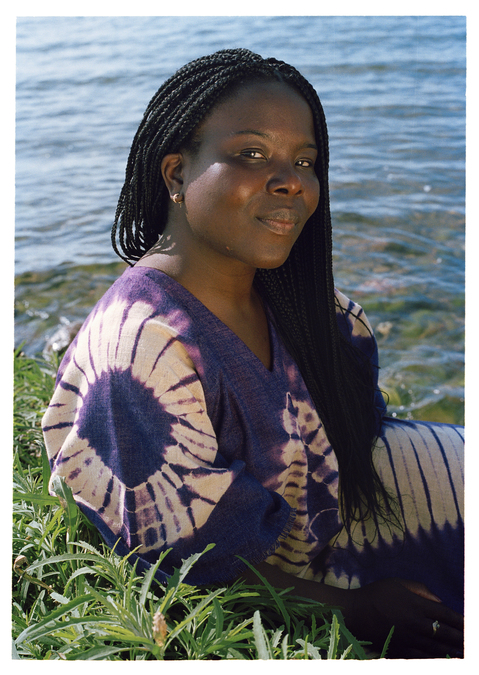
Photo: Carolina Ahrenkiel
“A lot of Black writers have been expected to undertake an ethical quest [in their work],” Odoom says, reflecting on the sociopolitical context in which Cosmos is situated; however, she wanted to ensure her work did not yield to the totalising moral framework of external expectations. Yet this is not to say political currents do not flow through the novella: Odoom was simply committed to finding different – and, perhaps, less doctrinal – ways of channeling her commentary.
“That's why I put a basketball court at the centre of [the story],” she explains, referring to one of the primary backdrops of Cosmos and Elizabeth’s budding romance. Its inclusion is an allusion to Love and Basketball, the 2000 cult classic and Odoom’s all-time favourite rom-com; it is also an effective site for the politically-shaped asymmetries of status, access and autonomy between Cosmos and Elizabeth to surface.
As the novella progresses, the world around Cosmos becomes one of many parts and an increasing number of paths. “Something draws Elizabeth to Cosmos’s world and the other way around,” Odoom says. When viewed through the lens of this dialectic, Cosmos becomes a highly compelling counterfactual text: one in which a Black migrant, in spite of the sundry indignities of itinerant life and invisible labour, in spite of the injustice of being subject to the ‘parallel societies’ reproduced at the level of the state, can still pursue his dream lover and dream in (relative) peace. It is a love story with real staying power.
Cosmos is out with Daunt Books now