Amy Abdelnoor on her debut novel Ever Land
Ahead of her appearance at this year's Book Fringe, Amy Abdelnoor introduces her debut novel Ever Land, a haunting ghost story set in Palestine
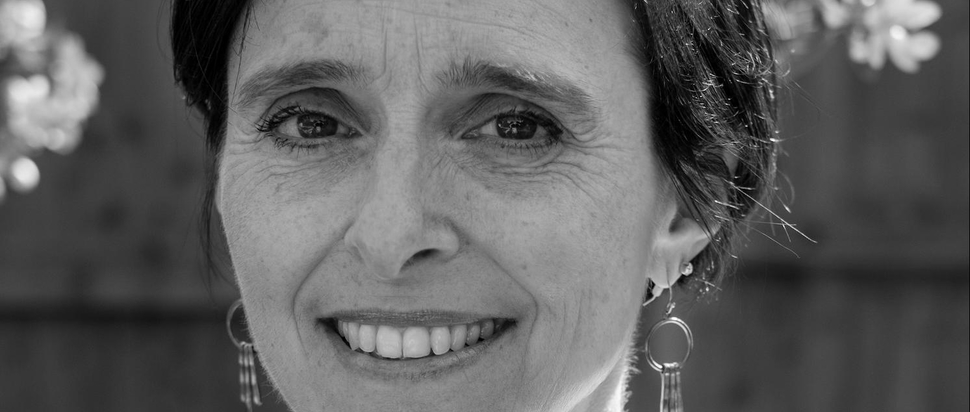
‘You know, there are two sides of every story.’ This was the reply Amy Abdelnoor received from one of her friends when, decades ago, the now-author wrote home about her experience volunteering at a refugee camp in the West Bank. The email stuck with her. What she witnessed then – open drains running through the streets, the smell of burning rubbish, the senseless violence at the checkpoints – was far beyond the comfort of moral relativism. 'If I could bring you here for a week, or a day, or even an hour, then you would understand,’ Abdelnoor wrote back.
That impulse lies at the heart of Ever Land. “This is what I wanted to do,” Abdelnoor says of her debut novel. “I wanted to bring somebody who hadn't been to Palestine, somebody who might never go to Palestine, to Palestine and show them what it meant.”
Finding the right vehicle for that came naturally to Abdelnoor, an avid reader since childhood. “Basically the nearest thing to having your own experience is to read immersively,” she tells me. “The power of literature to create empathy is enormous. It's also about the humanisation of the facts. If you read 15,000 Palestinians killed, 750,000 Palestinians made refugees, and 530 villages razed to the ground, these are just numbers; they're sterile. To try and understand what 15,000 dead means is really difficult, but if you humanise the people and show what it means to have lost somebody, and to say what a refugee is, then it’s different.”
So while she could have written a memoir or a work of non-fiction full of facts and figures, Abdelnoor decided instead to write a story, the story of two young women separated by decades of displacement and occupation, and by the privileges – or lack thereof – afforded to them by their heritage and religion. Dinah, a London-raised Jewish teenager, is trying to find her place in her new community in Israel, while Safa, a perpetually 14-year-old Palestinian girl, watches her settle in, unable to move on after being killed on that same land decades earlier.
The characters also arrived on the page in different ways. “Dinah evolved through a process of discovering what made her vulnerable, and how she was affected by what she was experiencing,” Abdelnoor explains. “Safa came out fully formed. [She] embodies everything I absorbed about Palestine. She is the pain, the yearning, the loss, the beauty and the poignancy of everything Palestine could have. She embodies what I experienced living with Palestinian families, and then going and living under occupation in the Second Intifada at the age of 21 or 22. I could feel her yearning and her pain, and I could feel her.”
Although Abdelnoor admits concern about misconceptions that might arise from describing Ever Land as a ghost story, she also remarks on the importance of spirituality for herself and the novel, as well as the imperative of Safa being a not-girl, a spirit. “I'm not religious,” Abdelnoor tells me, “but I don't believe that we die. I believe our energy, our souls, linger. I'm me because of where I was born, but is there a me that would exist if I had been born somewhere else?”
With this, Abdelnoor invites readers to question what really separates the displaced from the occupiers, or indeed from those entirely untouched by geopolitical conflict. At the same time, the notion of a lingering presence is uniquely emblematic of the Palestinian people. “I think Palestinian identity is defined by the past, and that's a tragedy,” says Abdelnoor. “The tethering of [the displaced] to Palestine exists through the insistence on the necessity of the past, because that is the legitimacy for their right of return. The term PTSD cannot be applied to Palestinian trauma because there is no post, there is no point at which it's ended and there can be healing. You can never move on, the occupation and the grief are continual. I think that whole idea is encapsulated in the concept of a spirit-soul.”
Over our Zoom call, Abdelnoor shares another story with me: “One of the first women I met in Lebanon was born in a refugee camp. During the Israeli invasion, she was fleeing with her family in the car, and the Israelis shot and killed her parents in front of her. Her story really resonated with me; this idea of a whole family being wiped out, leaving her as a vulnerable child. When I went to live in Ramallah, my friend asked me to go and find her village. When I found it, the cactus plants were still growing there —the sabar plants which have become synonymous with Palestinian identity and patience. I remember standing there and thinking, ‘The land is speaking. You can erase the houses, you can kill the people, you can raze everything to the ground, but the land speaks.’”
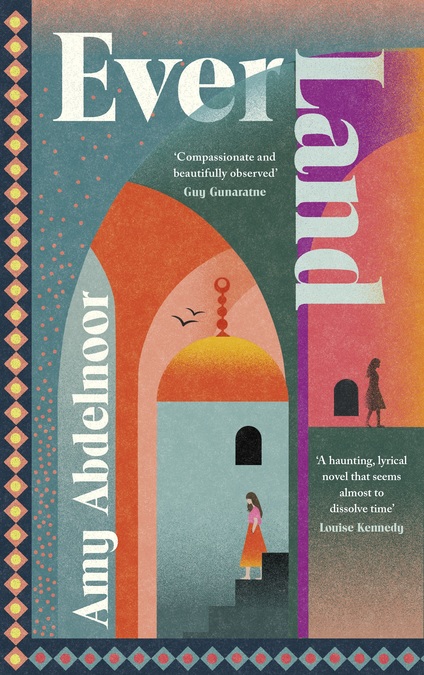
Ever Land is out now with Hutchinson Heinemann
Amy Abdelnoor appears at Book Fringe, Lighthouse Bookshop, 24 Aug, 12pm