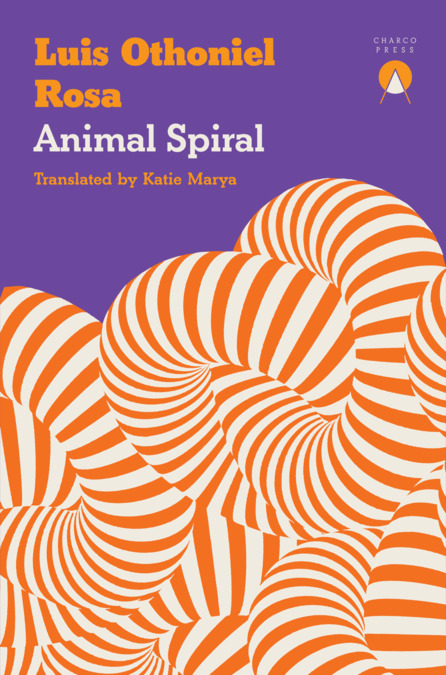
Animal Spiral by Luis Othoniel Rosa
Told (and possibly read) in non-linear order, Luis Othoniel Rosa's expansive sci-fi novel weaves myth alongside radical scientific imaginings
It’s the year 2034, and a pair of sci-fi obsessed streamer twins from Bayamón, Puerto Rico connect via intercerebral synapsis for the first time, awakening the collective consciousness known as ‘the Animal’ and triggering a revolutionary cascade of events that will ultimately liberate all from the oppression of colonial capitalism. But at what cost? Animal Spiral careens through 400 years of human and post-human history, and its themes are equally expansive, covering Central American and Caribbean mythology, the art of cooking, spiral mathematics, anarchism, artificial intelligence, quantum physics, diaspora, migration, love, and most importantly, cats (in the novel’s Spanish counterpart, the Animal is referred to as el gato).
Luis Othoniel Rosa’s language is poetic, sharp and colloquial, giving these ideas room to play without overworking them. Animal Spiral can be read in different ways: from ‘start to finish’ as normal, though not in keeping with linear time, or in terms of the Animal’s chronology as advised by the author’s note. The protagonists’ experiences mirror the novel’s Fibonacci-inspired narrative structure as they contend with a feral drive to master the constantly snagging, spinning, repeating nature of time. Animal Spiral will appeal to fans of Octavia Butler, Jorge Luis Borges and Donna Haraway with its exploration of radical reimaginings, the magic of dreams and cyborg-like assemblages.