We Contain Multitudes @ Dundee Contemporary Arts
From the vantage point of disability, four interdisciplinary artists challenge ableism in the arts in a new group show at Dundee Contemporary Arts
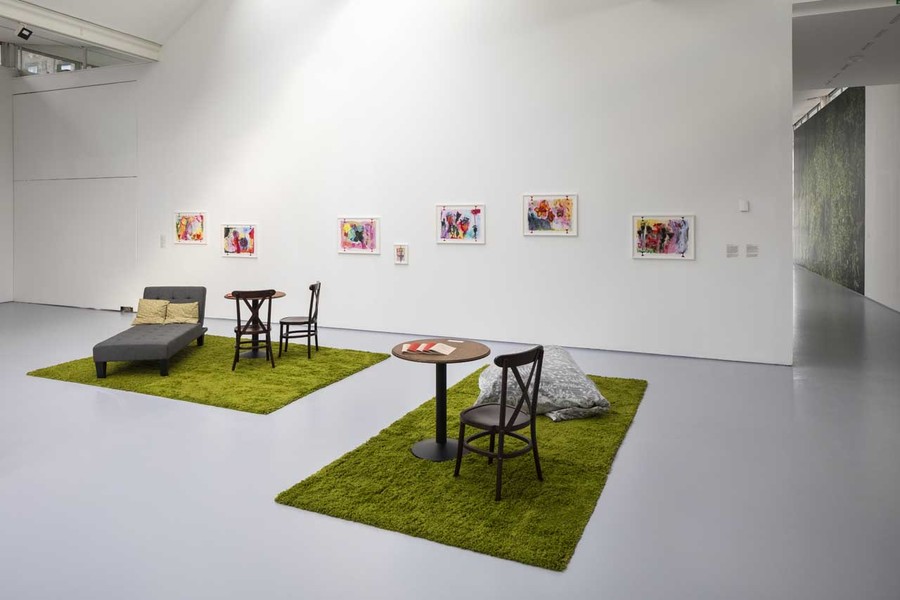
The first invitation of We Contain Multitudes, a group exhibition from Andrew Gannon, Nnena Kalu, Daisy Lafarge and Jo Longhurst at Dundee Contemporary Arts, is to rest. Synthetic grass and chaise longues present you with Daisy Lafarge's free pamphlet of poems, The Romance of the Sick Rose. The poems and their setting play on the sickly sweet pity offered to disabled people, a private garden that claims it is for wellness, but feels more like a prison, hiding restful bodies from an over-worked world. Lafarge rejects the isolation of the old English garden and stands alongside the other artists to question how health, healing and accessibility might be understood through public dialogue. The garden is made complete by watercolour paintings Lafarge works on while she waits on hold for the adult disability payment helpline. The time she might choose to indulge in that natural beauty supposedly on offer is actually sucked up by the admin and waiting times to get that access arranged. And she is not the only one who's seen the sun peak and fall while waiting for a doctor to call back.
After you have fought for accommodations, there’s the guilt of using them. Especially when it feels like your condition and your access needs are taken out of your hands and used as bait for dog whistles against diversity, equity and inclusion. Through prints, Jo Longhurst sheds light on the increasing use of NDAs to silence workers and vulnerable people. She highlights the risks of disabled people speaking truth to power: the risk of isolation and blacklisting for challenging an ableist employer and the risk of seeming 'too much' or 'unemployable' when advocating for disability justice.
There are all too many ways to silence the conversation around the experiences of disabled people, including NDAs, benefit sections, or a lack of privacy and public scrutiny. Longhurst’s presentation doesn’t provide the answers, but reveals an empathetic perspective on disability. She acknowledges that disability is unique to each individual and that the medical system is weighed down by bureaucracy.
Andrew Gannon puts his limb difference at the forefront of the exhibition. I catch blue silhouettes of him dancing along the white walls. Gannon shares the scientific community’s appreciation for prosthetics as art, but they diverge in their philosophy regarding art as a means of usefulness. There is an ableist implication that a prosthetic sets people back on the path of productivity. Instead, Gannon leans into meandering and multiple possibilities. When he fashions a new prosthetic, he doesn't make fingers; he doesn’t alter his limb and instead multiplies them for display. He calls for more people like him to have more visibility. Perhaps a blank canvas is the more fitting prosthetic for an artist, and imagined outside the realms of functionality, the casts become canvases for Gannon’s love of modern art and graffiti, bold colours and spraypainting.
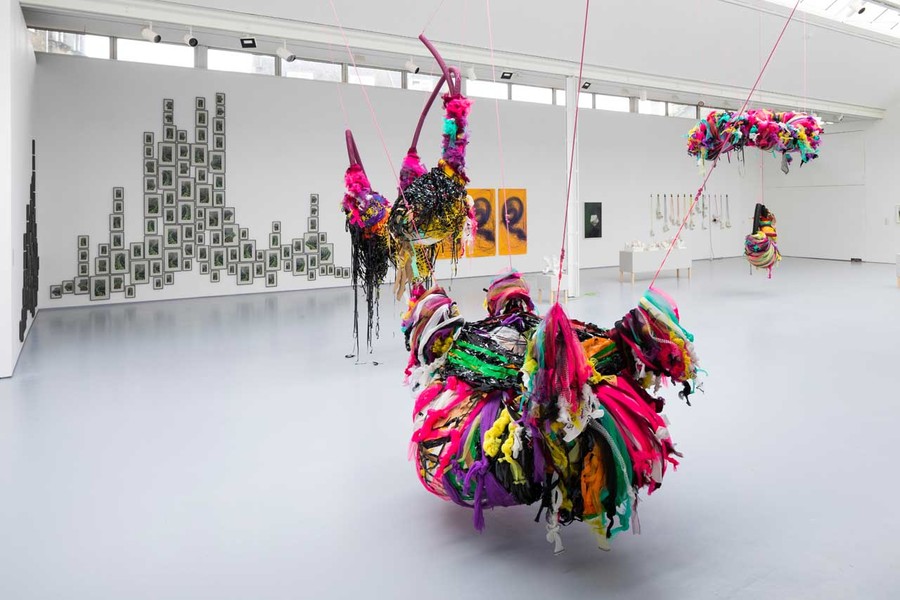
Installation view of We Contain Multitudes at DCA. Photo: Ruth Clark
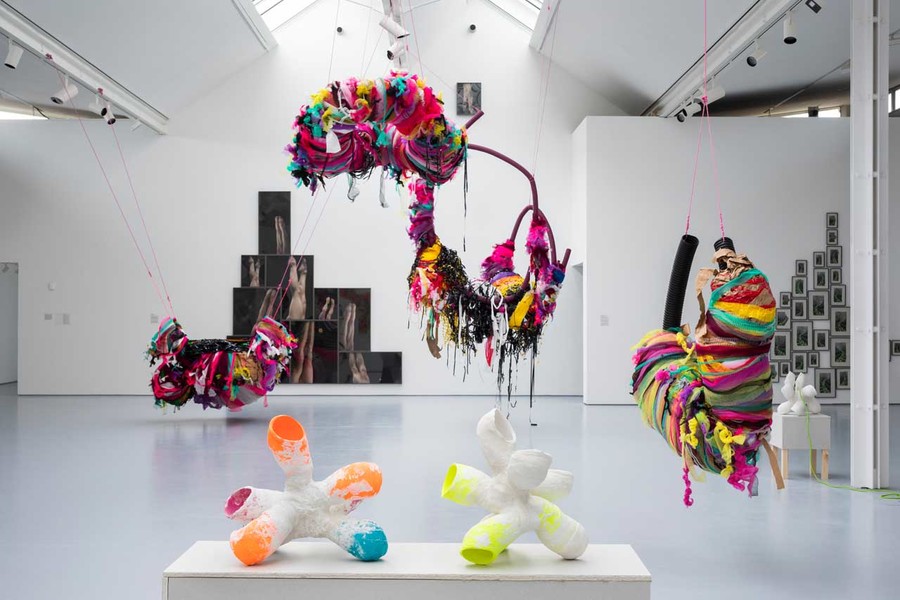
Through the work of Nnena Kalu, 2025 Turner Prize winner, we move from rest to ecstatic action, expressed in large sculpture and acrylic vortexes on paper, made over long stretches of time. Kalu uses simple, accessible materials to create extraordinary sculptures and wormholes that lead us into new dimensions.
The sculptures are made from netting, cassette tapes, rope, sponge, duct tape – architecture usually hidden in machines and buildings.
Kalu brings them to the light and forces them inside out. It's as if we're looking inside a body and seeing its vital organs. Her sculptures feel like a call to pay attention to the decaying infrastructure of public and private spaces, giving us care before it degrades from neglect.
Together, the works of these disabled artists bring us new ideas for accessibility in gallery spaces. There's a handling box where gallery goers can touch and play with some of the materials the artists have used: offcuts of Kalu’s sculpture materials, plastic binding foil from Longhurst, and one of Gannon’s prosthetics – all are an invitation to feel your way to understanding. This tactile experience doesn’t demand you be 'disabled enough' to use it. Instead, it asks a different question: Do you enjoy the access provided? If so, then you are welcome here. And you are one of us.
We Contain Multitudes, Dundee Contemporary Arts, until 26 Apr