Rae-Yen Song 宋瑞渊: •~TUA~• 大眼 •~MAK~• @ Tramway, Glasgow
A giant tentacled creature and its tiny co-conspirators occupy Tramway, as Rae-Yen Song’s world-building reaches hypnotic heights
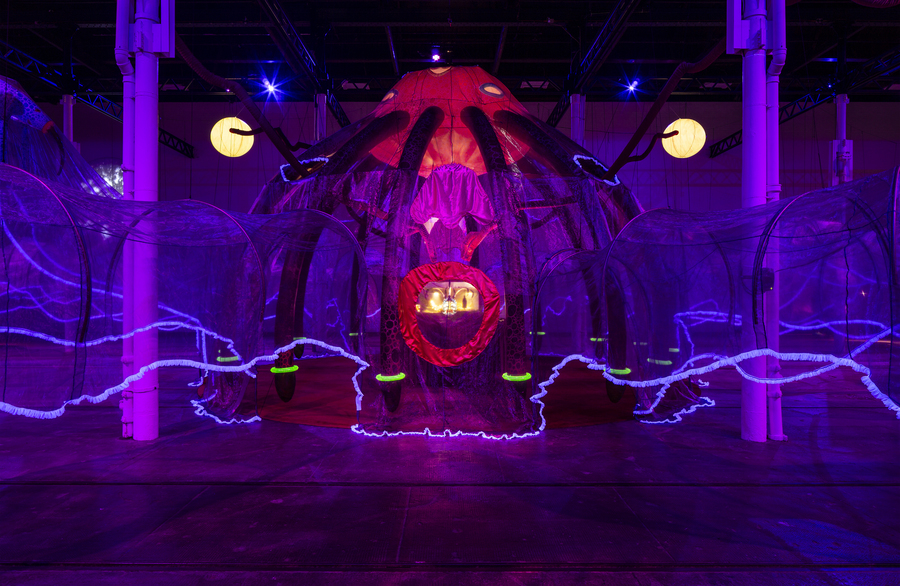
I’m in the belly of a giant beast, bathed in a glow of purple light and surrounded by the sound of twinkling keys and the hiss of exhalation. Glasgow’s Tramway has been transformed into a home for this gargantuan creature in the latest offering from multidisciplinary artist Rae-Yen Song 宋瑞渊, whose exhibition •~TUA~• 大眼 •~MAK~• encompasses ceramic, textile, light, sound and moving image to create a fully immersive world within the old train depot’s walls.
Immersive is, so it seems, the latest art-world buzzword, bandied about too often without carrying the weight of true immersion. Song’s exhibition, however, is a living, breathing, embracing entity. At its heart, •~TUA~• 大眼 •~MAK~• is an exploration of mythology, in particular, the mythologies that permeate the artist’s family ancestry and Daoism more generally. A guiding presence throughout the exhibition is Tua Mak (大眼; ‘big eyes’ in the Teochew dialect), a Song family ancestor who drowned at sea at thirteen. This personal lineage extends into a wider mythological framework, with Song also drawing inspiration from the Chinese myth of Pangu, a deity of creation whose decaying body became the elements. Song repositions these disparate mythologies, linking them via their ecological roots and speculating on the decomposition, consumption, and regeneration of these past bodies.
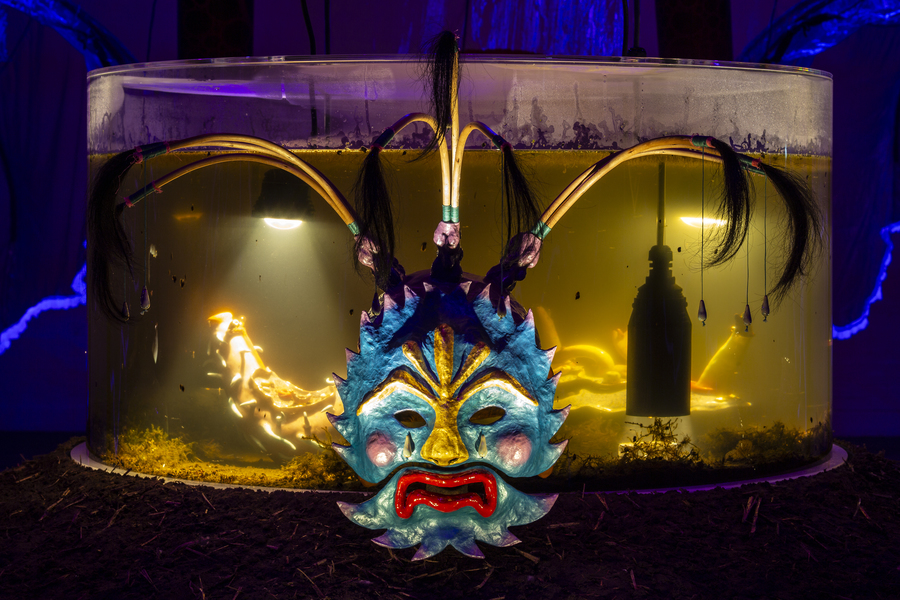
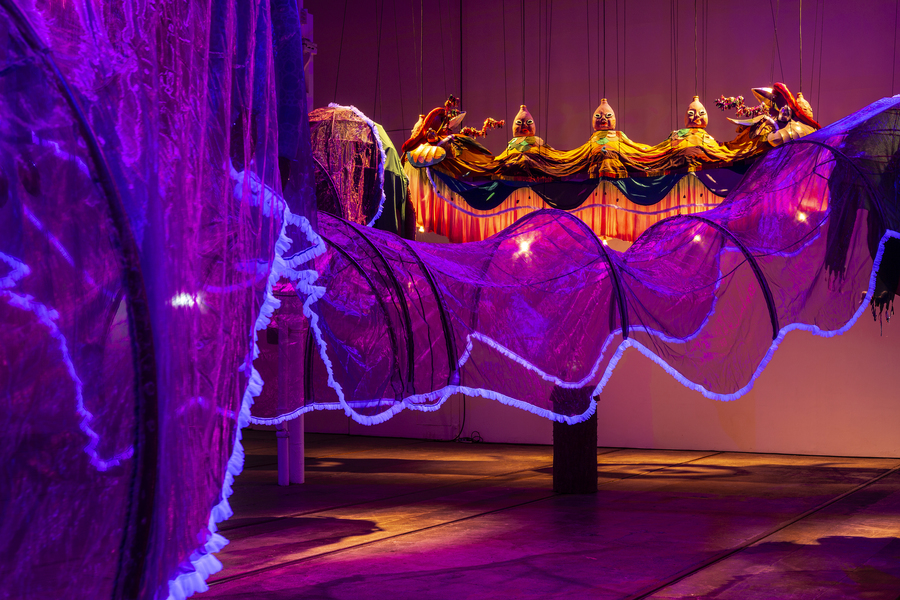
The exhibition text promises a 'sub-aquatic world,' and Song delivers, creating an ethereal realm ruled by micro- and macroscopic creatures, the largest of which occupies almost the entire space. Its iridescent purple tentacles undulate, winding their way around the gallery and doubling as tunnels to meander through, cocooning visitors and beckoning them to the centre. Here, nestled under its inflatable, bouncy-castle-esque skeleton, we rest in the creature’s central atrium: its belly, its brain, its heart? Anatomy aside, it feels like a safe space inside the beast, with plush red benches to settle into and observe the fish tank inhabited by an ecosystem of scurrying creatures.
Gazing into the tank with several other spectators, our eyes meet through the murky water as time slows and we move at a more meditative pace in the presence of the aquatic cultures that reside within. These microscopic lifeforms are Song’s co-creators who, along with experimental sound artist Flora Yin Wong, compose the ever-evolving soundscape that reverberates around the gallery. Provoked by the creatures’ movements, the sounds are a blend of discordant chimes and laboured breathing that evoke the slumber of a sleeping giant and have a lulling, hypnotic effect.
Alongside the show’s central behemoth, smaller-scale ceramics, suspended costumes, and richly embroidered textile banners are dispersed around the gallery. Every object is anthropomorphised, given blank, cartoonish faces with puckered, pouting mouths; for shrieking, for singing, for kissing? Perhaps Song’s instinct to grant every object a face is about giving the non-human form, features and feelings. At the end of each tentacle, on the outer edges of the creature’s reach, lie mouth-blown glass heads, bell-jar-shaped with Song’s signature gaping O-shaped mouths. Trapped inside are 3D renderings that function like glimpses into a parallel world, a near-distant future, or a long-forgotten past. These renderings – made by 3D artists Maurice Andresen and Tim Dalzell – dance and shimmer, existing somewhere between sci-fi hologram and pure magic, captured and doomed to dance forever in a glass prison. Song’s world-building is emboldened by these many collaborations, which add intricacy and brilliance to an already rich landscape. It’s refreshing to see all the collaborators listed, showing that building a world such as this takes the time and care of many hands.
Through evocative ancestral stories and a focus on non-human intelligence, •~TUA~• 大眼 •~MAK~• highlights the delicate dance of mythology and ecology. The exhibition interrogates the role of our non-human counterparts, ruminating on how they long precede us and will long outlive us. In this sense, Song’s world has the ability to make you feel existential, but refreshingly so. I leave the exhibition feeling both insignificant and boundless, micro and macro. Anything is possible.
Rae-Yen Song 宋瑞渊: •~TUA~• 大眼 •~MAK~• , Tramway, Glasgow, until 24 Aug 2026, Wed-Sun, 11am-5pm, free entry