Paloma Proudfoot: Glass Delusion @ Collective, Edinburgh
Paloma Proudfoot symbolically avenges Jean-Martin Charcot’s 'hysteric' patients in a sprawling multimedia exhibition
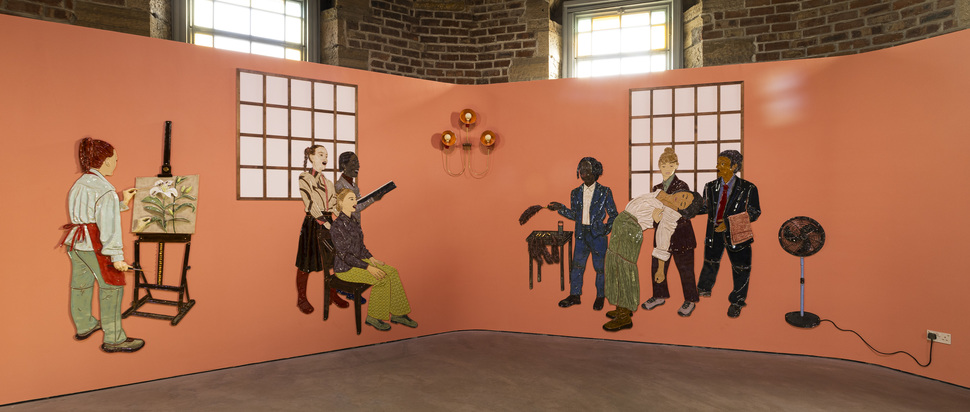
At first glance, the works read like soft, textured hand-tufted cut-outs pinned to the wall. It was only on closer inspection that their surfaces hardened into glossy, three-dimensional ceramic forms, composed of interlocked, contoured planes that delicately constructed each figure. For a moment, I felt briefly misled, my own short-sightedness playing tricks. But this small perceptual slip became a way into Glass Delusion, London-based artist Paloma Proudfoot’s first solo exhibition in Scotland, presented at Collective, Edinburgh.
Moving around the circular Dome Gallery, the exhibition unfolds as a narrative composition. Set against an orange backdrop, sculptural sash windows are positioned in dialogue with the gallery’s own windows, creating an illusory playfulness in the use of space and architecture. Independent sculptural pieces lead into a longer central frieze, where figures engaged in ambiguous activities begin to gather, suggesting a moment mid-action. But something more sinister begins to emerge as the eye moves toward the body of a fainted figure, which comes to feel central to the entire scene. While a sculptural stand-fan connected to an almost plausible socket further illustrates the moment, I found myself narrowing my eyes at the pile of feathered fingers arranged on the table and wall-mounted bulbs set into shallow, dish-like reflectors, reminiscent of the clinical glare of antiquated examination lamps, making the space feel increasingly charged, melancholic and uncanny.
Was it a scene from a classroom: a painting lesson, a singing session? Was there a disagreement, an accident: perhaps it was a court room? Was it a theatrical performance? Or a lecture in biology, a hospital scene? Presumably, an experiment. Indeed, the entire composition on the frieze references André Brouillet’s 1887 painting A Clinical Lesson at the Salpêtrière.
The exhibition title alludes to a medieval psychiatric condition of the same name, said to have been prevalent around the time when glass was in circulation and highly prized. The condition affected individuals who lived in constant fear of shattering, with King Charles VI of France often cited as the earliest example. In this latest series, Proudfoot delves into histories of psychiatry, particularly the work of 19th-century French neurologist Jean-Martin Charcot and his hypnotic experiments on women diagnosed with 'hysteria'. As part of her ongoing research into his ill-famed experiments, Proudfoot reworks Brouillet’s composition on the frieze, responding to the painting in three parts by replacing the male-dominated scene of Charcot’s demonstration of the experiment to his students, with contemporary female and non-binary figures.
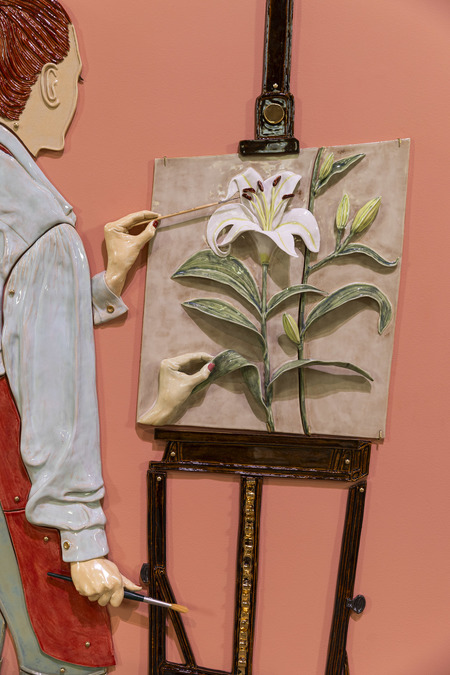
Paloma Proudfoot, Glass Delusion (Dissection) at Collective Gallery, 2026. © The Artist and Courtesy The Artist and The Approach, London. Photo by Eoin Carey
On the frieze, Glass Delusion (Dissection) shows a figure positioned against an easel painting an image of a lily in response to the anatomical sketch of a woman in Charcot's painting. In Glass Delusion (Lament), this extends into a group of three choir-like singers who appear to be singing with passion. Then, Glass Delusion (A Clinical Lesson) depicts the limp body of the collapsed woman – that of Marie Wittman, the female patient who Charcot hypnotised and experimented on. Grief and death become an underlying concern, particularly through the recurring symbol of the lily and its association with purity, innocence, and death.
Coupled with this, Proudfoot explores gendered bodies and the voice through two freestanding sculptures of lily stems held between hands, passing through mouths and blooming outward like trumpets in Keener II & III. These works reference the ancient practice of 'keening' in Gaelic traditions, a form of collective lament practised amongst women, asserting agency in spite of suppression.
These moments of collective agency are interrupted by scenes of isolation. On the opposite wall, Doublespeak shows a solitary seated woman, wearing a female marionette-mannequin torso like a bodice that gently holds her, as she faces another torso of a disembodied marionette-mannequin hanging listlessly nearby in Lay Figure II. Both bodies exhibit half-open zips and exposed hollow interiors, suggesting dissection and repair of staged bodies: patients handled and treated like puppets who are caught between agency and control, and the subsequent friction between medicine, technology and the self.
Mirroring the circular space, history here comes full circle.
Paloma Proudfoot: Glass Delusion, Collective, Edinburgh, until 24 May
Paloma Proudfoot performs with Aniela Piasecka, with a new sound score by Ailie Ormston, at Collective on Fri 22 May, 6pm