Ayesha Jones & Aqsa Arif @ Street Level Photoworks, Glasgow
In two contrasting exhibitions at Glasgow's Street Level Photoworks, photographer Ayesha Jones documents overlooked experiences of female health while artist Aqsa Arif reclaims the Pompeii Lakshmi

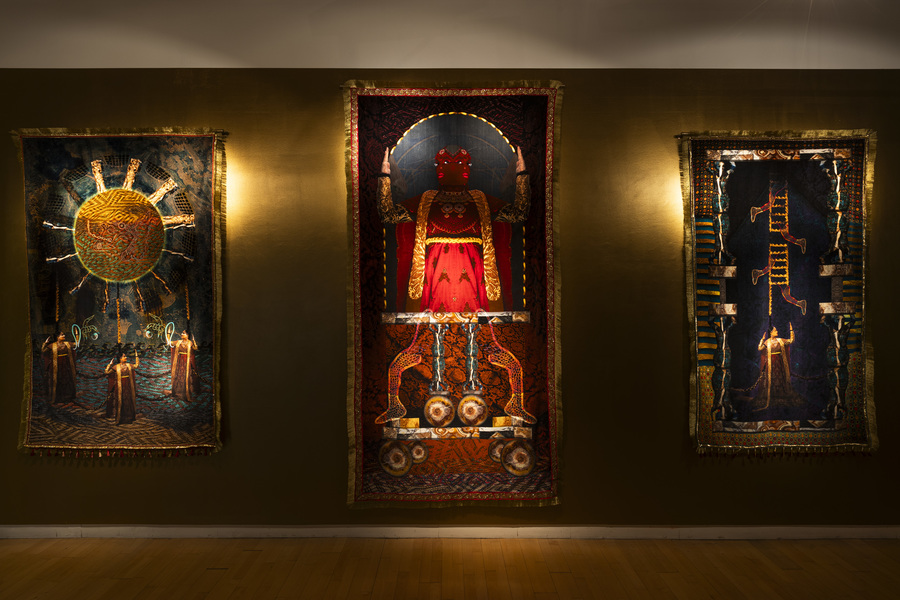
I see Ayesha Jones’ exhibition first, through Street Level Photoworks’ windows on King Street, and so that’s where I begin. I say hi to the receptionist and hesitate in front of a honey velvet curtain that hangs against black walls and haunting whispers of Aqsa Arif’s exhibition, but pivot left instead, stepping down into the window light. Later, I think how fitting it was to start at The Backbone before seeing Beneath the Ivory is Molten Brown: to begin with the tangible body before facing the intangible thing within it, like dropping an anchor to root around in the disorientating dark for something like identity.
Aesthetically, Jones’ and Arif’s exhibitions contrast more than they cohere. Their opposing lights compound the contrast between Jones’ pared-back documentary photography and Arif’s maximalist tapestries and collage film. Where Jones is ostensibly concerned with the intimacies of corporeal life – bones, flesh, scars, needles, medicine – Arif works from the realm of the conceptual, letting history and mythology take precedence over immediate corporeality.
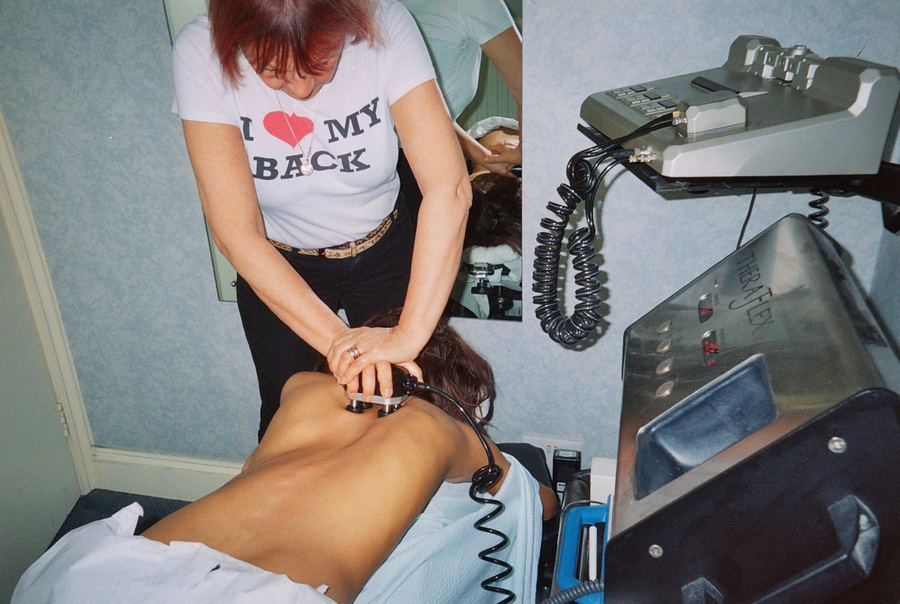
Both exhibitions are, however, guided by autobiography: Jones’ experience living with idiopathic scoliosis and Arif’s dual Scottish-Pakistani heritage. Jones was diagnosed with severe scoliosis as a child and underwent spinal surgery in her 20s. On the first wall of The Backbone, she hangs a series of digital photo prints, taken at the time to document her medical journey, in the scrapbook way favoured by teenagers decorating their bedroom walls.
Photos captured mid-bikini wax or while shaving in the shower reminisce on coming of age and coming to know your body, though their intimacy refuses adolescent embarrassment. They are pinned alongside portraits of Jones with her face scrunched against the needle-prick of an injection or through the face hole of a treatment table while getting physio on her back. My gaze feels invasive over some of these, like the airport security I read about on the fourth wall who asked to see the scar of ‘Patient 04’, who always beeps now.
The cause of the beeps – the spinal rods, pedicle screws, plates and hooks used in scoliosis surgery – get their own portraits. Blown up against white backgrounds and hung atop Jones’ x-rays, they epitomise the disembodying experience of a surgery far more invasive than a gaze. Their blunt representation, much like the minimalism of Jones’ back portraits, work to emphasise the depersonalisation of women’s healthcare still influenced by myths of wandering wombs and ovarian hysteria.
It is that engagement with mythology as an existentially definitive force that bridges the gap between Jones’ and Arif’s otherwise disparate exhibitions. Both artists are searching for autonomy, of body and mind, beyond the stories others want to tell about them – 'the pillars of power above my crouched back,' as reads the text on one of Arif’s tapestries.
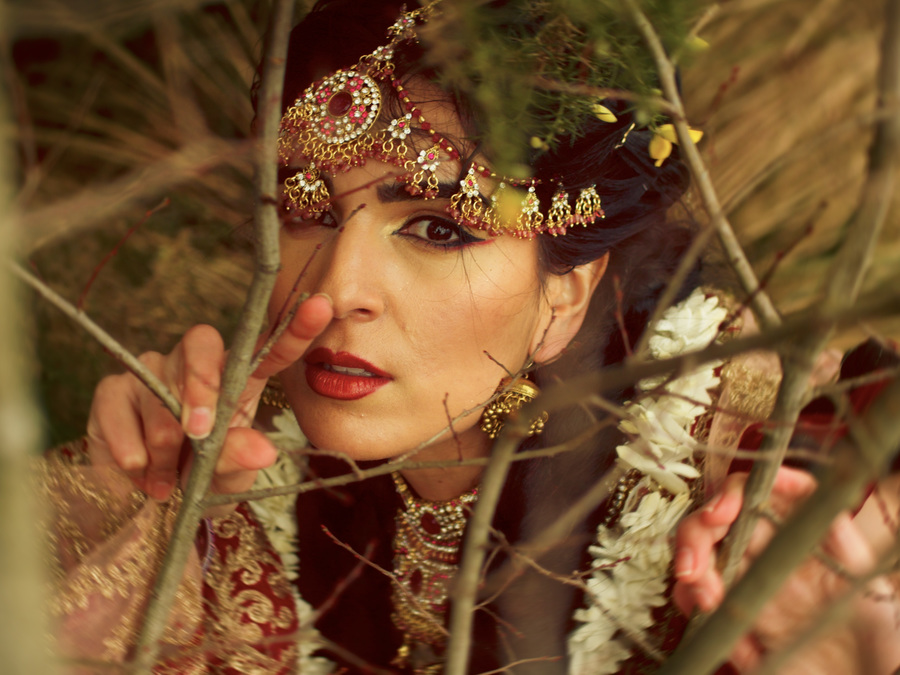
In Beneath the Ivory is Molten Brown, Arif re-asserts her identity as continually 'cracked, coalesced,' held together like a spine straightened with rods. She takes 'Pompeii Lakshmi’ as her reference, an ivory statuette found in the ruins of Pompeii. It is thought to represent either the Goddess Lakshmi of fertility, beauty and wealth in Hindu, Buddhist and Jain religious mythologies; Yakshmi, a female nature spirit; or a syncretic Venus-Lakshmi figure that reflects the ancient exchange between Greco-Roman and South Asian cultures.
That cultural exchange belies the modern myth upon which pillars of power are built: a belief that purity, whether cultural or national, of gender or of body, exists in the first place. Playing the role of Lakshmi/Yakshmi/Venus-Lakshmi, Arif places herself on the disorienting outskirts of that ethnocentric myth, where personal questions of identity and belonging reign.
She finds company there with Jones. Bodies, it turns out, are as malleable as minds, and the aesthetic contrasts between these two artists bleed into a shared preoccupation with identity as something unfixed, uncontainable and anti-institutional.
Ayesha Jones: The Backbone and Aqsa Arif: Beneath the Ivory is Molten Brown, Street Level Photoworks, Glasgow, until 30 Aug