Åsa Johannesson: The Queering of Photography @ Stills, Edinburgh
At Stills in Edinburgh, Åsa Johannesson's photography exhibition reconfigures the queer gaze and plays with the relationships between sitter, photographer and viewer
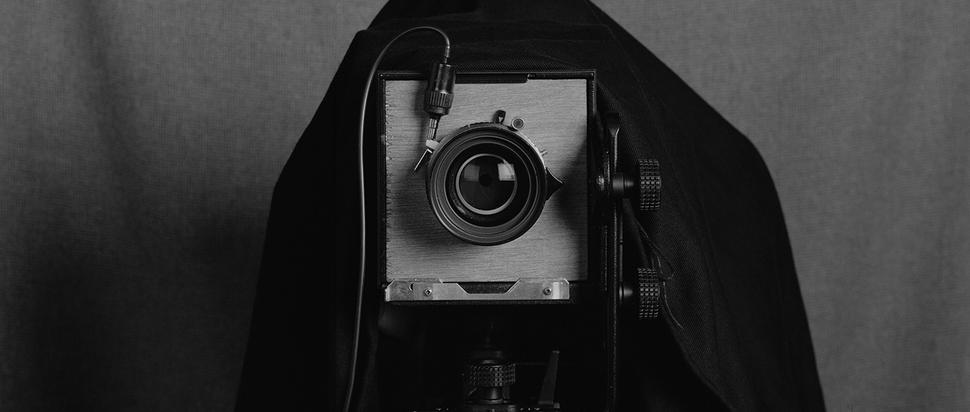
In Åsa Johannesson's exhibition The Queering of Photography, there is an almost life-size photograph of a large format camera on display, its lens pointed directly across from the gallery entrance. The camera operator’s body is obscured by a black cloak; only their white hand appears in the foreground to steady the tripod. We know the photographer under the dark cloth is the artist Åsa Johannesson, who directs her camera lens outwards and asks us to pause. Accompanying the exhibition is Johannesson’s prose poem, Coda (The Queering of Photography), which enlivens the intimately relational, yet ultimately mediated experience of creating a photographic portrait: "I hold you with my eyes. But I remain behind the camera. I do not touch you."
In the first room, an arm detached from its body holds the camera’s trigger release and protrudes into the photographic frame. In a small-scale print nearby, the fabric backdrop from this scene is found elsewhere pinned to the white walls of an emptied studio. Between these photographs a portrait of a subject, with short white fluffy hair, is hung upside down, mimicking the process of viewing the sitter through the glass focusing screen of a 5x4" large-format camera. Throughout the exhibition, Johannesson fragments and subverts the conventions of the traditional studio portrait, before assembling their constitutive elements back together again.
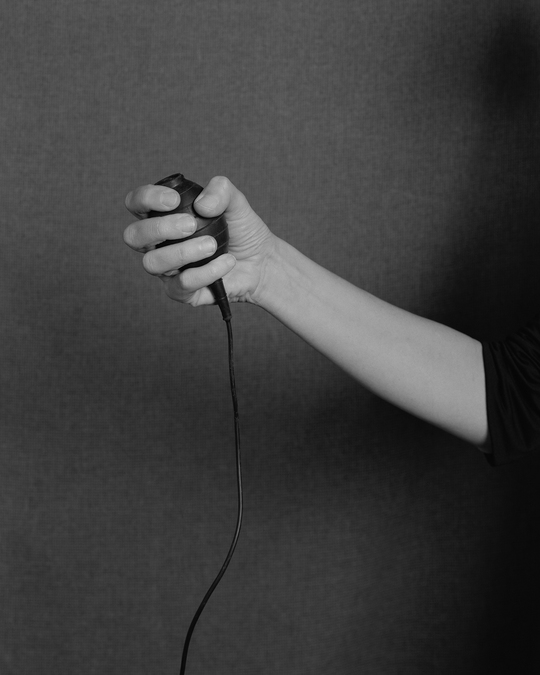
Frame#5 (2025) by Åsa Johannesson. Courtesy of the artist.
The exhibition at Stills is Johannesson’s first time showing work in Scotland and builds on her doctoral thesis from the Royal College of Art and recent research monograph Queer Methodology for Photography (Routledge, 2024). In this long-term project, Johannesson proposes that we rethink the queer gaze by going beyond what or who is being photographed, to consider how queering is activated in the photographic process of production. Playing with assumptions around queer portraiture, Johannesson writes in her prose poem: "I explain that I do not wish to represent you." She extends her practice beyond the bounds of visibility and representation, and sidesteps fixing queer image-making in the sitter’s identity.
Formal black-and-white studio portraits populate the gallery space at Stills, staged as conversations between sitter, photographer and viewer. Some subjects meet our gaze with astounding directness, while others turn away from the camera to refuse identification or codification by the photographic portrait. Experimenting with a large-format plate camera allows Johannesson to capture her sitters with exacting detail and texture, while the long exposure time requires a great deal of stillness and precision from the sitter. What emerges on the chemically altered surface of the print are minute details: the metallic sheen of a nose ring, dark fuzzy midriff hairs, a white painted star on an eyelid, and a finely rendered tattoo of a flower.
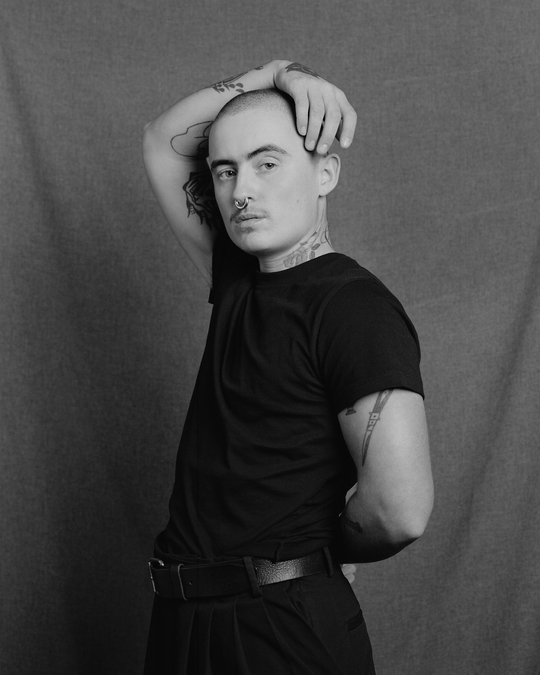
Looking Out, Looking In #32 (2025) by Åsa Johannesson. Courtesy of the artist.
Johannesson uses Polaroids as exposure tests for her large-format works, a technical role which is transformed in her collection Skin to create a series of three-dimensional works. For Skin, Johannesson separates the Polaroid emulsion from the weight of the photographic paper. These become fragile sculptures which in the exhibition are anchored by stainless steel wires in frames. Johannesson’s Polaroid skins are difficult to categorise and their elusive materiality queer the assumed function and limits of the photograph. Oscillating between transparency and opacity, the see-through emulsion furls up to obscure the identity of the sitters. Johannesson writes, "you are fragile and thin. Your existence in doubt, see-through and groundless. Yet still a Photograph."
In another series of Polaroid portraits, titled Turn, the sitters evade identification by turning away from the camera. The instantaneity of the Polaroid print, versus the darkroom development process, becomes a site of negotiation for photographer and sitter. Rather than deciphering individual features, Johannesson’s Polaroids accentuate the negative shapes created by the sitters’ elongated necks and also replicate the head and shoulder format of a marble bust.
The sculptural returns in the second and third rooms of the exhibition, with Johannesson’s portraits of Roman statues that she developed at artist residencies at the British School at Rome. Statues are positioned in dialogue with her human portraits in the exhibition but offer Johannesson a different set of formal possibilities to experiment with longer exposure times. Smooth, hard textures of marble bodies queerly correspond with the androgynous look of her human subjects, where flesh and skin transform into marble.
The stillness of the statue is disrupted by Johannesson’s moving image piece, Coda (The Queering of Photography), which depicts the artist posing in the photographic studio as she reads her accompanying poem. Here, Johannesson becomes subject in the studio; the 'I' and the 'you' of the prose poem are inverted, made strange and slippery: the queering of photography.
Åsa Johannesson: The Queering of Photography, Stills, Edinburgh, until 27 Jun
stills.org/exhibitions/asa-johannesson-the-queering-of-photography/