The Skinny: Back from the Brink
With The Skinny almost closing last month, it got people in our community talking about the health and significance of local arts journalism. We speak to some of the organisations that had incisive things to say on the subject
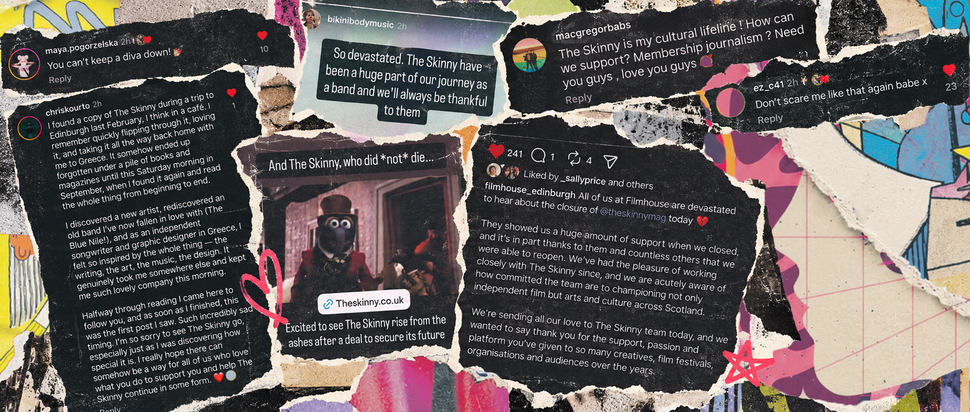
Well isn't this awkward. We’d love to say reports of our death were greatly exaggerated, but they were bang on the money. At the beginning of September, The Skinny braced for immediate and permanent closure. No more Heads Up. No more listings. No more crossword. No more reviews, features, columns, illustrations and photography from our talented team of contributors.
But as one reader wrote on Instagram, “you can’t keep a diva down”. Outer Spaces came to the rescue, pulling us from the brink. The Edinburgh-based arts charity is buying The Skinny’s publisher, Radge Media, in a deal that’ll stabilise us financially, meaning our team can get back to what we do best. Namely, shining a torch on arts and culture being made in Scotland and providing a platform for emerging arts writers, editors, photographers and illustrators to investigate these scenes.
As you might expect, it’s been an emotional month for the people who make this magazine. Not only are we still reeling from our near extinction, but we’ve also been completely overwhelmed by the outpouring of support we received from readers, artists and the wider arts community in Scotland. For this interim edition of the magazine, we decided to reach out to some of the organisations in the community who wrote particularly thoughtful words when it looked like we would close, to ask why they feel local arts journalism is so essential.
One of the first organisations to make a statement of solidarity when it appeared we were done for was EHFM, the first-rate community radio station we’ve been fans of since they began broadcasting in 2018. “We owe The Skinny a great deal,” says EHFM's station manager, Vicky Kavanagh. “You gave us our first piece of coverage and have always been a role model for us as a local arts media outlet.” While there are many differences between The Skinny and EHFM, Kavanagh sees plenty of overlap. “We’re ultimately both trying to do the same thing. We need to show solidarity with each other because we are keenly aware of the tightrope we’re walking. We couldn’t see the closure of The Skinny and not express our gratitude and appreciation, as well as our despair at the state of the arts right now. Institutions like The Skinny should not be allowed to fail!”
Like EHFM, Edinburgh arthouse cinema Filmhouse regularly features in the pages of The Skinny. “Your magazine plays a massive role in us getting the word out about our programmes,” says Filmhouse’s executive director Andrew Simpson, “as well as often being a major space where a lot of the wonderful films, filmmakers and festivals we host can get coverage. We know how important The Skinny is for the cultural ecosystem in Edinburgh and throughout Scotland, so you guys not being around anymore would have been a massive negative for us.”
We were also deeply moved by words of support from fellow arts magazines. The List’s October issue led with an editorial on the “delicate ecosystem” in which arts magazines like us operate, while SNACK’s editor, Kenny Lavelle, wrote a barnstorming piece lamenting our demise and celebrating the importance of print journalism. “The closure of The Skinny would have been a great loss to the country,” says Lavelle when we ask about his article. That might sound like a lofty statement; national importance possibly oversells arts journalism’s relevance. But Lavelle makes a good case. “Local arts journalism gives context to the many disparate strands of a country’s arts landscape,” he says. “It provides a place of convergence, and a wider view to understand a country’s arts and artists – and ultimately its people.”
While not working in the same field, literary magazine Extra Teeth is another bold Scottish print publication with whom we feel an indelible connection. Its fearless co-founder and managing editor, Heather Parry, agrees there’s a kinship. “We all understand how vital print media is to professionalising within this industry – especially if you are in any way marginalised,” she says. “The Skinny has started or supported the careers of many writers we've gone on to publish, so we feel very interconnected.”
Jess Brough, the indefatigable founder and director of Fringe of Colour, is similarly ardent when it comes to the primacy of on-the-ground independent media. “We cannot and should never rely on media conglomerates as tastemakers or sources of solidarity for the arts,” Brough tells me, “because they are driven primarily by profit and therefore have neither taste nor the capacity for solidarity. Local arts journalism exists for the community; without it, the whole ecosystem falls apart.”
If the shock at our almost-closure has had a silver lining, it’s that it’s got many people in our community thinking about print media, local journalism, and its importance in celebrating, critiquing and creating an archive of the arts in Scotland. “With review space diminishing to next to nothing, and professional critics and arts journalists being replaced with influencers across the board, it is essential that we protect the few spaces we have left that publish real, thoughtful, constructive engagement with the arts – from a variety of backgrounds, perspectives and expertise,” argues Parry. She also makes the valid point that our “national” papers of record, while more robustly funded, can’t be relied upon to document scenes happening north of the border: “With Scottish artists continuing to be ignored by England-based media, Scottish arts publications like The Skinny are truly vital to ensure our writers, musicians, filmmakers and all other types of creatives get a fair shot in the wider British landscape.”
Simpson reckons The Skinny (and other publications like it – The List and SNACK) help to make audiences’ worlds bigger. “[Art journalism] plays that key role in understanding what's going on across the cultural landscape,” he says. “A lot of us pick up The Skinny from month to month simply to engage with what's going on, for instance. Without local arts journalism, your cultural field of vision instantly becomes narrower.”
For Lavelle, the importance of strong arts journalism in Scotland is to give context to and uplift the creative work of the nation. “Independent arts magazines join the dots between disparate voices and scenes and give a regular and cohesive snapshot of a country’s creative world,” he states. Lavelle also points out that print media provides a reliable archive that digital platforms have yet to deliver. “Who knows if these tech companies will still exist in their current form in 20 or 30 years? Can we still reliably access what we once wrote on Bebo or MySpace? Print arts magazines give a permanent record of who we are at a given moment in time in a way that is not possible otherwise.”
The Scottish arts community's concern that The Skinny might have been lost is not to say there’s a dearth of critical voices here. “In some ways, it seems there’s more local arts journalism than ever now,” notes Kavanagh. The democratisation of journalism does have its drawbacks, though. The issue with Substack and the like, says Kavanagh, is that “these are all siloed platforms, almost always presented from a single individual’s POV. The importance of outlets like The Skinny is that they are collective efforts with a much more ambitious scope, presenting a plurality of voices from across the country.” In other words, in our individualistic, atomised world, The Skinny (and magazines like us) represents a kind of collective endeavour that is both socially important and increasingly rare.
If it isn’t already clear, arts journalism is urgent and indispensable. The question remains, though: how do we create robust economic systems where community-centred arts journalism can not just survive, but flourish? Everyone we spoke to for this article suggested convincing visions for the future of local arts criticism, and we hope to delve into their ideas at a later date. For now, all that’s left to say is a massive thank you to EHFM, Fringe of Colour, SNACK, Filmhouse, Extra Teeth and a whole litany of other arts institutions, journalists, artists, arts workers, government organisations, MSPs, venues and readers who reached out with kind words in our darkest hour. Your solidarity meant the world to us, and only convinced us more of the importance of arts journalism in Scotland and our privileged role within it.
ehfm.live
filmhouse.org.uk
snackmag.co.uk
extrateeth.co.uk
fringeofcolour.co.uk