Ruthella Dafnis on her solo exhibition Secondhand Smoke
The Skinny X RSA Contemporaries awardee Ruthella Dafnis' first solo exhibition shines a light on homelessness, addiction and care experience
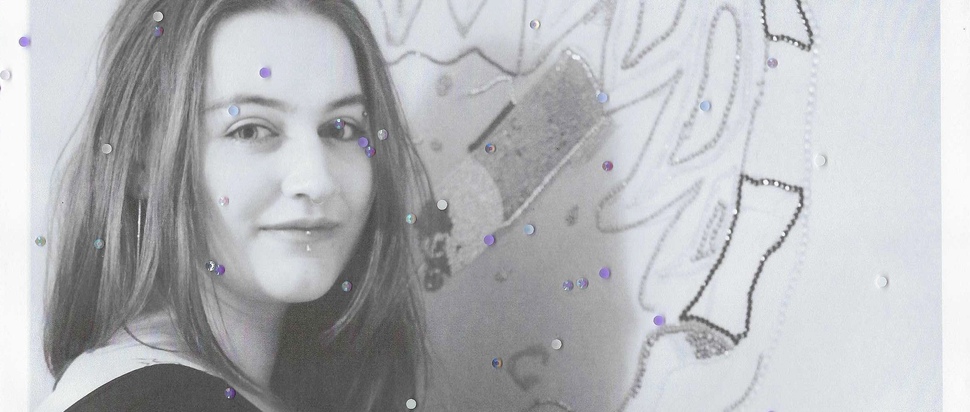
“My work is political and I want it to be.” It’s a sunny autumn day exactly one month before the opening of Ruthella Dafnis’ exhibition Secondhand Smoke. Between rhinestoning a giant ashtray, Dafnis stresses to me the importance of making the personal political, and the desire to use her own lived experience and family archives to create a body of work that spotlights contemporary socio-political issues of homelessness, addiction and care experience. “I'm using these archives as a vessel for protest in a way,” says Dafnis. “If I can have people understand a small part of what's going on in the country, that means a lot to me.”
These hard to swallow topics are mainstays in Dafnis’ practice. At the Royal Scottish Academy New Contemporaries exhibition, she received The Skinny Prize for her series of sublimation prints which explored themes of loss, government intervention and early displacement. Now, tracing a similar thematic path, she prepares to present her first solo exhibition, Secondhand Smoke, at Summerhall.
Using Dafnis’ complex relationship with her late father as a catalyst, the show examines the ways in which vulnerable people are failed by the structures and systems of society. Having been estranged since early childhood, Dafnis and her father reunited last year, just months before his untimely passing, due in part to the lack of care available to homeless people. Born of rage and frustration, and infused with Dafnis’ own experience of the care system, Secondhand Smoke has emerged as a way to process her grief, and as a protest to the injustices people like her father face.
I probe Dafnis on the show’s evocative title and its ability to conjure up connections and sensory associations; secondhand smoke as something lingering, unwanted and hard to shift. “Totally,” she agrees, recalling the reunion with her father that serves as the foundation of these new works. “My day was full of cigarettes. When I met him, the only fundamental thing we both did was smoke. I think about how that experience held on to me; I just couldn't shift it. I was like, ‘Oh God it’s like secondhand smoke, I'm stuck with this.’”
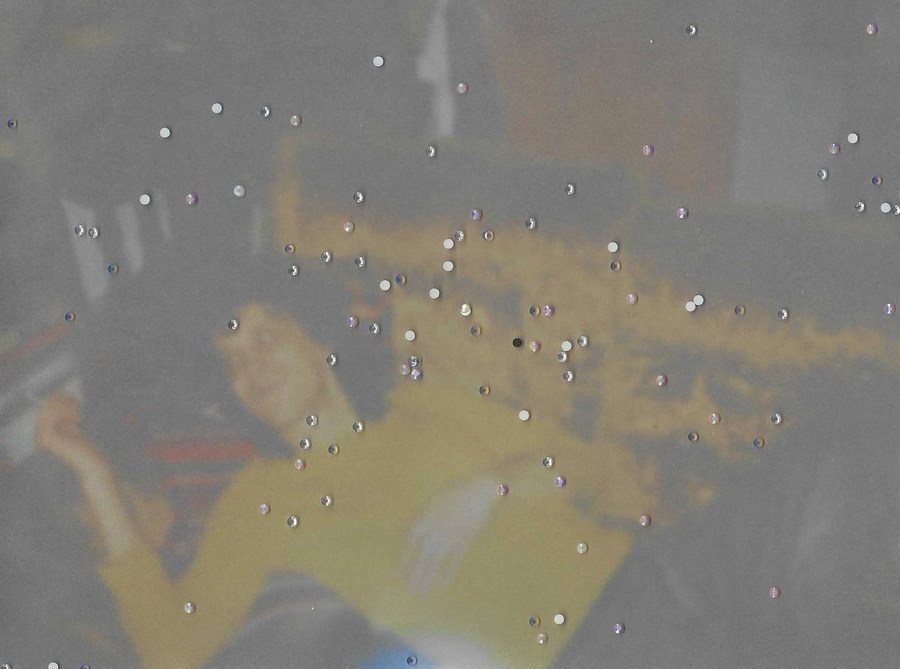
Secondhand Smoke (2026), Ruthella Dafnis. Image courtesy of the artist.
That clawing, hard to shake feeling sets the tone for the show, which comprises text works, sculpture, archival photographs and a ‘90s rave track that permeates the gallery. Throughout these works, distorted and layered images mimic the dreamlike and unreliable nature of memory. “A lot of the imagery I share looks so positive, but in context it wasn’t. I was in the care system, dealing with issues at school and homelessness, and those aren’t depicted in the photos.”
Positioning these relics as unreliable narrators, Dafnis plays with dual perspective throughout Secondhand Smoke, with images morphing and warping depending on the audience's position in the room. Using the magic of lenticular printing – the technology that produces images with the illusion of depth – Grin and Bare It oscillates between an image of Dafnis’ father, and, if you move a few steps across the gallery, one of her sisters. Similarly, a meticulously hand-beaded curtain is embellished with text which warps and wanes at different angles. It’s this unreliability that underpins Dafnis’ practice.
An ashtray shared between Dafnis and her father is the subject of a beguiling still life; a mundane yet intimate act that is immortalised in around 1000 rhinestones. There’s a rebellion in this choice to draw attention to things usually left concealed, to bejewel the unsightly. “I think being from a working-class background, oftentimes you see that culture glamourised. I’ve spent a lot of my life seeing it depicted in a certain way.” It’s clear Secondhand Smoke is an exercise in taking back control of that co-opted narrative.
Manual and labour intensive, the making of Secondhand Smoke offered Dafnis a space for mourning and reflection. “I was looking for a way to meditate and do something where I could just sit. Also the mess it caused: my room is covered in rhinestones. They’re in my shoes.” Those skulking rogue rhinestones seem like a fitting parallel for the inescapable grief around which the show orbits; encroaching on everyday life and found in the most unexpected of places.
Although this grief hangs heavy over Secondhand Smoke, there’s an abundance of joy and hope to be found in Dafnis’ works. In agreement, she explains that the exhibition, as well as functioning as a protest for her father, is also a celebration of him, and an attempt to move the needle on conversations surrounding care. “What can we do next? How can things be better? I want people to walk away from the work thinking about that.” Dafnis’ work tackles the slippery nature of grief, lamenting not just what has been lost, but also what was never able to be. Beneath this loss, however, Dafnis has buried a sparkling jewel of hope in Secondhand Smoke. Sometimes hidden away, but, like the lenticular print, present nonetheless.
Secondhand Smoke, Summerhall, Edinburgh, 17-22 Nov