Internationalism Strains at the Venice Biennale
Scotland + Venice Emerging Writer Samuel Riddy considers the pitfalls of the Venice Biennale's logic of global impartiality through the controversies surrounding the Russian and Israeli pavilions
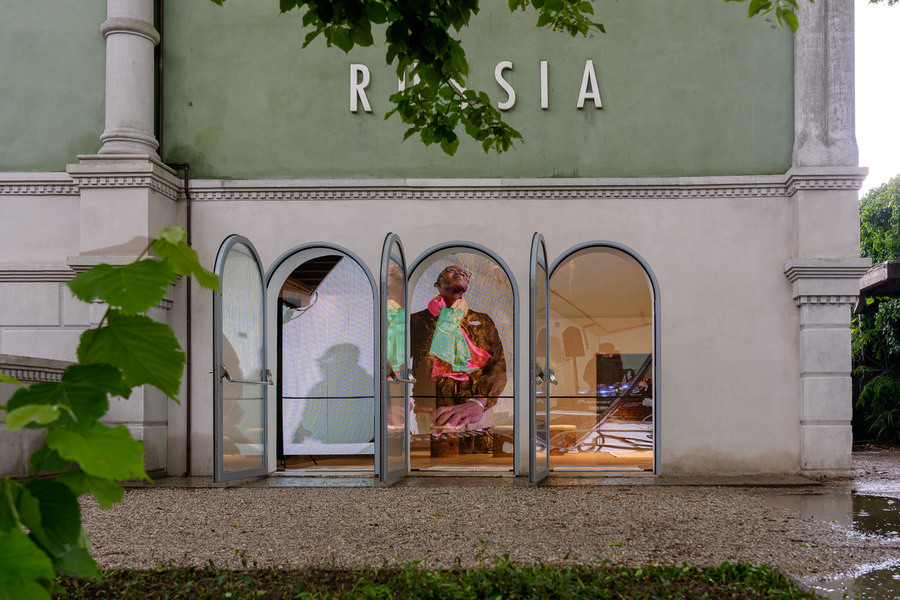
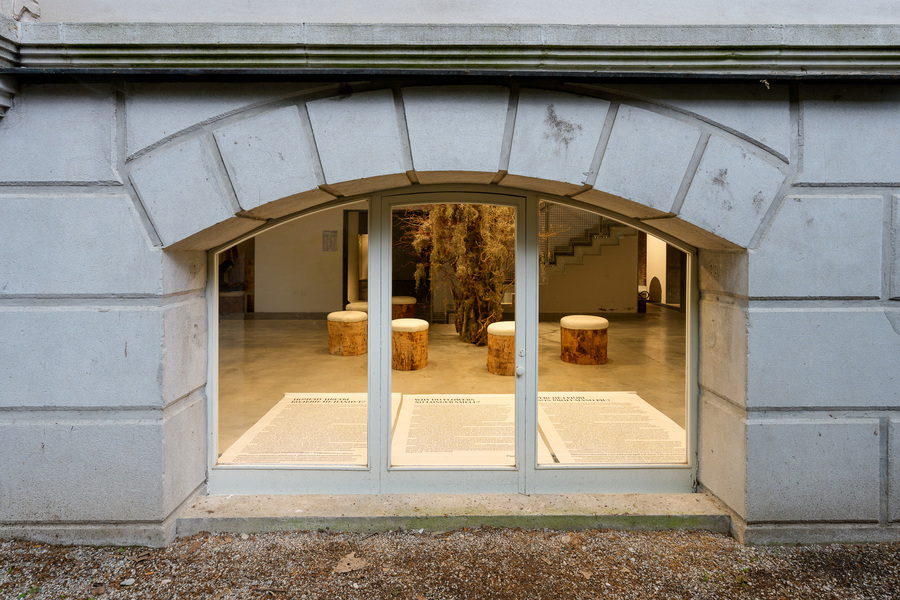
In the Giardini della Biennale, the Russian Pavilion sits, its exhibition barely visible, unattended by invigilators and obscured behind locked doors. Faint videos of dancing figures can be seen when peering inside, which some visitors try to film on their phones. The exhibition is titled The tree is rooted in the sky; also discernible is the outline of its namesake arboreal sculpture, encircled by empty wooden seats. Russia’s containment is not an independent choice by the Biennale, but a decision taken as the EU moved to withdraw €2 million in future funding. Far from being a triumphant return to the international stage after a four-year absence, the pavilion was only permitted to open for the Biennale’s three-day preview window. If you wanted an artistic symbol for the demise of a liberal, democratic, outward-facing Russia, this accidental image seems as illustrative as any deliberate artwork. One can detect the reverberations of the Biennales of 1978 and 1980, when the pavilion was left closed during the Soviet invasion of Afghanistan.
Across the wider Biennale, a language of neutrality and inclusion struggles to assert itself. In its international structure, the Biennale has historically been termed the 'Geneva of the Arts'. Just as Geneva was supposedly a neutral ground for global dialogue, Venice positions culture as an impartial realm of international healing and growth. As Biennale president Pietrangelo Buttafuoco said: "If the Biennale were to start selecting not works but affiliations, not visions but passports, it would cease to be what it has always been: the place where the world meets."
Where the Biennale’s international exhibition might be mystical, postcolonial, and even embody some form of leftism, its rhetoric instead signifies a centrist disdain for dogma and an intertwined habit of diplomatic neutrality. This tension might have held in the Biennale’s past, but now provokes a myriad of walkouts and demonstrations. Regardless of whether one agrees with Buttafuoco, his perspective has been made volatile by the fallout of a tumultuous outside world.
Nowhere is this volatility more apparent than in the Israeli Pavilion and the controversy surrounding it. The Biennale’s logic of global impartiality enables Israel’s inclusion, contradicting the politics of many of its employees. In my first week as an exhibition associate for Scotland + Venice, Venetian culture workers went on strike to protest Israel’s inclusion, the second such strike to affect the Biennale so far. The institution has excluded nations before, notably apartheid South Africa until 1993. This indicates that its current, optimistic framework is historically contingent, most recently emboldened by the 1990s in which Israel had signed the Oslo Accords, beginning a now-stalled peace process with the Palestinian leadership. The confluence of Oslo, the end of apartheid South Africa, and the collapse of the USSR marked the period more widely as one of international optimism. It was also an era in which the Biennale was less affected by the pavilion protests, strikes, and resignations that have defined 2026’s edition.
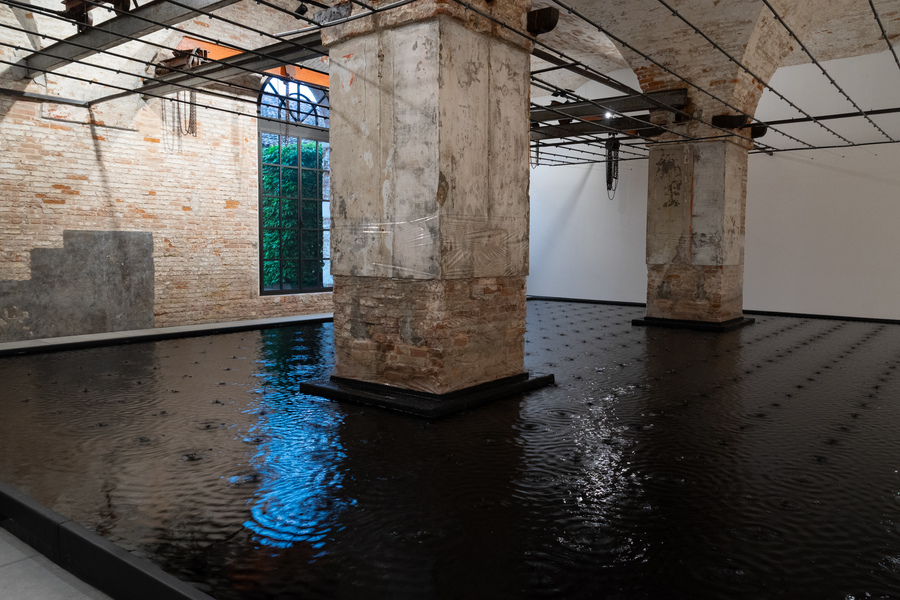
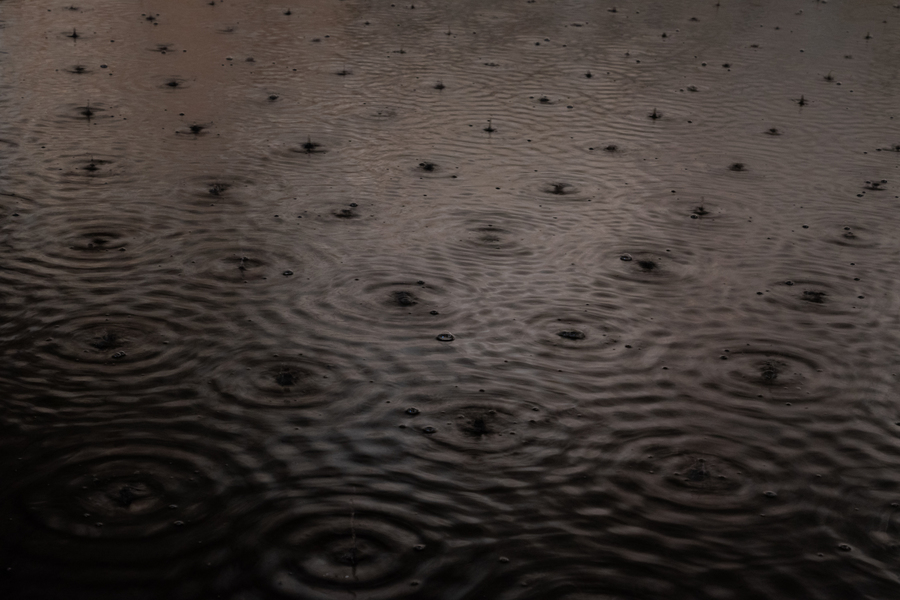
The contested view of Israel as an ordinary participant in global dialogue is echoed further in its pavilion. For a state whose prime minister is facing an ICC arrest warrant, Israel’s pavilion is remarkably normative, composed of serene water-based sculptures which sidestep the external atmosphere of controversy. Agricultural pipes drip inky liquid over a pool, and nearby a black rose sits frozen in ice. Artist Belu-Simion Fainaru is inspired by Kabbalistic symbology and the poetry of Paul Celan, specifically Todesfuge, a haunting piece informed by the loss of Celan’s parents in the Holocaust.
However, there is little of Celan’s harrowing historical immediacy in these sculptures beyond a straightforward material translation into conventional forms. Celan’s line regarding the "Black milk of daybreak", for instance, is manifested as rippling and dripping black liquid devoid of context beyond its curatorial text. Within the pavilion, Todesfuge’s specificity is broadened into indirect objects of aesthetic contemplation. While there is nothing inherently wrong with formalist sculpture, it also carries unique implications in the pavilion’s context. Where many expansionist governments foreground grandiose narratives (see the colonial-era architecture of Britain’s pavilion), Israel has instead presented sculptural forms which appear almost devoid of narrative, and far more interested in sculptural form. Whether the artist’s intention or not, such work seems to evade critical attention through its polite and depoliticised aesthetic, elegantly fitting the Biennale’s wider language of impartiality. What remains is the uncanny tension of apparently neutral sculptures quietly affirming the rhetoric that surrounds them.
Viewed alongside today’s geopolitics, neutrality itself becomes less neutral. Simultaneously, the Biennale continues to inhabit that aforementioned more optimistic world order. The chaotic results of this nostalgia are readily apparent: the Biennale jury have collectively resigned over Israel and Russia’s inclusion, protests have erupted outside those pavilions, and one is left asking why the institution is so entangled in an embattled paradigm of liberal orthodoxy.
As internationalism is challenged by global conflict, the Biennale continues as a relic of its political commitments. For its audiences, Venice attempts not only an aesthetic escape from 2026, but also a political one.
Scotland + Venice, Bugarin + Castle: Shame Parade, Olivolo, Castello 65a 30122, Venice as part of La Biennale di Venezia, until 22 Nov 2026
This article was supported by the Scotland + Venice X The Skinny Emerging Writers partnership. Throughout 2026, four Scotland + Venice Exhibition Associates are writing about their experiences and observations of the Venice Biennale.