New Perspectives: Collective Gallery's Time + Space exhibition
From a hairy animatronic sculpture to a film of Arab queer love, an autumn exhibition at Collective Gallery presents the work of four early-career artists based in Scotland
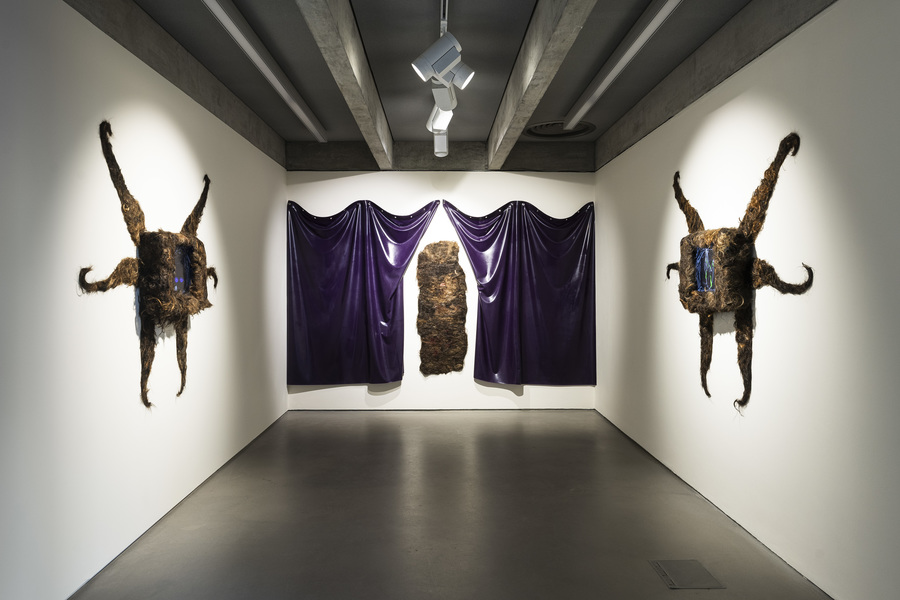
At the summit of Calton Hill, inside the old City Observatory, a mound of human hair curls on its plinth like a sleeping creature. It rises. It falls. It is breathing. Rumour has it, one older visitor sat down on the beast, thinking it was a bench. I don’t blame him, although I was warned by its maker, Gianni Esporas that “It will touch you back.”
This animatronic sculpture, Monotonous Brunette, is one of several works in a group exhibition at Collective Gallery, running until 20 December. Spread across the Dome and the Hillside gallery, the exhibition is part of Time + Space, a new programme for early-career artists in Scotland. Over nine months of crits, workshops and field trips, Esporas and fellow artists Hetal Chudasama, Abi Lewis and Huss Al-Chokhdar explored ritual, myth and memory through printmaking, painting, sculpture, film, textiles and poetry. Together they have turned the gallery above the clouds into an eclectic land of arcane symbols, lovable chimeras and enlivened ephemera.
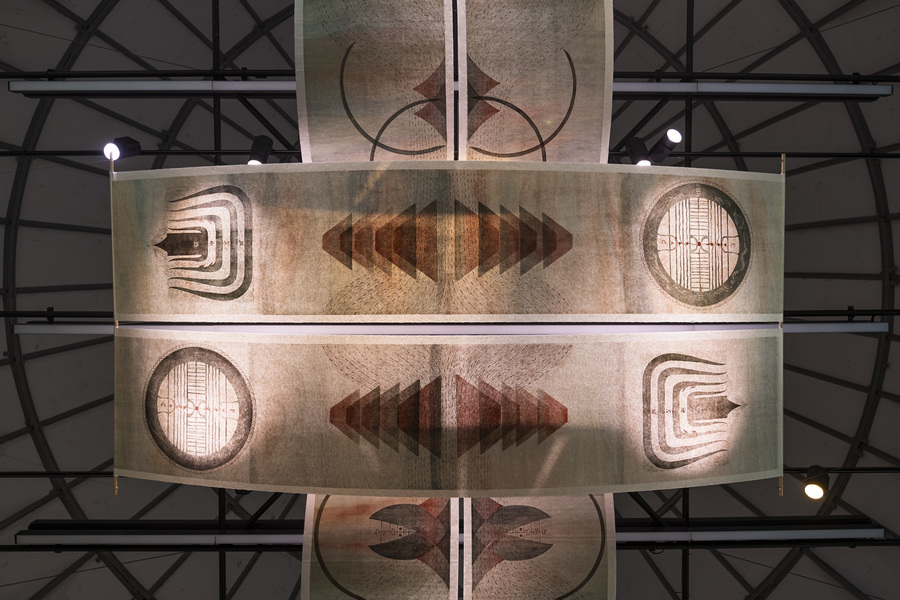
In the Dome, the mechanical whirring of Monotonous Brunette draws me to a set of silent wooden shapes on the far wall. The central circle could be the trunk of a felled tree carved with nearly recognisable symbols. These woodblocks are part of Chudasama’s An Hour in Chrysalis. The symbols are of Jain and Tantric origin, cosmological diagrams she first encountered while restoring temples in India. Chudasama explores how observations of the cosmos become belief systems that shape lives. As she puts it, “You make some lines, and then this diagram dictates your religious practice for the next thousand years.” Suspended from the ceiling, a series of woodblock prints invites us to trace connections between block and print. Her work reveals how an image can be larger than its origins.
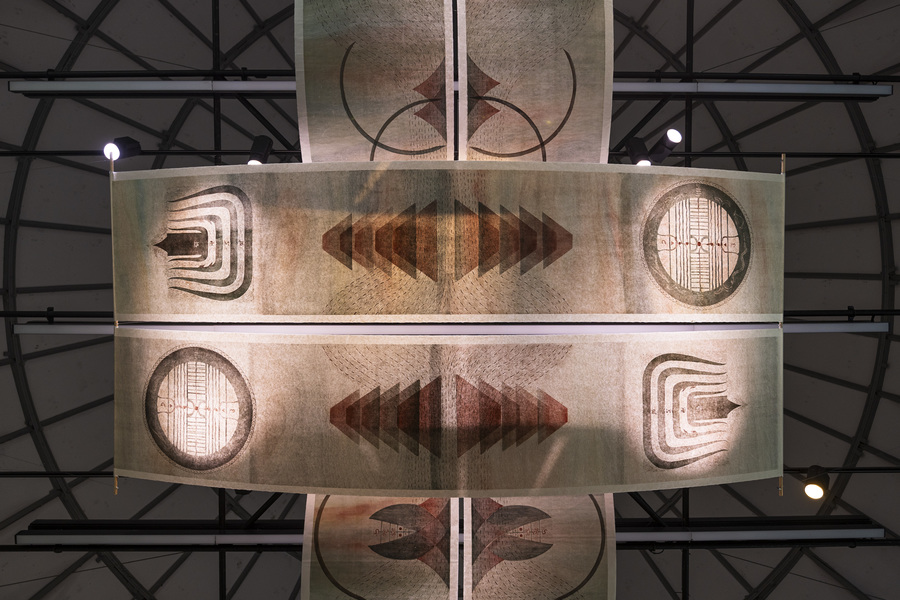
Hetal Chudasama, An Hour in Chrysalis, 2026. Courtesy of the Artist and Collective Gallery. Photo: Eoin Carey
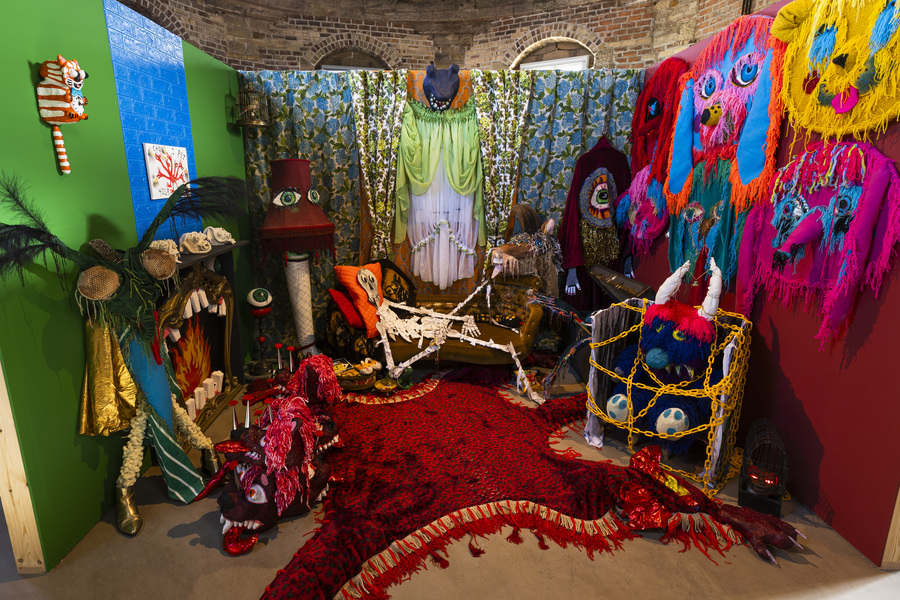
Opposite this soft minimalism hangs Night tether (i), a cartoonish, crowded painting by Lewis on a makeshift partition. A blue demon with candles for fingertips and eyes on its behind dominates the scene, while a golden horse licks the head of a terrified child clutching a red ribbon tied around a skeleton’s pelvis. Peer behind the partition and the painting spills into 3D: a living room with a fireplace that has teeth, a one-legged lamp with two eyes, and a skeleton draped across a chaise longue. Lewis calls this a “wonky aesthetic... Once you add the eyes to it, it’s a being of sorts,” they tell me. A broken broom by a bin is a creature waiting to happen. This world is inspired by night terrors, yet it is endearing, perhaps a way of taming fear by letting it become real.
Before leaving the Dome, I find the quietest piece: a golden bell with a thick white rope pooling on the floor beneath it. The surface of the bell is engraved with Arabic I cannot read. This is the work of Al-Chokhdar, whose film The Ship That Left Without Us continues in the Hillside gallery. I have been told about the beauty of Arabic; Al-Chokhdar’s film makes that beauty clear to non-Arabic speakers. Set on a ship, it centres two men, lovers yearning for one another. Its dark, sparse aesthetic creates a melancholic yet warm atmosphere. Inspired by the 2001 raid on the Queen Boat, a floating Nile nightclub where queer Egyptian men danced, the film imagines a “pure queer Arab love” untouched by the violence surrounding it. Another golden bell in the Hillside gallery answers the first, holding us in suspense between ocean and land, between two lovers, and drawing us toward queer Arab experience and in turn our own hearts.
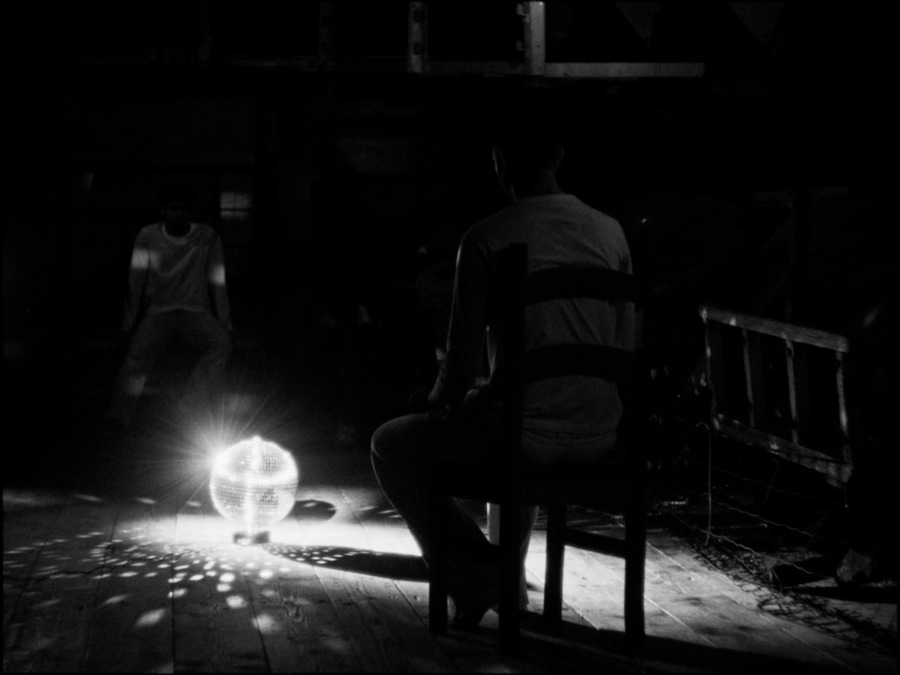
The Ship That Left Without Us (2026) by Huss Al-Chokhdar. Courtesy of the artist and Collective Gallery. Photo: Eoin Carey
Some pieces of ourselves we cherish and some we discard. One piece of us – our hair – is the central tension in Esporas’ work. Her primary material is a bag of dirty human hair donated by Glasgow College’s hair and beauty department in 2024. Through it she explores labour, feminism and migrant work.
Monotonous Brunette, made by laboriously wet felting human hair, brings to life something repulsive. In Long Haired Freaks, hybrid video textile works personify hair and give it a voice. By touching what is dirty and unwanted, she asks us to reconsider what and who we cast off, and to reckon with the possibility that those things and people, given time and attention, may touch us back.
What these artists share is a peculiar way of looking: at what is unseen, ignored, discarded or too subtle to make a solid impression. Their work invites dialogue with imagination not only for escapism, but to change how and what we perceive, whether it’s the power of an image, the line between object and person, the space between ocean and land, or the value of what is discarded. Put simply, sometimes you have to climb a hill to gain a new perspective.
Time + Space, Collective Gallery, Edinburgh, until 20 Dec