The Skinny's Edinburgh Old Town Quest for Kids
Take a tour through Edinburgh’s Old Town to learn some facts about Scotland’s weird and wonderful history
Start: Edinburgh Castle Esplanade
End: National Museum of Scotland
Distance covered: < 1km
Standing on Castle Rock, a 350 million-year-old volcanic plug, the site of Edinburgh Castle has been occupied by humans since at least the Iron Age. The oldest part of the fortress that stands there now is St Margaret’s Chapel, which was built in the 12th Century. It’s been a royal residence, an arsenal, a military garrison and now a visitor attraction and home to the Crown Jewels of Scotland.
Question 1: Stand in front of the entrance to Edinburgh Castle and look above the main gate. What do you see on a yellow shield?
- a) A pink swan
-
b) A red lion
c) A blue unicorn
Question 2: Walk away from the castle towards the Royal Mile. When you leave the gates there’s a restaurant on the right – and there’s something buried in the wall nearest to the castle, above the window in the middle. What is it?
-
a) A cannonball
b) A spear
c) A rose bush
Question 3: Keep walking down the Royal Mile until you reach George IV Bridge. Cross the road, and you’ll find a massive statue of the philosopher David Hume. He lived in the mid-18th century and was a key figure of the Scottish Enlightenment, a period of radical development in philosophy and science whose ideas influenced modern societies around the world. Look at his toe – it’s very shiny. Why do people rub it?
-
a) For luck
b) Because their tour guide told them it was a real local custom
c) To release the genie
Question 4: Across the road is St Giles’ Cathedral, the 900-year-old High Kirk of Edinburgh. On the cobbles outside you’ll find the Heart of Midlothian, marking the site of the Old Tolbooth, which was demolished in 1817. The building used to house the city’s main jail, where prisoners would experience gruesome torture and even execution. What do locals do to the Heart of Midlothian for luck?
-
a) Jump on it
b) Stroke it
c) Spit on it -
Question 5: Head back to George IV Bridge, cross the road, turn left and walk along the weird tunnel that's replaced the pavement for years, no one knows why. Cross over Victoria Street, and you'll find Edinburgh Central Library on the other side. The first entrance is the children's library, which has a craft room and a chill space at the back if you need a break. Built in 1890, this was the first public library in the city. There are some carvings above the main entrance – what do they say?
-
a) I Love Reading
b) Let There Be Light
c) City of Edinburgh Council Rules OK
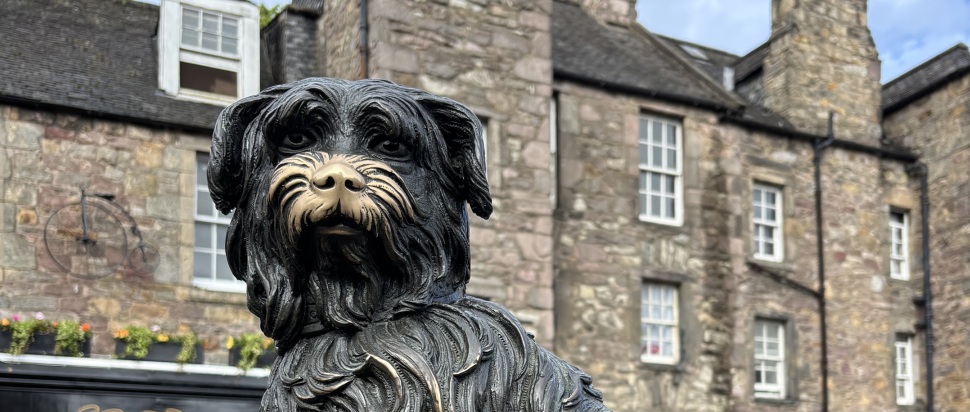
Question 6: Continue along George IV Bridge until you reach a statue of Edinburgh’s most famous wee dug and very good boy, Greyfriars Bobby. This Skye terrier lived more than 150 years ago and has been celebrated ever since for his incredible loyalty. He guarded the grave of his owner John Gray for 14 years until his death in 1872 – you can find his grave in Greyfriars Kirkyard over the road. It's the one with a pile of sticks in front of it. It’s become a custom for tourists to rub part of Greyfriars Bobby for luck, but which part is it?
-
a) His paw
b) Under his chin
c) His nose
Question 7: Cross the road, where you will find the National Museum of Scotland. Entrance is free – grab a map and make your way to the Science and Technology area of Level 1. Here you’ll find Dolly the Sheep. She’s very famous, but why?
-
a) She’s a clone
b) She’s the star of The Sheep Detectives
c) She’s the first of a new breed of sheep
ANSWERS
1 b) A red lion, also known as the Lion Rampant of Scotland – apparently the king can arrest you if you use it without his permission. Which is surprising, but did you know he also owns all the swans? The unicorn is the national animal of Scotland due to its proud, untameable, fiercely independent nature.
2 a) A cannonball. Some say it was shot towards Holyrood Palace and Bonnie Prince Charlie when he was laying siege to the Castle during the Jacobite rebellion of 1745. Others say it was placed there as part of engineering works, which is much less exciting.
3 a) and b) The statue isn’t as old as it looks – it was made in 1995. So rubbing the toe isn’t an ancient custom, although some locals might do it for luck on their way into the High Court next door. David Hume likely would have hated becoming a good luck charm as he famously rejected religion and superstition in favour of rationality and reason. That was kind of his whole thing.
4 c) Spit on it – historically to ward off the chance of ending up in the cells or maybe to express disdain for the people imprisoned there. Now it might also have something to do with individual feelings towards local football team Heart of Midlothian F.C.
5 b) Let There Be Light – the man who paid for the building, Andrew Carnegie, insisted this was written over the door of every library he funded. And he funded a lot of libraries – thousands in fact, in the UK, Ireland, the US, Canada, Australia, South Africa, New Zealand, Serbia, Belgium, France, the Caribbean, Mauritius, Malaysia and Fiji.
6 c) His nose. No one knows why it started, it drives locals insane.
7 a) She’s not just a clone, she’s the first clone! Dolly the Sheep was created by Edinburgh scientists in a test tube from an adult sheep cell, and born on 5 July 1996.