Trongate 103: Community, Creativity, and Glasgow's Cultural Crisis
Glasgow's art scene is under threat. In light of City Property's decision to quadruple rent for tenants at Trongate 103, we question the profit-motivated decisions damaging the arts community
There’s a gigantic protest banner stretched across three storeys of the building at Trongate 103. In letters six feet tall, it pleads: 'GCC DON’T BREAK OUR 'ARTS.' It’s a huge pushback, against a huge problem; Glasgow’s art spaces are under fire.
In February, City Property – a subsidiary of Glasgow City Council (GCC) – terminated the lease agreements of the seven charities and cultural organisations who call Trongate 103 home, issuing new contracts, with occupancy costs skyrocketing by four times the current rate. Their proposition puts the tenants in unprecedented and precarious conditions if they choose to sign, and out of a home if they don’t. With this one swift rent hike, they threaten to undo years of community building, ripping apart Glasgow’s major cultural ecosystem.
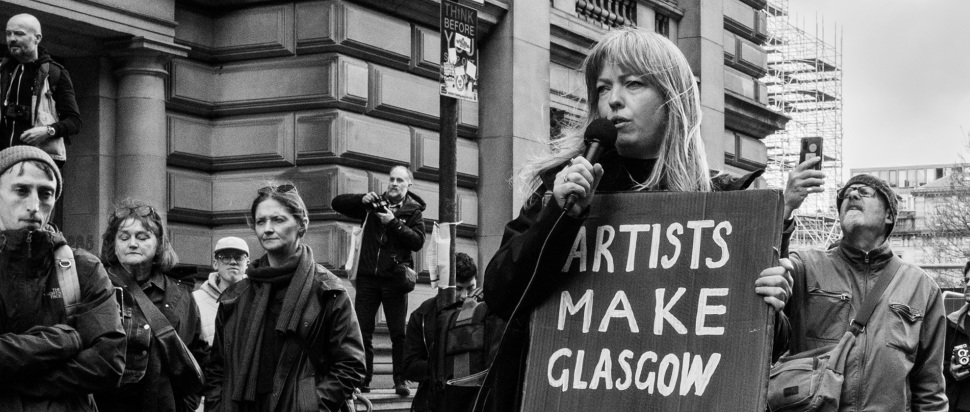
Running since 2009, Trongate 103 has served as an exhibition space, workshop venue and affordable studio for local artists. As a deeply valued space foundational to the city’s creative scene, residents and supporters alike were shocked by City Property’s new proposal. In true Glasgow fashion, the city has rallied together, starting a petition which now has 25,000 signatures, and in March, hundreds took to the streets to express their devastation at the possibility of losing (yet another) pillar of the arts community.
As a result of this pushback, GCC has backed a Green motion which will secure a £200,000 ‘Culture and Creative Industry Property Support Fund’, allowing short term relief to those organisations dealing with City Property’s soaring costs. Green Councillor Holly Bruce, who fiercely campaigned for the support fund, explained just what is at stake if the city were to lose such a space. "The campaign to save Trongate 103 isn't just about a building,” she explained, adding: “It’s about the very soul of Glasgow.” The fund, however, is marked for city-wide distribution, so it’s still unclear how much of the financial help will go to Trongate 103 directly. In short, this is not a long-term solution, meaning the future of the building and its residents remains uncertain.
Trongate 103: A home to community, care and culture
Home to collectives who otherwise could not survive the crippling commercial rents that run riot in the city centre, Trongate 103 allows its tenants to value community, care and cultural significance above profits, principles seemingly insignificant to a commercial outfit like City Property. Organisations such as Glasgow Print Studio and Street Level Photoworks, for instance, function as major UK centres for contemporary art which help cement the city’s international reputation, with recent exhibitions by artists including Ciara Phillips, Claire Barclay and Simon Phipps. Other spaces, such as Transmission Gallery and Glasgow Project Room, have nurtured emerging and early-career artists through grassroots, artist-led programming, while charities GMAC and Project Ability provide essential community support and talent development.
Project Ability, in particular, offers essential support for artists with learning disabilities and mental ill-health, with its gallery profiling both service users and internationally recognised artists, including 2025 Turner Prize winner Nnena Kalu. Together, Trongate 103’s organisations form a cultural network which promotes global exchange while supporting emerging local talent, and championing socially engaged practice.
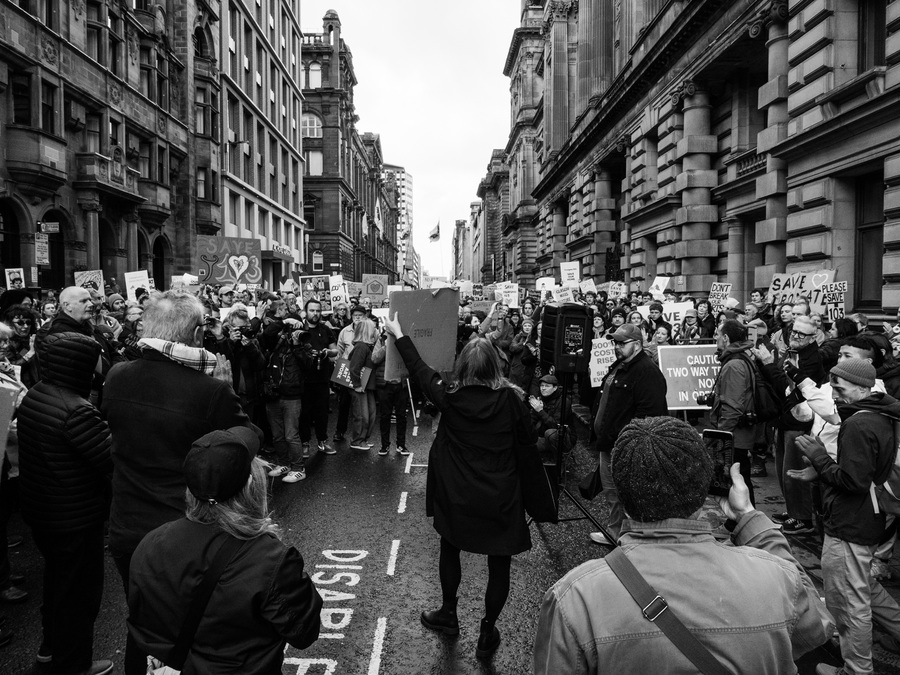
Image: Mark Cameron.
Despite sharing the same building, the organisations are taking varied approaches to the new let agreement, reflecting the varying needs of the diverse communities they serve. With the needs of their artists paramount, Project Ability have reluctantly signed the new lease stating: "Our artists are at the heart of everything we do. With that in mind, and not without significant concern and reluctance, we have taken the decision to sign the new lease in order to ensure we can continue to provide a vital space for over 200 artists each week to create, connect and be supported." However, they also stated their future remains uncertain, with "serious concerns about the sustainability of operating under these new terms."
Others are protesting the new conditions, leaving the building entirely. Choosing to move their premises to The Pyramid at Anderston, GMAC reflected on their time in the building as being “fraught with behind-the-scenes problems, emanating from Glasgow City Council’s decision (16 years ago) to move Trongate 103 into a commercial property portfolio.” It is this tension that is at the heart of the issue; creativity and commerce don’t mix well.
"Some of us only have this place to go"
Gary, an artist who attends Project Ability’s Aspire programme, spoke on the importance of Trongate 103 for artists like himself: “Some of us only have this place to go to and for people who depend on this space they would lose a lot of their confidence and lose friends. They’d lose out! In my lifetime I would never have thought that I would have had work in an exhibition until I came here. I don’t want that to go.”
Gary’s experience shows the human impact that City Property overlooks: Trongate 103 is not just bricks and mortar, but a community that nurtures confidence, connection and opportunity.
Gary is just one of the 200+ artists and cultural workers who will be affected by the rent hike, which will disrupt the lives and livelihoods of the immediate artists, while also putting a major cultural dent in Glasgow’s footing as a respected international arts destination, something which will have a domino effect in years to come.
The situation at Trongate 103 is representative of the slow erosion of Glasgow’s rich cultural scene. It seems to have been in a downward spiral since the 2024/25 financial year – the Scottish Government could not confirm the release of £6.6 million for Creative Scotland, resulting in a temporary closure of the Open Fund for Individuals. It may be the case that the Culture and Creative Industry Property Support Fund suspends the situation at Trongate 103, rather than fully resolving it. The deep-rooted issue is that Glasgow’s cultural spaces are treated as commercial assets first, and community infrastructure second.
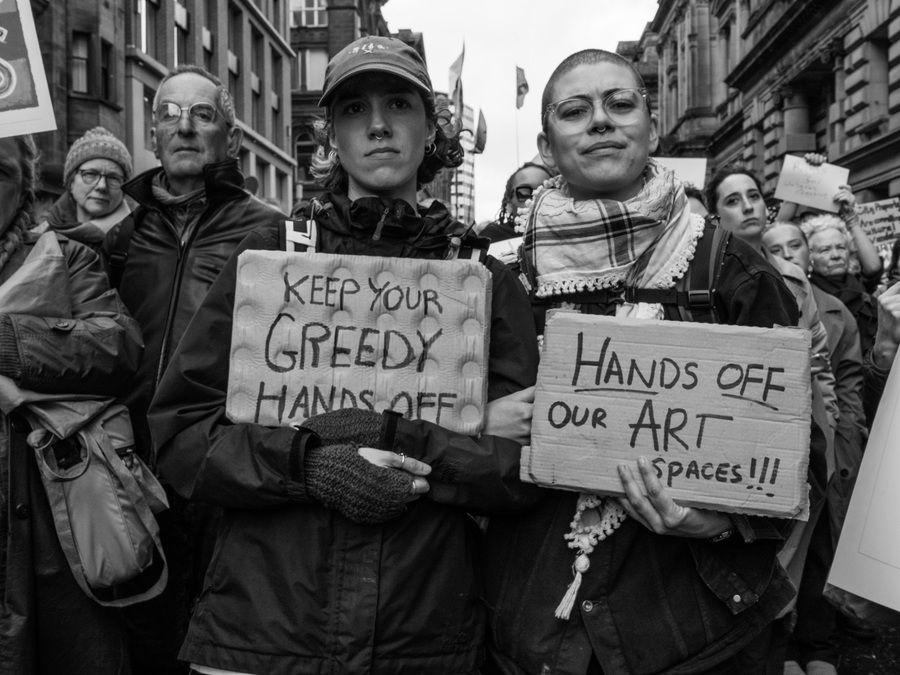
Image: Mark Cameron.
Following the demise of the CCA, alongside the slew of temporary closures affecting council-run venues such as The Lighthouse, the People’s Palace and Queen’s Park Glasshouses, it is understandable that the people of Glasgow feel their communities and culture have been reduced to an afterthought.
When asked for a comment, GCC lauded that only one of the seven organisations has decided to move out of the premises claiming that “the building retains its original purpose of supporting cultural organisations.” Although true, it fails to consider the challenging circumstances these organisations are now navigating; higher rents, uncapped service charges and a council that doesn't see the value in creating sustainable environments for the arts to thrive. The building may appear unchanged, but a culture of uncertainty festers beneath the surface. In this context, the relief fund feels like a mere band-aid over the city’s gaping wound.
Welcoming the World to a City in Crisis
The situation feels especially pertinent with Glasgow International looming. Scotland’s biennial festival of contemporary art is set to welcome artists and cultural workers from across the globe this June. This international cultural event is sure to put the Trongate 103 situation under the microscope, perhaps prompting the council to ask: what does it mean to welcome the world to a city whose cultural infrastructure is in crisis?
So what is the long term solution? City wide rent controls, publicly owned and protected spaces and a major shift in the perception of cultural value. Without these the relief fund is not preservation, it’s managed decline. This is why the rallying cry around Trongate 103 could be heard so loudly; this isn’t an isolated incident, but a systemic issue.
Last month, as hundreds marched in solidarity with the studios and charities, many of the placards read ‘Everybody To Trongate 103’, an homage to the ‘Everybody To Kenmure Street’ protests of 2021. The now infamous incident saw hundreds of people flocking to Kenmure Street, blocking a van detaining two Sikh residents for alleged immigration violations. After eight hours the men were released and the movement has since become legend in the city, demonstrating the power of community solidarity. Through invoking the spirit of past movements, the protestors signal an unwavering belief in the strength of collective action. It’s a powerful reminder of what we as a city can achieve when we stand together.
change.org/p/save-trongate103-from-closure