Reclaiming Censored Queer Art in EAF26
Rare solo exhibitions dedicated to the queer photographer Del LaGrace Volcano and the late fetish artist Sadao Hasegawa challenge the cultural devaluation of LGBTQ+ erotic art
In 1964, the Jacobellis v. Ohio Supreme Court Case gave rise to the most infamous attempt to define pornography; when pushed, Associate Justice Potter Stewart claimed: “I know it when I see it.” The case reversed Ohio State’s decision to ban a public showing of Louis Malle’s The Lovers – a French film about a woman who, dissatisfied with her marriage, pursues a sexually liberating affair – on the grounds of obscenity. As Stewart’s murky definition implies, the distinction between art and pornography relies more on subjective intuition – which is shaped by societal bias – than on a robust critical framework.
Queer artists, whose practices – in art and life – offend and disrupt heteronormative, traditionalist values, are particularly vulnerable to accusations of obscenity. From Robert Mapplethorpe’s raw documentation of S&M to David Wojnarowicz’s filmic meditation on the AIDS crisis, conservative groups and politicians have notoriously approached explicit queer art as a wedge issue, seizing the opportunity to stoke a culture war. In Scotland, we recently saw just how volatile subjective judgements around obscenity can become in the takedown of Leonie Rae Gasson’s REIN in 2024. The moving-image installation, which sought to explore 'dyke sexuality' through sex acts, was censored before it was even made. A whirlwind of political outcry followed The Scottish Sun’s report on the public funding of 'STATE-FUNDED PORN'; consequently, Creative Scotland withdrew the funding, arguing that they did not realise that the project involved real sex.
While the censorship of Gasson’s REIN is a recent high-profile case in Scotland, this year’s Edinburgh Art Festival foregrounds the experiences of international queer artists whose work has been vulnerable to obscuration in the 20th century, placing contemporary debates around obscenity in a longer historical continuum. In Leith, two rare exhibitions – one by the American artist and activist Del LaGrace Volcano and another by the late Japanese fetish artist Sadao Hasegawa – are brought into dialogue through their celebrations of underground queer culture.
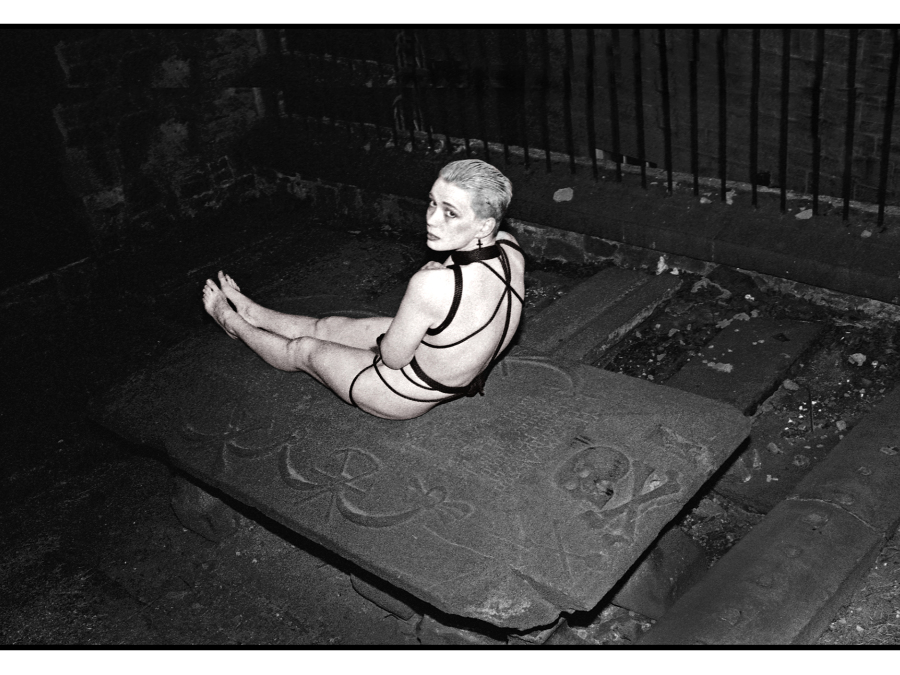
Chilling at Greyfriars with Sylvia, Edinburgh (1989) by Del LaGrace Volcano. Image courtesy of the artist.
“The Edinburgh Art Festival this year is very sexy,” says curator Eleanor Taylor with a coy smile, adding that it’s not unusual for her to be discussing chains, whips and dicks with colleagues by 10am on a Monday. The upcoming EAF programme is the fourth under the directorship of Kim McAleese, in which the Festival has shifted from a commissioning focus on public sculpture to three weekends of performance and provocations. Taylor confirms that the programming team gravitate towards artists who don’t fit neatly into an art historical narrative: “We’re expanding what the festival considers contemporary art.” This commitment is pertinent given the politically divisive debates over the boundaries between art and pornography, through which censorship has restricted queer artists’ expression, condemning it as too explicit for public exhibition.
Exhibiting artist Del LaGrace Volcano has experienced their fair share of censorship. Raised in what they describe as a “working, working-class family” in California, Volcano moved to London in the early 1980s, where they were active in the local BDSM community and captured the dyke cruising scene in monochrome. In 1991, they produced their debut monograph, Love Bites, an unapologetically sex positive documentation of lesbian subcultures in all their intricacies, “[f]rom clubbing to marching, harness to tutu, ruff sex to romance,” as the back cover declares. Upon publication, Love Bites was seized by US customs, and in the UK, LGBTQ+ bookshops refused to stock it; West & Wilde Bookshop in Edinburgh was the only exception.
“There was nothing I considered pornographic,” Volcano says, with exasperation in their voice, over Zoom from their studio in Sweden. “There was nothing you could prove was violating the Obscene Publications Act.” It’s clear that the artist still bears the weight of the obscenity accusations three decades later. Paralleling the furore surrounding REIN, it was the tabloids that pornified Volcano’s intimate portraits of queer connection and exploration, appropriating the language typically associated with Page 3 imagery in a bid to sensationalise them.
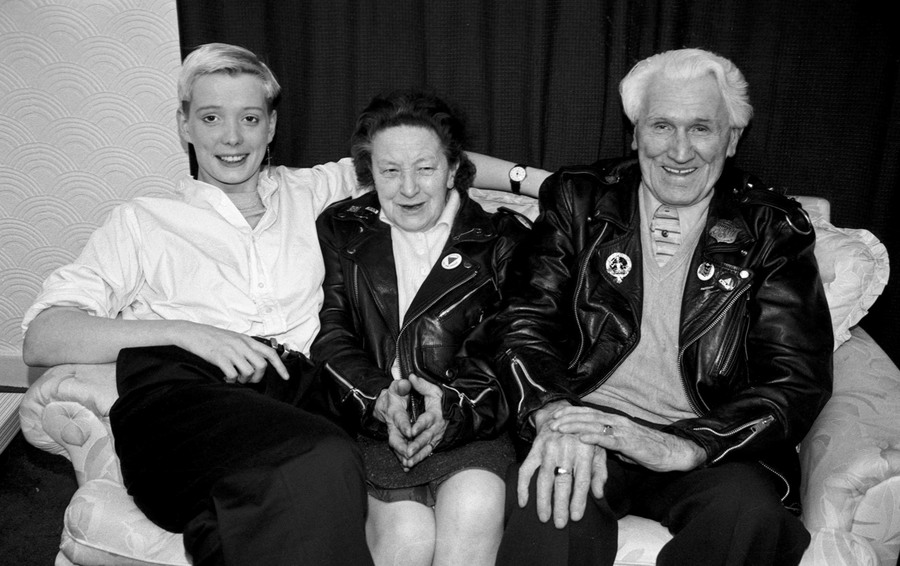
My (X) girlfriend Sylvia McFarlane with her Nana and Gramps in our leather jackets, by Del LaGrace Volcano. Image courtesy of the artist.
At EAF26, Volcano pushes against censorship attempts with Love Bites Back at 92 Constitution Street. In preparation, the artist has been working through their self-made Queer Archive of Resistance, selecting dyke photography taken from 1982 to 1995 for display. In retracing their movements through London’s dyke scene, the artist has been considering their “right to exhibit [the images] of intimate moments” more than three decades later. Where there is doubt, Volcano has sought “renewed consent”. Movingly, through creating this exhibition, Volcano has reconnected with an ex – Scottish lover, Sylvia. In Love Bites Back, Sylvia stares longingly at Volcano; cosies up to her leather-clad grandparents on the couch; and, in bondage gear, balances on a tombstone in Greyfriars Kirkyard. With care and consent, the couple’s relationship and escapades in Edinburgh are presented in all their multitudes, captured with the intention of eliciting aesthetic and emotional contemplation.
Subjective, state-enforced judgements around obscenity shaped the curation of Sadao Hasegawa: Carnal Desires. Presented at Custom Lane, the exhibition explores the self-taught artist’s sprawling universe of gay male desire through a selection of illustrations, sketches and paintings produced throughout the 1970s, 80s and early 90s. Although Hasegawa was prolific in the international gay magazine industry during his lifetime, exhibitions of his work outside of Japan remain rare.
Bringing Hasegawa’s work to Edinburgh required curator Edmondson to navigate UK and Japanese customs regulations governing obscene material, with guidance from Gallery Naruyama, which cares for and preserves the artist’s estate. Discussing the thematic contradictions in the selected works, Edmondson suggests that obscenity is an unstable category. For example, some representations of homosexual penetration could not be guaranteed safe passage back to Japan, yet depictions of penetrative bestiality – including works from the 1982 series From the Story of the Princess and the Eight Dogs – were considered permissible.
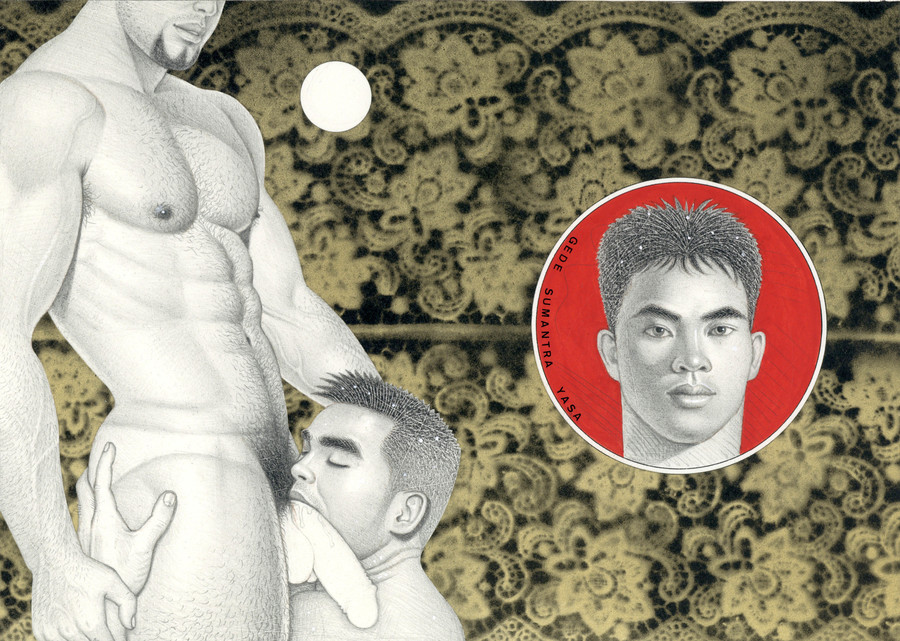
Artwork by Sadao Hasegawa. Image courtesy of Gallery Naruyama.
Hasegawa's marginal position within Japanese art institutions provides integral historical context for these ongoing tensions. Despite his prolific career in gay press, he came up against the hetero-conservatism of mainstream museums. Two years before his untimely death by suicide in 1997, he wrote to Durk Dehner, co-founder of the Tom of Finland Foundation, reflecting on his pursuit of "spiritual, profound beauty and eros" while expressing frustration at the reluctance of museums to exhibit and collect gay art. This marginalisation was felt deeply in his personal life, too, as a man closeted to his family; his sexuality and his artistic practice only became known to them in death. Had Hasegawa not left a note instructing his estate be entrusted to Gallery Naruyama, his family considered throwing away his work out of fear of the shame it would bring upon them. Through Carnal Desires, EAF strengthens the public and international visibility of a body of work that has been vulnerable to erasure and institutional neglect.
In platforming Volcano and Hasegawa, EAF challenges the cultural devaluation of LGBTQ+ art with erotic themes, in turn promoting tolerance towards non-normative sexualities. Curated with a sex positive mindset, the programme offers a space to encounter the aesthetic merits of the artists’ diverse practices, from Volcano’s liberating lens to Hasegawa's futuristic reinterpretations of shunga. And if the tabloids are eager to condemn the works as too explicit for public exhibition, we must challenge the impulse to restrict queer artists’ freedom of expression.
Edinburgh Art Festival 2026, 14-30 Aug
Del LaGrace Volcano: Love Bites Back, 92 Constitution Street, 14-30 Aug
Sadao Hasegawa: Carnal Desires, Custom Lane, 14-30 Aug