After Shock: 5 artists shaping performance art in Scotland
Inspired by an exhibition on Marina Abramović’s first performance in Scotland, we interview five artists about the enduring appeal of the experimental medium
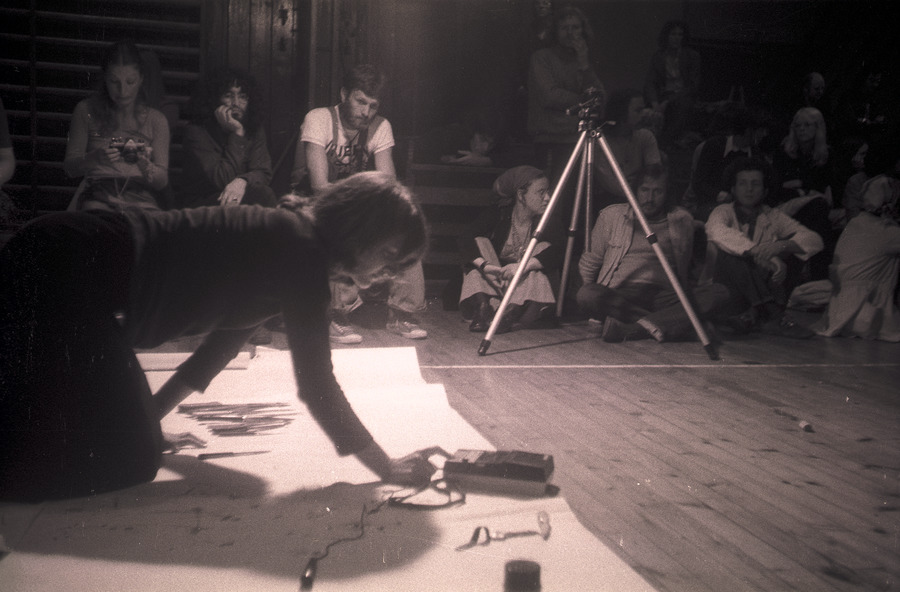
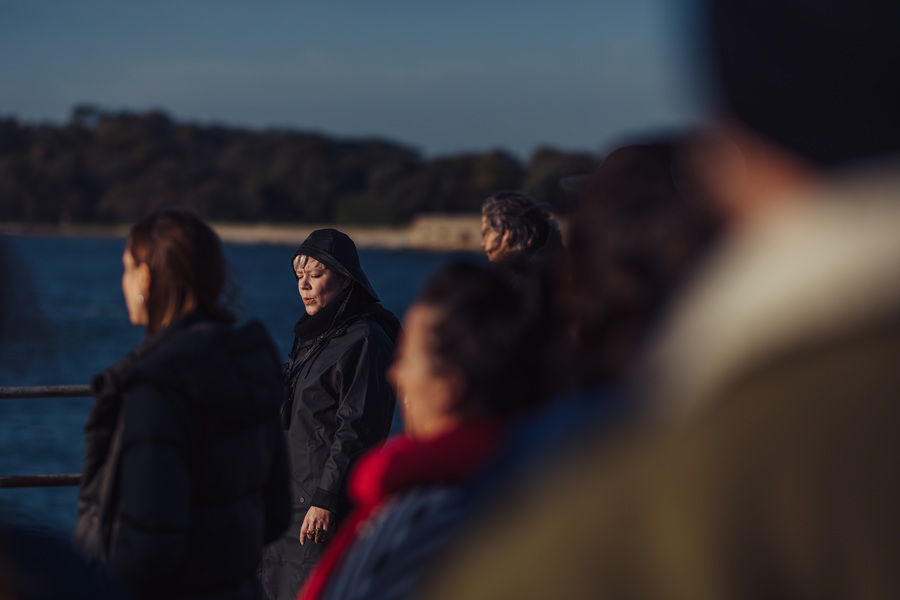
Edinburgh, 1973. A crowd gathers around an up-and-coming artist, engrossed but a little terrified at the sight of her splayed fingers on a white sheet of paper, now streaked with lines of blood. She is playing a game, a reckless one. From a line-up of perfectly sharp kitchen knives, she picks another and goes again: rhythmically jabbing the narrow space between her fingers to the disorientating sound of a tape recording of the previous round.
This is the sight of Marina Abramović, the 'grandmother' of performance art, finding her medium. Through pain and physicality, Abramovic is worshipped for pushing the medium, the body and the audience to their limits. And though it was her first-ever performance, Rhythm 10 can be read as a public declaration of her intent to shape the medium through her own body.
Rhythm 10 is a mythologised moment in the history of performance art, anchored in Scotland. It was part of the Edinburgh Arts 1973 programme, organised by Richard Demarco. Photographs from that extreme performance are now on display at Fergus Purdie Architects’ Window Gallery in Perth, in an exhibition titled Marina Abramović, Rhythm 10 Revisited.
While the exhibition looks back to that violent spectacle and its bloody aftermath, what if we were to take stock of how artists are currently shaping the medium in Scotland? In our conversations with five visual artists active across the country, we learn that performance serves as an integral developmental force for their ideas, which are expanded into different media.
Rae-Yen Song 宋瑞渊
For artist Rae-Yen Song, family outings sometimes take the form of performance. The ongoing song dynasty series involves unannounced processions on the streets of Glasgow, as Song’s immediate family wear an elaborate sculptural costume that requires multiple bodies to move. Audiences are deliberately de-centred, as passers-by encounter the performances without any context. Song is intrigued by the idea of people “stumbling upon the work rather than gathering for it”. “The audience is part of the environment, not the focus,” the artist reflects. The work, rooted in diasporic family experience, is ultimately “more for us – being together, taking up space, documenting these as a growing archive.”
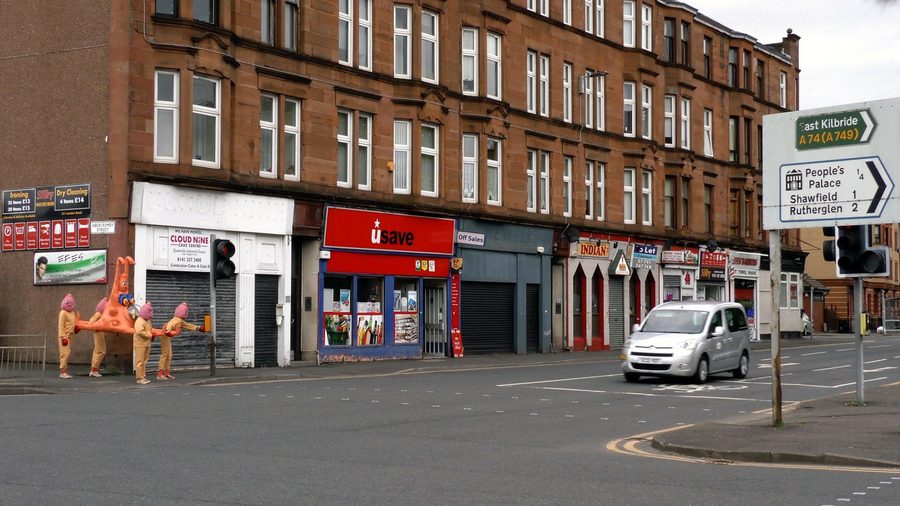
Rae-Yen Song, song dynasty ○. Photo by Michael Barr.
To mark the recent opening of the critically acclaimed •~TUA~• 大眼 •~MAK~• at Tramway, Glasgow, the Song family convened inside the gallery space. Together, they awakened song dynasty ○○○○, a multi-limbed parasitic worm costume, by flowing together as 'one organism' and navigating the gallery space with limited vision, relying on mutual guidance.
Hanna Tuulikki
While Song’s performances are rooted in ancestral mythology and familial connection, Hanna Tuulikki creates place-responsive performances that navigate “the emotional terrain of the climate crisis and biodiversity loss”. Occasionally, the artist invites multispecies interaction through performance. In Seals’kin (2022), Tuulikki improvised seal calls on the banks of the Ythan estuary, prompting seals to return her calls and meet her eyes from the water. Rather than treating this as a one-off encounter, Tuulikki developed the work into a participatory performance, which began as a vocal workshop and culminated in a collective lament at the turn of the tide, inviting seals to surface in the water. “What moves me the most,” Tuulikki reflects, “is how our vocalisations open a parallel connection among the humans as well: a brief sense of attunement, of being-with, that mirrors the possibility of encounter with the seals.”
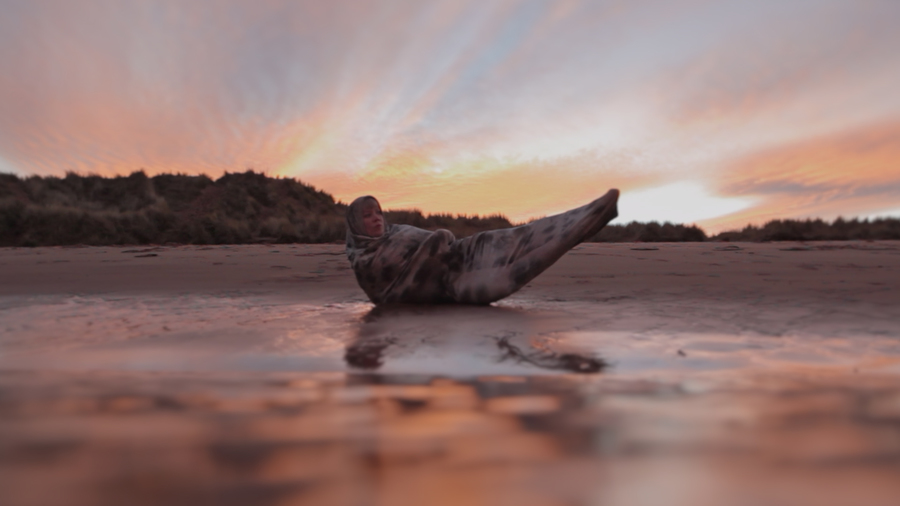
Still from Seals'kin (2022), by Hanna Tuulikki.
Just as care is foundational to Song’s family outings, it is also for Tuulikki, whose performances invite a recalibration of perception. “I believe that performance has the capacity to open and hold space for audiences to feel, to connect and to encounter the world differently,” Tuulikki offers. She speaks of Away with the Birds (2010-15) – a multidisciplinary project that explored mimesis of birds in Gaelic song – with a particular fondness, as its performance on the Isle of Canna (2014) made her reflect deeply on the power of the medium. In part, this was due to the audience’s reaction, as they reflected that they heard the island differently – that “every sound, from water to birds to wind, suddenly felt like music.”
Ashanti Harris
For Ashanti Harris, performance becomes a site of embodied history. Originally trained in sculpture, Harris took to performance because she found the process of making more rewarding than the finished object itself. She roots this in her childhood experience of attending Afro-Caribbean dance classes: “When I danced, I always felt like I was embodying my culture and its associated histories,” she says. Over time, performing with others, frequently with BPOC communities, became a way of processing histories “together as a collective body.”
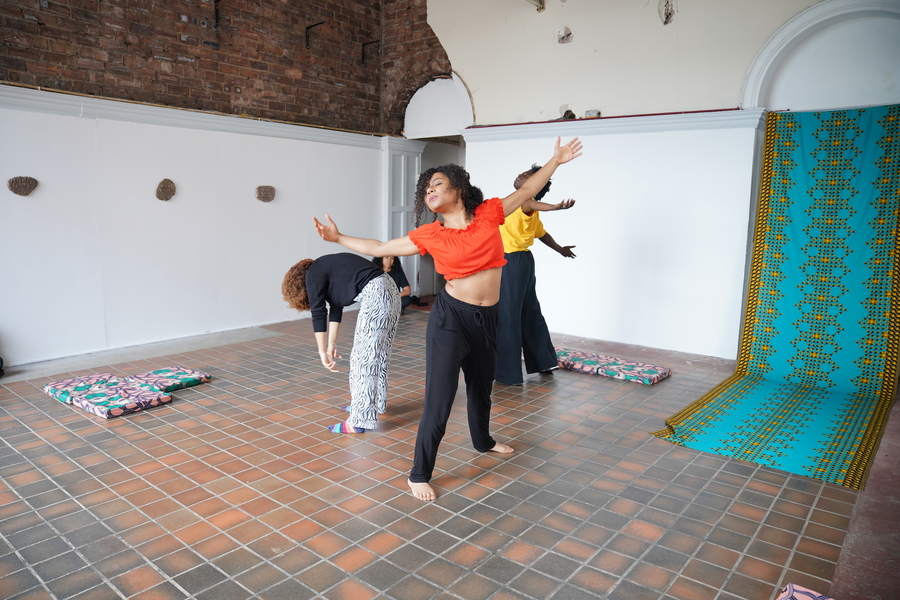
Ashanti Harris, Second Site (2019). Group shot of performers Libby Odai, Natasha Ruwona, Adebusola Ramsay. Photo by Sekai Machache
Second Site (2019) was informed by Harris’s research into women of African-Caribbean heritage in Scotland during the 18th and 19th centuries. The performance took the form of a collaborative ritual with women of shared African-Caribbean heritage in Glasgow, shaped by the group’s ancestral legacies as an embodied experience. In Civic Room Gallery, a mercantile-era building, the group inhabited the space “like ghosts." In this empowering and vulnerable collective action, the visitors responded by giving the performers the space they needed in the building.
Saoirse Amira Anis
“I […] dance while making art, so why not make the dancing the art?” queried Saoirse Amira Anis as she found the medium of performance. Sharing synergies with Harris’s focus on movement, Anis’ performance practice began “simply as an extension of [herself].” While the audience is not the primary focus for Song, Anis regards onlookers as an essential dimension to performance. “It wouldn’t exist without them,” she reflects. A world away from Abramović’s tests of endurance (for both artist and audience), Anis puts parameters in place to ensure that spectators feel “held,” rather than “on edge”.

Saoirse Amira Anis, breach of a fraying body (2023). Photo by Cara Pirie
In 2023, Anis performed breach of a fraying body as part of Art Night Dundee. The performance saw the artist embody a sea-dwelling creature inspired by myths both Scottish and Moroccan, as she moved and improvised through the city from dusk to dark. Behind a tentacled costume and mask, the artist’s gaze set up a dialogue between creature and onlooker. Anis reflects on the culmination of the performance, in which she smeared henna on audience members’ hands and addressed them, breaking the fourth wall: “I could see in people’s body language their gratitude for the performance... for what I hope was a feeling of being held."
Tako Taal
While Anis’s and Harris’s performances encourage fluid movement, Tako Taal’s performances are predominantly text-based, involving collective situations such as readings, table works, as well as rehearsed and unrehearsed encounters. She is drawn to performance as a means of interrogating the psychic impact of colonialism. “Performance is an experiment... about how we’re living together in this specific moment,” Taal mediates. She reminds us that the idea of creating a condition where everyone feels safe is a “falsehood,” or simply not possible. Instead, Taal is interested in creating conditions to “get better at feeling.”
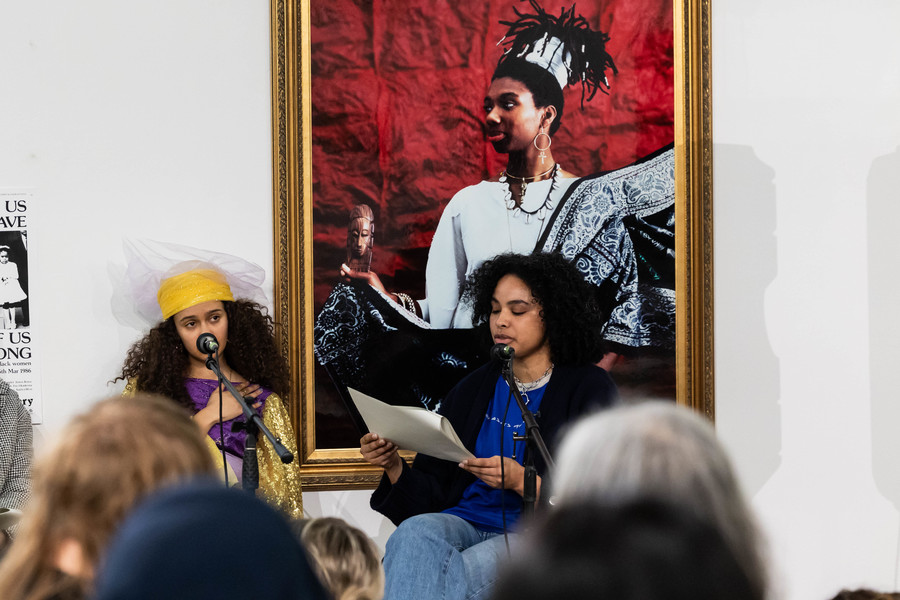
Tako Taal @ Cooper Gallery, DJCAD, 2025. Photo by Sally Jubb.
Taal is keen to challenge institutional pressure around scale and growth, observing that the expectation for each artwork to be larger than the last is unsustainable. We discuss the current inaccessibility of the medium, as galleries and institutions are reluctant to invest in performance, which is timely and costly to realise, compared to physical artworks. Performance is unique, Taal argues, because it is not “a commodifiable object that can sit easily within an archive, or even within a gallery or a show.”
In the afterlife of Abramović’s Rhythm 10, we gather what it might’ve been like to be a witness by examining photographs and hearing second-hand testimonies. The overwhelming consensus is shock. In Scotland today, performance thrives as an experimental and ephemeral tool, one that resists easy documentation but lives most vividly in the memories of those who took part.
Marina Abramović: Rhythm 10 Revisited, Fergus Purdie Architects’ Window Gallery, Perth, 1 Jan-21 Feb
rae-yen-song.com
hannatuulikki.org
ashantiharris.com
saoirse-anis.com
takotaal.com