Gut Feelings: The Ham
On the surface, Manet's The Ham is an innocuous still life... one writer probes beneath the surface of its fatty flesh to find a darker subtext
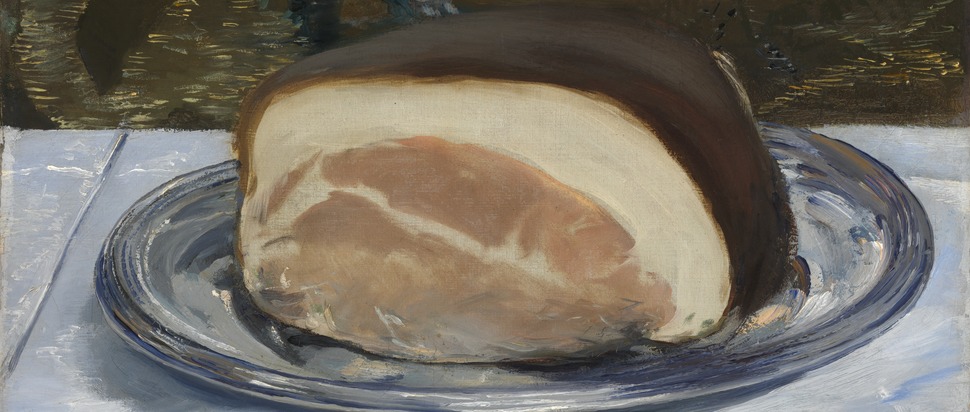
In a shadowed corner of the otherwise sun-drenched Burrell Collection hangs a peculiar plate of ham. Cooked and carved, its flesh is a fading coral, the white of its fatty veins exposed like the glisten of living tissue, and its rind has been painted the same dank mahogany as the ghastly wallpaper behind it.
In the right hands, still life painting can pulsate with significance and story. The artist who served us this distinctly unappetising vision was Édouard Manet, a brilliant painter of visual riddles who has fascinated me for as long as I can remember. Manet was an infamous provocateur; yet behind his urbane wit there also lurked a profound melancholy that sometimes manifested in moments of intense artistic morbidity.
I find myself lingering beside his ham whenever I visit the Burrell. As a fellow melancholic, I find the effect deeply unsettling. The dullness of the colours makes the dish seem like little more than dead flesh, while the prone knife resting beside it implies a looming spectre of violence. I remember that Manet’s first studies of meat were made after he witnessed the public executions of 14 political prisoners; later he would fixate on the brutal suppression of the Paris Commune that immediately preceded Paris’ much-vaunted ‘Belle Époque’.
As I finish writing my first novel, set in Manet’s era, I am struck by several similarities. Then, the working classes were losing their homes to gentrification and were pushed into desperation through terrible leadership and successive cost-of-living crises. Meanwhile, the rich luxuriated and grew unprecedently richer. Below this painting, the label asks – is this really a ham? For me, it is a closet full of skeletons. It strips the scales from my eyes, revealing the ghostly undercurrents of violence and exploitation that lurk still beneath the surface of civilisation.