Backs To The Wall: Glasgow, Community and AI Murals
An AI-generated mural mock-up has struck a nerve in Glasgow's creative community, prompting us to cherish the democratic medium's activist roots
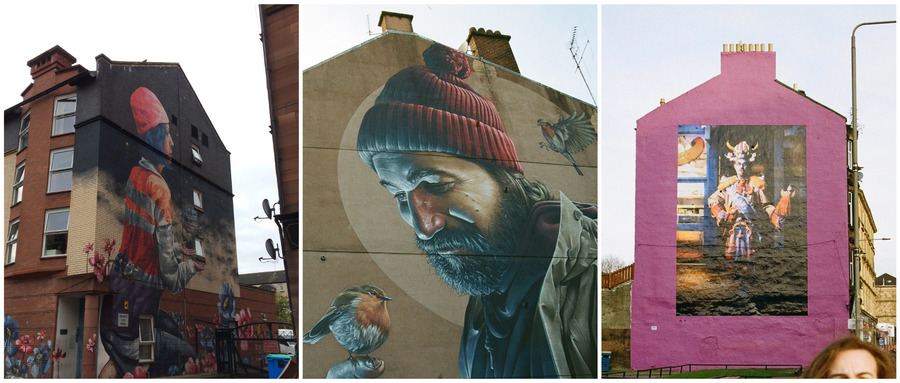
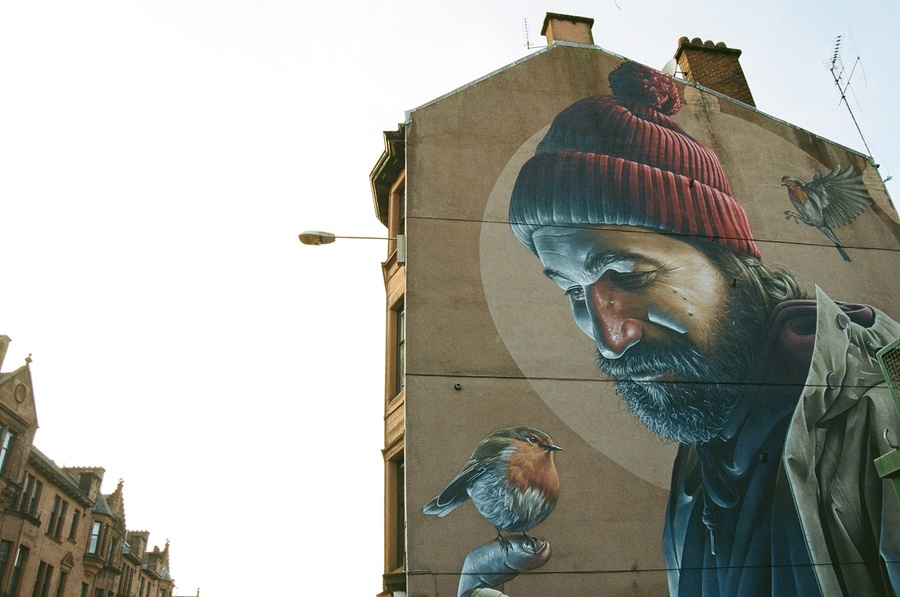
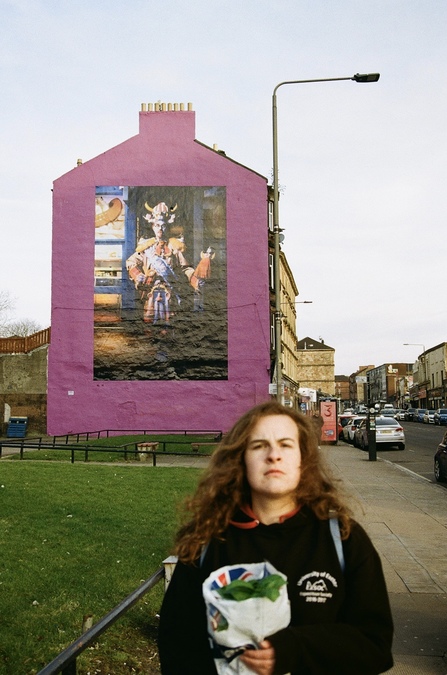
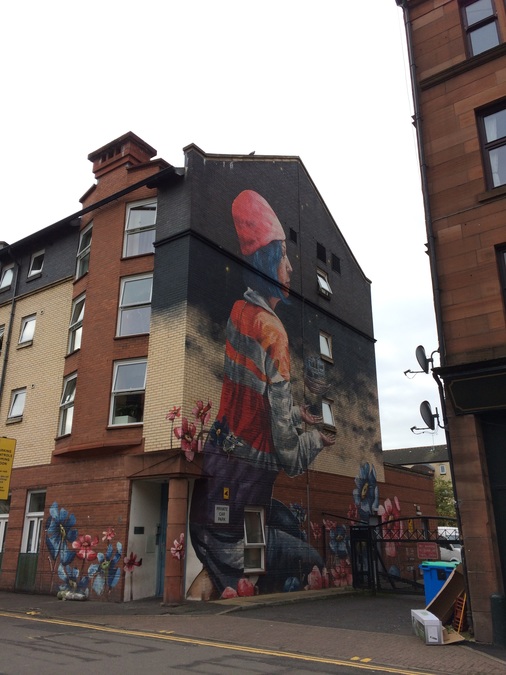
When I first moved to Glasgow, I pieced together the city through its murals. Through my homesickness, I found Saint Mungo and his resurrected robin near the necropolis, Rachel Maclean’s rendition of the Big Yin round the corner from the Barras, and a blue-haired giant within arm’s reach of the River Kelvin. That was 2017. Fast forward to a 2026 fever dream, and the internet is losing its mind over the news that Glasgow City Council approved plans for a new mural on a wall in Elmbank Street. Here’s the fever-inducing thing: the applicant, Derek Paterson, used AI to generate a mock-up of the design for the proposal.
It all started with one eagle-eyed Redditor posing the question, “Is it just me, or does this proposed mural for Elmbank St look AI-generated?” The composite image is of an idyllic landscape gone slightly wrong: a man (not unlike Robert De Niro, as one social media user points out) releases a double-beaked American eagle into a wind turbine. On top of the incongruous nods to America, the design conjures up a cheesy representation of Scotland, reminiscent of the kind of art you might find in an Airbnb in the Highlands (will we ever be able to escape knock-offs of The Monarch of the Glen?).
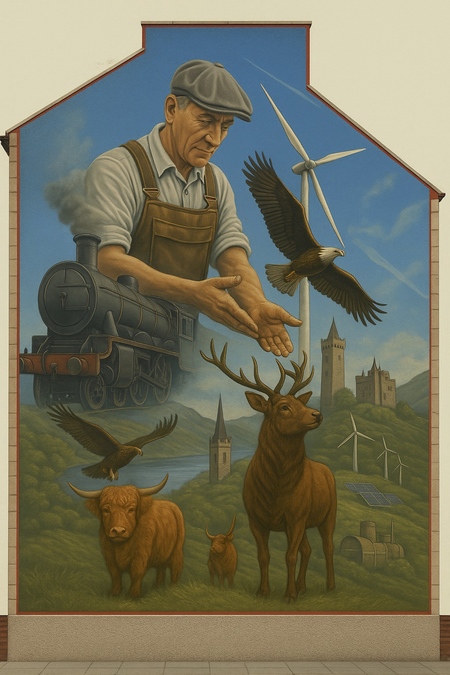
The illustration provided by Balmore Estates in their planning application to Glasgow City Council.
The National broke the news, leading with a provocative title: 'Plan for massive AI-generated mural given green light.' The article is behind a paywall, and without all the information readily available, many social media users misunderstood, believing the final design to be generated by AI. Honestly, same. I was so ready to egg this AI mural.
It transpired that Glasgow street artist Rogue One (aka Bobby McNamara) was approached to create the mural in 2025, but he didn’t have time to provide a mock-up for the planning application. Paterson, the applicant, provided an AI-generated version instead. While we have been reassured that no AI will be used in the final design, a nerve has nevertheless been struck in the creative community.
Why does the idea of an AI-generated mural hurt so much? Globally, murals have a long and rich association with activism and community empowerment. A democratic way to experience art, murals occupy public space – sometimes without any planning permission in place – to convey disruptive, spirited messages, from welcoming refugees to condemning police brutality. While mural art has its roots in the twentieth century, during the COVID-19 pandemic and the 2020 Black Lives Matter protests, we once again saw the power and potential for murals to activate calls for political change. By 2022, some 2,700 memorial murals for George Floyd could be found across the world.
AI crowdsources – it scrapes the internet to provide an average approximation of what is requested by the user. But the feeling of community can never be crowdsourced. It is baffling, then, to turn to an AI system to generate something that is so beautifully human, knowing that the likes of ChatGPT reproduce society’s inequalities by absorbing human biases and amplifying them.
Glasgow’s muralled streets are always evolving, reflecting and channeling the needs of the local community. Take the Albert Drive Community Mural, for instance. In 2024, Tramway commissioned the mural in partnership with the Gurdwara, involving the voices of the Pollokshields community, including the Glendale Women’s Café and children from the local primary school. Executed by artist Molly Hankinson, the kaleidoscopic mural celebrates Pollokshields' history of collective action, particularly in the fight against racism. The mural is a stone’s throw away from Kenmure Street, where, in 2021, hundreds of locals gathered to successfully stop two Sikh members of the community from being taken away by immigration officers during a Home Office raid.
As far-right views surge and are normalised, community-designed initiatives are needed more than ever. Murals are a striking way to stand up against the political scapegoating of groups and individuals. In a way, it was heartening to see the Scottish creative community cause such a stink about the AI mural online. Ethical concerns around AI-generated art – such as income and job loss, and intellectual property infringement – were raised. We can’t use AI as a shortcut to generate an 'artwork' that resembles community; it will always fall short of the human experience of working together to challenge the status quo.