Political Highlights: On Felicity Hammond and Jamie Cooper's new exhibitions
Two solo exhibitions by Felicity Hammond and Jamie Cooper highlight their political points with vivid colour
Colour is often seen as one formal detail in an artwork. Felicity Hammond and Jamie Cooper seem to question this logic. More than attractive elements, appealing to the eye and uniting a composition, these artists embrace bold colour choices to root their artworks in specific sociopolitical contexts, immersing viewers in the complexities of their critical points of view.
Felicity Hammond: AI, Arizona orange, and green screens
Hammond is concerned with the landscape of artificial intelligence (AI). Throughout her artistic practice, she maps how digital media is made, connecting screen-based images to real-world sources; the elements and minerals, the industrial players and faceless labourers who underpin the production of technological systems. Hammond’s exhibition V4: Repository at Stills builds on a series of research exhibitions held across the UK, in Brighton (2024), Derby and London (2025), each exploring how digital images morph and malform in relation to the physical world. At Stills, the data gathered through this series has been artistically deposited to create a surreal stage set. Recalling a factory, or dystopian IKEA, this set-up aims to haunt machine learning systems and the way digital images are made by connecting these technological processes with the ecological impact of industrial mining.
Hammond’s orange is a shade of Arizona, highly saturated and noxious. The colour appears throughout V4: Repository, on the installation’s cage-like architecture as well as in the photographic prints affixed to this. Evocative of the desert spaces where mines are often found, this orange also recalls the paint colour used to protect industrial machinery from the corrosion caused by processes of geological extraction. Further, for Hammond, the lucidity of this colour resembles the acidic byproduct of industrial mining, runoff, a toxin which transforms whole ecosystems into wastelands. Applied to Hammond’s exhibition scenography, this orange highlights how the extraction of ecological materials, such as lithium, silicon and other elements essential to the manufacture of computers, is coeval with the production of digital images; we cannot have a digital world without the wrecking of our own.
The green-screen-green walls in V4: Repository work in a similar manner, pointing to both the natural world and how images are made through CGI technologies. Alongside this structural use, Hammond’s green features in the photographic prints that punctuate the installation. Used in the backgrounds, in the floors and frames of these ambiguous scenes, this green appears as a mist, out of which labouring figures creep. A direct reference to the pixel, grids recur throughout these compositions making each image look like a photo held in a state of loading, a green state, somewhere in between pre- and post-production. For Hammond, this state of flux is precarious, an allusion to the way digital data malforms as it migrates across different storage systems, further connecting digital and physical worlds.
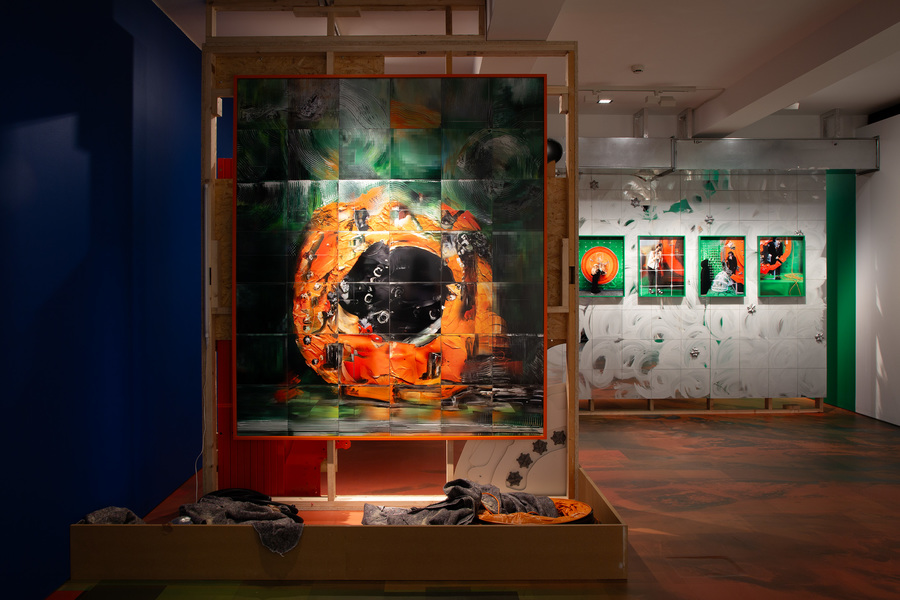
V3 Model Collapse, Felicity Hammond. Photo: Kate Elliot.
Jamie Cooper: Pink light, big characters and political power
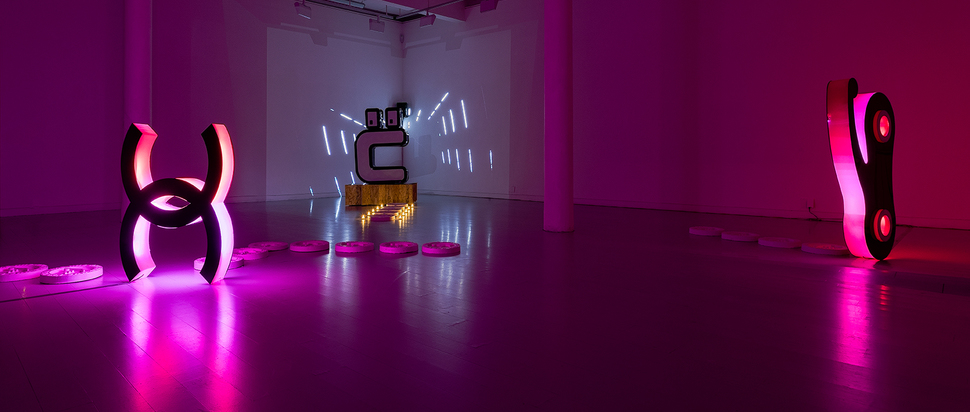
From orange to green to pink. Jamie Cooper's solo exhibition at Fruitmarket, LEVELLING UP, is set to be another occasion where bold colour is used indicatively. Cooper often creates kitsch-looking sculptures that recall brand or public service provider logos (the kind of illuminated signs found in shopping centres). Alongside newly produced audio and moving image artworks, LEVELLING UP will feature a number of these ‘characters’, as Cooper calls his branded sculptures, all situated within a space floodlit dewy pink.
The exhibition’s title is a direct, satirical reference to the Conservative Party’s 2019 Levelling Up policy, which was aimed at spreading opportunity more equally across the UK by increasing public spending in working-class, 'left-behind towns'. It was ultimately a non-starter. As with his previous artworks, such as Nomnom (2021), which transformed the aesthetics of retail into an icon of liberation, for this exhibition Cooper will create a number of sculptures, as well as audio-visual artworks, which aim to subvert this Conservative rally cry; transforming the policy slogan into an assembly of disenfranchised figures, still waiting for the political promise that Johnson’s Government preached. Cooper will use pink light to flood Fruitmarket’s industrial Warehouse gallery, seemingly riffing on the way political rhetoric acts as an affective smoke screen; a tool to gain voters by appealing to emotions rather than the ability to deliver civic action.
Alongside the allusion to UK politics, the exhibition title alludes to video games to mark a user's progress, new growth and power. In this way, Cooper accentuates the gamified nature of much contemporary politics, where characters emerge as gluttonous icons hunting for power through a pink cloud of their own creation.
Amongst a flood of other physical and theoretical details, colour operates across Hammond and Cooper's artworks to highlight key political motivations, making the complexities of their critical points of view visceral and engaging.
Felicity Hammond: V4 - Repository, Stills, Edinburgh, until 7 Feb
Jamie Cooper: Levelling Up, Fruitmarket, Edinburgh, 13 Dec-18 Jan