DJCAD Degree Show 2026: The Review
Art students at Duncan of Jordanstone in Dundee reckon with meaty topics: state neglect of social housing, sleep under late capitalism and the increasing presence of AI in filmmaking
The Duncan of Jordanstone College of Art and Design annual Degree Show ran from 23 to 31 May, and featured works by over 400 final year students. The Fine Art and Art & Philosophy students showcased their work across four floors in the Crawford Building, where there is a deep and multifaceted investigation of materiality and multi-modal forms, which are grounded in a sense of place. Works span themes of fragility, selfhood and the documentary, breaking down traditional boundaries across media.
In the entrance to the Cooper Gallery, Matthew Tilbrook’s clay spherical sculptures resemble planets and moons – cracked and porous – and are displayed alongside his photographic experiments. His figurative photographs show giant rubber exercise balls suspended in mid-air, which were themselves used to mould the cardboard papier-mâché spheres that hang from the opposite wall and sit on the gallery floor. Another series of photographs that look like celestial diagrams are Tillbrook's photographs from inside the cardboard sculptures, which capture their intricately textured surfaces against the impression of the exercise ball’s concentric circles. Tillbrook writes that his work is about the “investigation of each material’s possibilities, limitations and accidental outcomes,” interweaving the relationship between sculpture, deep time, finitude and his own experience of chronic illness across material processes.
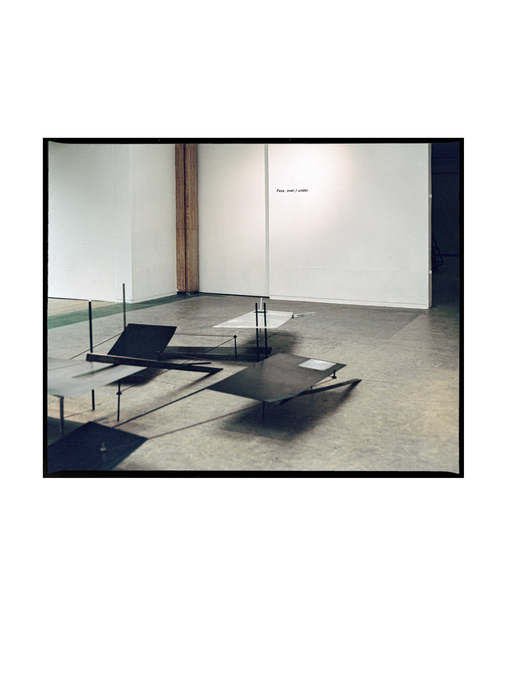
Luke Kelman, Pass, over / under (2026), courtesy of the artist
Luke Kelman’s process is also directed through a multitude of mediums for his installation Pass, over / under, which focuses on a motorway overpass. The central floor-sculpture consists of sheets of aluminium and steel at a series of angular planes, echoing the architectural form of the highway. Kelman states that his work is “an experimental portrait of site which holds an essence of the place,” deploying the physical materials of the highway. Road salt oxidises aluminium sheets and white thermoplastic road marking paint is melted onto steel rivets, which resemble crash barriers. Photographs of the overpass are etched onto the sculpture’s surface to provide an indexical trace of the site itself. The wall pieces also incorporate photography, for which Kelman used a specialised colour film process that takes a positive print onsite. Kelman’s use of photographic film dovetails with his use of cassette tape, onto which a site recording is transcribed and loops around the floor-sculpture, continuously deteriorating as it gathers dust over time.
Approaching analogue processes from a different perspective, Kirsty Scott’s film and installation To the Moon draws from Jonathan Crary’s book 24/7: Late Capitalism and the Ends of Sleep (2013) to explore sleep as a rebellious act against its inevitable commodification. Scott’s black and white film features a woman who is in the middle of an endless dream, with a piano soundtrack written by her collaborator Gillian Walker. To narrate the story, Scott films a typewriter as it transcribes the script’s text, its mechanical levers faltering periodically as the type hammer becomes stuck. Finding inspiration in early silent films, Scott explores the practical effects and physicality of early cinema, whose imperfections are reminders of the human and rebel against the ever-increasing presence of AI in filmmaking and photography.
Ambivalent feelings on the changing landscape of Dundee are foregrounded in Abbie Fordyce’s social documentary works. Her architectural portraits map decaying and abandoned buildings across the city. A lifelong Dundonian herself, Fordyce finds it “deeply disturbing how some places have remained standing yet have been subject to change”. These neglected sites show signs of their past lives; one photograph shows peeling paint above a boarded-up door front, which reads, “Welcome to the Westies”. Once a bar by the Overgate shopping centre, Westies also happens to be the place where Fordyce’s parents first met. The artist foregrounds the way in which remnants of the past can be swiftly overwritten by focusing on the contemporary graffiti tags that adorn the stone walls of the buildings and places she photographs.
Nina B’s work similarly researches demolition and deterioration, in this case in the context of the Scottish post-war new towns, and the failed ambitions of social housing and brutalist architecture in the UK. Her work translates the photographic to the sculptural, printing images of neglected buildings onto fragile and transparent materials, as well as robust construction material, to, as she describes it, “highlight the landscapes’ perceived solidity with its tenuous reality”.
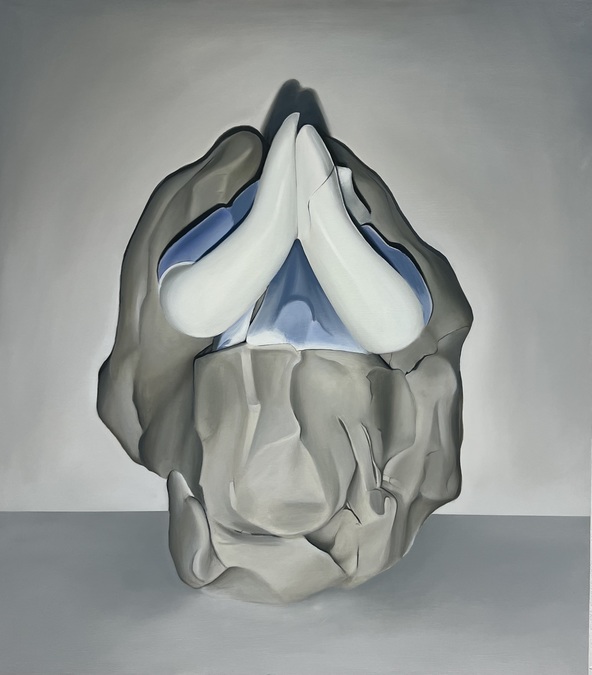
In Place (2026), Fay Cardigan, courtesy of the artist
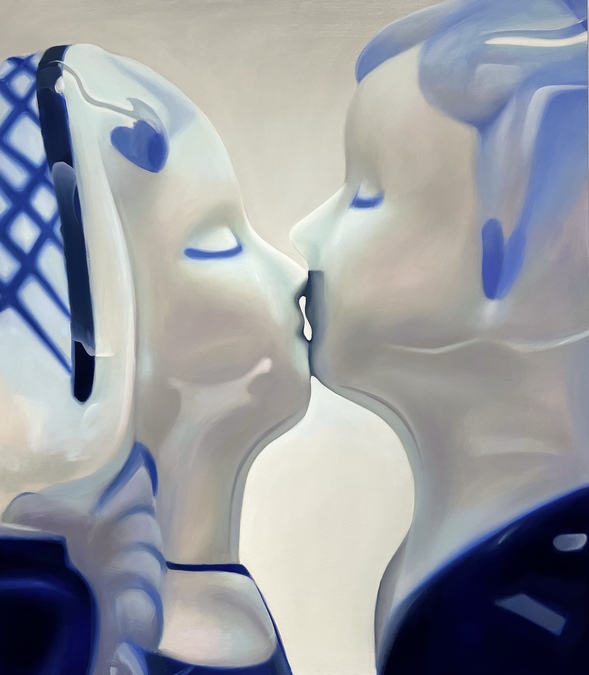
Domesticity and the elevation of the everyday are key threads explored by several painters in this year’s show. Fay Cardigan translates chintzy ceramic figurines found in the home to a monumental scale in her large-scale paintings. Cardigan carefully mimics the sheen of the painted ceramic surface, against which she incorporates plasticine as a tampering and contrasting material to cover some of the figures. In one painting, Cardigan depicts the arms of a figurine in prayer whose hands show a crack, and its body is smothered with malleable plasticine. In another work, two figurines kiss, but the hardness of the clay means their lips do not touch, coalescing between play and disturbance, femininity and fragility.
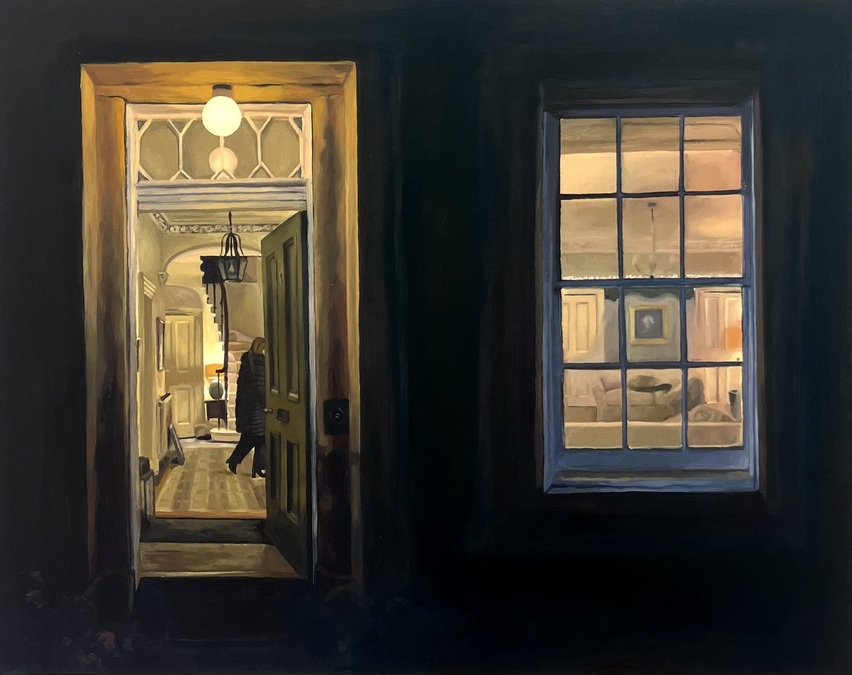
For painter and printmaker Kate Mcintosh, the home is a space to investigate her relationship with her mother as the domestic becomes a space of both “comfort and confinement”. Mirrors, windows and doors feature as thresholds and frames through which she paints quiet portraits of her mother. In a small-scale work, her mother’s presence is legible only by her unmade bed, reflected in a portal-like circular mirror. A larger work focuses on the intimacy of the everyday on the bathroom sink, which holds toothbrushes and an open make-up bag; her mother’s shadow appears as a reflection in the mirror above.
Beyond the seven artists highlighted here, DJCAD’s class of 2026 are guided by experimental processes to find new possibilities for a range of materials and forms. What is striking is a commitment to the present against the uncertainty for young artists working in Scotland today; intimate observations of the everyday and atmospheric landscapes in flux offer quiet sites for navigation and resistance.