Craft is Cancelled: On ECA's cuts to its craft courses
Edinburgh College of Art intends to close its undergraduate degrees in craft disciplines. Our editor-in-chief, an ECA graduate, explores why this is a short-sighted, disastrous decision, with members of Scotland's craft and design community

When Edinburgh College of Art announced in September that they were closing their degree programmes in Jewellery and Silversmithing, Performance Costume and Textiles, there was an outcry of grief, outrage... and confusion. Why would these courses, which are at the very heart of the art school, among the most successful in terms of graduate employment, and internationally renowned, be cancelled? Months have passed, and the institution remains immovable, inscrutable in its decision. Motions have been lodged in parliament, petitions have garnered thousands of signatures, alumni have written movingly of how the programmes altered their life paths, industry figures around the world have spoken out in support of the lost degrees… Yet ECA and its handlers at the University of Edinburgh hold fast.
It’s been widely reported that governance procedures were bypassed to accelerate the course closures, with the university’s own Senate compiling a 24-page report on their exclusion from the process by University leadership. An open letter from School of Design staff states that leadership have been weaponising confidentiality to quash dissent. They say: “We deplore the way that ECA managers have allowed this infantilising, fear-mongering and hostile tactic to have been used here on us (and themselves) to achieve compliance within systems and processes that we know are publicly questionable.” Irene Kernan, Director of Craft Scotland, expresses the collective shock of the sector: “For this decision to be made without consultation with staff and students, without engagement with industry and without having a full handle on the potential cost savings, illustrates an uninformed management process outsourced to consultants who do not have a proper understanding of what they are consulting on.”
I send some questions to ECA to clarify the data around applications, demographics, and the level of due diligence that had actually been completed before this decision was reached. Can I see the EDI report? The industry consultation report? The report on the projected sectoral impacts in Scotland and beyond? Who has made this decision – anyone with an actual background in any of these specialisms? Professional subject knowledge should be the minimum requirement, but apparently they spent £435,660 on ‘strategic management consultants’ instead.
I didn't receive any satisfying answers to my questions, just a lot of obfuscating business speak and links to evasive statements published by university leadership to justify their cultural vandalism. As a graduate of ECA, it is saddening and enraging to see this place that felt like a home of creativity and inspiration hollowed out by corporate management processes.
Attempting to apply a veneer of logic and progress, ECA say: “Design has changed significantly in recent years as developments in technology have reshaped professional practice. Skills development in both digital and traditional media is increasingly important for our students, and we must respond to these evolving needs while continuing to deliver high-quality education that remains relevant and sustainable.” What does this mean? 3D printing? AI? Sending fabrication overseas? If the design staff weren’t consulted, if no one can offer any evidence of industry professionals having been consulted, what is this assessment based on?
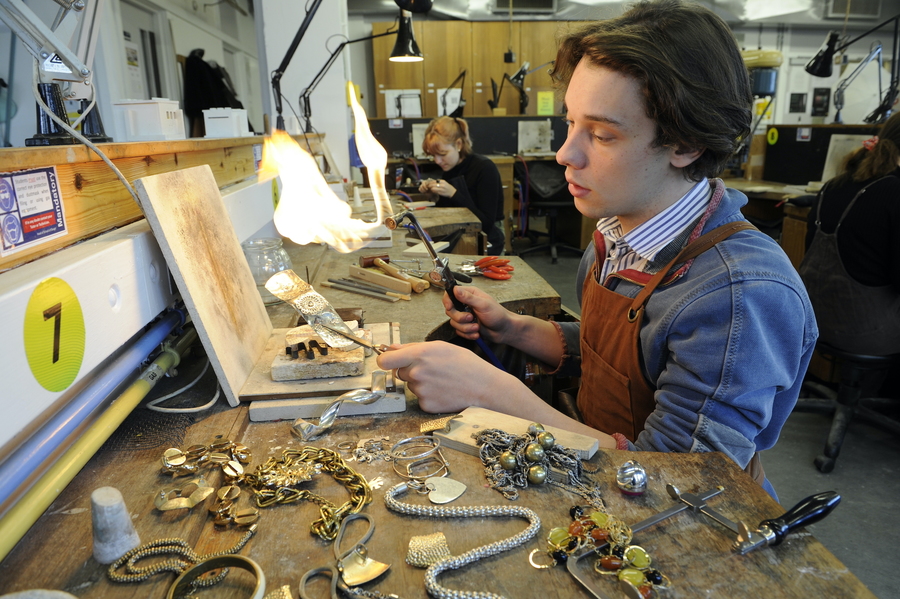
Former ECA Jewellery & Silversmith Students Ramsay Pagett (foreground) and Honor Dodd (background) at Edinburgh College of Art. Photo: Colin Hattersley for Scottish Goldsmiths Trust
Design critic Hugo Macdonald, whose Bard studio in Leith fosters and promotes Scottish craft, offers a historical context. “Over time we have built industries of global renown and significant economic might on our textiles and metalwork, our performance and ceremonial dress,” he says. “These industries have waned as our rampant capitalised and globalised economic hunger has led to factory closures, outsourcing and off-shoring.”
Data I requested from ECA included statistics on gender, class and nationality (Scottish, rUK, international). These vocational subjects offer a pathway to employment (both in established businesses or self-employment), a pathway which is less clear in many of the art school’s other disciplines and indeed the majority of the University’s College of Arts. They’re popular options for Scottish students who want a creative career but don’t have the means to, for example, study in England with the unsubsidised tuition fees, or for students from the Lothians or Fife who wouldn’t be able to afford accommodation costs if they left home. Numerous industry figures have spoken out in support of the quality of graduates, of how consistently they would be hired. Removing this pathway feels like yet another step towards the erasure of people from working-class backgrounds in the creative industries.
Renowned design curator Michelle Millar Fisher describes the cancellation as displaying “a true poverty of imagination and insight into what makes Scottish culture world class, into what makes us all tick as humans – and is pulling up the ladder behind us by the very people afforded opportunities for explorative study when they were young." She continues: “Decision-makers like Principal Professor Juan Cruz and senior university leaders such as Professor Sarah Prescott studied for free or low cost on the very types of courses they are now responsible for closing. It is not ethical to benefit from such educational resources to then turn around and remove them for next generations. This is not what we do in Scotland. This is not who we are.”
In an open letter addressed to Cruz, a collective of Performance Costume alumni pull no punches. “You will be disadvantaging students with a clear ambition for their professional path, depriving Scottish students of opportunity, and dismantling a pathway into industry, as well as destroying a hub of creativity and specialist education that is a valuable part of Scottish heritage.”
So why is this happening? The aforementioned tuition fee subsidy means Scottish students don’t bring in as much revenue as international students, and neither do those from the rest of the UK – degree show data suggests these two groups form the majority of the cohort on the threatened degrees, compared to 50% international students across Edinburgh University as a whole.
These programmes are technical and workshop-heavy. That’s expensive. Tools are expensive, machinery is expensive to run. If, hypothetically, your focus was on generating a percentage of profit on each course rather than on the wider, less tangible benefits of skills, culture, individuals graduating with the tools to build a meaningful career in the place where they live (things that are less easily demonstrated to management consultants or university leadership with zero applied arts education)… If, hypothetically, you had fallen under the thrall of Excel spreadsheets, KPIs and business nonsense and forgotten what an art school is, what education is… It’s understandable that you would think this decision was justifiable.

An outfit at ECA's Performance Costume degree show in 2025. Photo: Brian Hartley
I speak to Dr Peter West, who was ECA's COO at the point of the college's merger with the university, for an insight into the evaluation process. He says: “University courses need to be evaluated by rather more complex factors than contribution rates. Reputation, employability, synergies with other subjects and external views from the sector in question should all be taken into proper account.” He continues: “Traditionally, universities have been happy to cross-subsidise so that areas rich in overseas students meet from their surplus the costs of those which are not, to preserve the special diverse character of the institution... Courses such as Jewellery are simply different from courses elsewhere in the wider university and it is a category error to judge their viability by the same criteria.”
Macdonald also understands the consequences of these decisions implicitly. “We all know that numbers are not the full story of anything. The axing of these historic and unquantifiable courses at ECA is symptomatic of the perverted world order we are living in. You could look at textiles, jewellery and costume design as frivolities. But these are powerful forces in Scotland’s cultural traditions and identities.” He continues: “The obvious madness, however unquantifiable it may be, is that we are sacrificing the roots of three inestimably human courses at a time when we are told everywhere that our human skills are what we must preserve and safeguard over anything that AI could potentially master in our near-future.”
Richard McVetis, textile artist and lecturer at the Royal College of Art, says: “Textiles doesn’t derive its value from the other disciplines. It provides the gateway into them. Value cannot and must not be measured in monetary terms. Fee income, students recruited and graduate salaries are just one facet of what a discipline can offer. The knowledge in the hand, the craft traditions passed from one generation to the next, and the way one material discipline can strengthen the others are things you can’t quantify. If we only count the things that are easy to count, we will be closing the very things that make an art school more than a collection of courses.”
The gendered nature of the cancellations is also impossible to ignore, although it is unclear if the decision-makers have spent much time considering why designations around craft and art exist, how the imposed hierarchies reflect a patriarchal system, or what their own prejudices might be. There is really no evidence of decision-makers having any formal knowledge of applied arts – University leadership includes an English literature academic, a physicist, and a doctor, alongside those expensive management consultants. Even Cruz is a painter by background, which is, again, not the same thing.
The staff and students of all the programmes targeted are predominantly women. McVetis points out that “Textiles is overwhelmingly studied, taught and led by women and so the impact of the closure of Textiles is going to fall disproportionately on women. Who is going to stay and who is going to have a voice in the institution?”
The University claims that the taught skills will be retained through course electives, a concept that is inherently flawed – it takes an extremely long time to train in these disciplines. A four-year degree in Jewellery and Silversmithing equates to roughly 5000 hours of workshop time (“ECA does not use ‘bench time’ as a metric or measure ‘skill levels’ in this way,” says a spokesperson). Even developing the portfolio to start the process takes a really long time – anyone who has applied to art school can tell you this. It is not a system that can be treated in the same way as, for example, the constituent courses that make up an English literature degree. To put it in terms those decision-makers might understand, it is like saying you can do an elective in Shakespearean sonnets, open to anyone, no need to be able to read English. Or, you know, I’m doing an elective in brain surgery, and I don’t need to have studied the anatomy of the brain to have a shot.
The Performance Costume alumni emphasise the nonsense of the elective replacement in a second open letter to Cruz. “Costume is a specialist art form,” they write. “You maintain that it can be taught as an elective without harming the employability of graduates who hope to work in film, television and live performance. It cannot. More than 700 professionals have signed our open letter, and the industry professionals backing this campaign are all clear that this training cannot be replaced by something shorter or more general. Once the degree is lost, so is the route into this profession for the students who would have taken it.”
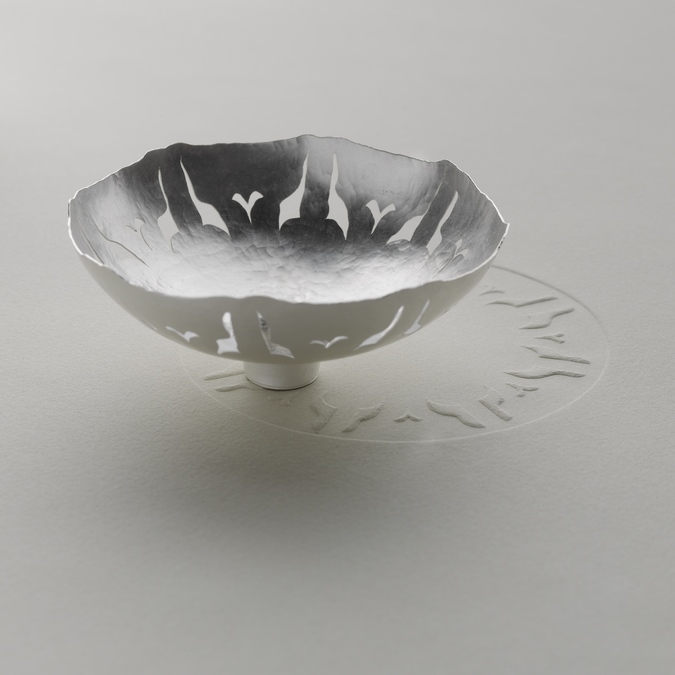
Distorted bowl by Eleanor Scott, a 2026 graduate of the ECA Jewellery and Silversmithing course. Photo: Shannon Tofts
Jewellery’s future is apparently as an elective within the Product Design degree, a decision that was surely made by someone with no knowledge of either jewellery or product design. Natalie Ryde, a Jewellery & Silversmithing alumna who has built a successful and varied career as a jeweller, teacher and fine artist, points out the fundamental ignorance at this suggestion's core. “Specialist craft and applied arts courses are the antithesis of product design. Jewellery is worn by people in cultures around the world and evidenced in the archaeology of early human development. The body is the first site of self-expression. It’s a tacit language spoken globally and has the potential to connect cultures and examine histories. Like textiles, jewellery travels with people, and the legacy of pattern and style tells a story of cultural development.” It is not an exaggeration to suggest that the destruction of our craft education threatens the continuity of our national cultural identity.
Ryde elaborates: “Once we lose these hand skills, they are gone. They are no longer handed down, to any great extent, through families. There’s a craft extinction list.” She continues: “Scotland sells itself through individuality, through pride in heritage and culture. We’re ripping the heart out of culture at the moment, but we need it to feel human. Increasingly we work to function, to survive and are told that culture is too expensive, too frivolous… We need culture to connect with others and to feel a sense of self, community and national identity – a national identity that isn’t about flags and protectionism, an identity of what we can do, not what we can’t.”
Kernan warns that the dissolving of these courses could be detrimental to our industries' international standings. “Scotland's rightly deserved international reputation for craft excellence is seriously under threat with the closure of these undergraduate degree programmes,” she says. “To remove opportunities for young people in Scotland to contribute to the country's craft identity while realising their own creative potential demonstrates a complete lack of understanding of the value of these craft-based degrees.”
The impact of the loss of these skills in Scotland is incalculable because no one thought they needed to calculate it. Stacey Hunter, Craft Scotland’s Creative Director, who originally trained as a goldsmith, draws a comparison with the felling of the Sycamore Gap tree. “No one thought to build a fence around a tree that had been there for a century. Why would they? Why would anyone destroy it? It's an act of vandalism. But then, suddenly, someone does and you realise that it can’t be replaced. This is a balanced ecosystem where skills are taught from one generation to the next. When you destroy that, there’s no coming back.”
When an art school becomes more about profitability than being an art school – a space for experimentation, cross-disciplinary learning, magical thinking, an unquantifiable mixture of tangible and intangible creative skills – then it has lost its soul. The Edinburgh College of Art I attended was a profoundly inspiring space, and these courses were at the heart of that. It is devastating to see them summarily cancelled by a management structure that doesn’t even understand the value of what it is destroying.
Craft Scotland has a petition to save these craft and design courses at ECA. To make your voice heard on the subject before a review by the University Court on 7 Dec, head to craftscotland.org or on Instagram @craftscotland