Shame Parade: Bugarin + Castle's Scotland + Venice exhibition
At the Venice Biennale, Bugarin + Castle's Scotland + Venice pavilion reverberates against rising transphobia, reimagining cross-cultural traditions of public shaming through sound, sculpture and spectacle
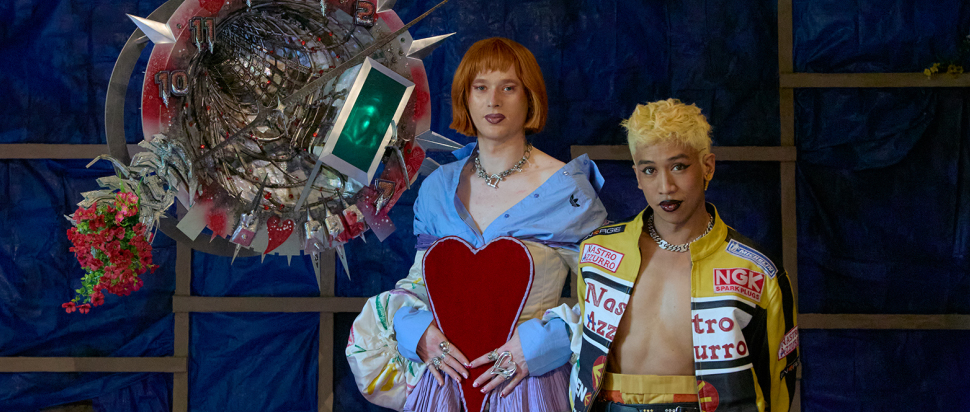
Tucked within San Pietro di Castello, an otherwise unassuming doorway draws visitors into the Scotland + Venice pavilion through a narrow corridor – as if passing through a portal – that opens onto a garden and the gallery beyond. A haunting sonic landscape of breathing, heaving, gulping, and swallowing reverberates through the passage, building a sense of anticipation before arriving at the exhibition itself. There is something about a pull inward: an auditory, visual and spatial beckoning that draws the viewer deeper into the space, another timeline, or another state of perception.
Marking Scotland’s return to the 61st Venice Biennale after a four-year hiatus, the 2026 Scottish Pavilion presents Shame Parade by Glasgow-based queer and trans artist-duo Davide Bugarin and Angel Cohn Castle, who first began collaborating over a decade ago through Castle’s cabaret company Pollyanna. This year, the Pavilion is curated by Morven Gregor and presented by Mount Stuart Trust.
Using sound, spatiality and performance to explore how identity and memory move through changing structures of control, the exhibition takes its title from the historical European practices of 'charivari', 'rough music', and 'scampanate', alongside post-Reformation Scottish traditions of public shaming, in which people accused of moral or social transgressions were publicly mocked and ridiculed through parades, effigies, impersonation, and the historical use of cross-dressing – spectacles used to enforce social conformity. Shame Parade reimagines these histories in relation to the hostility faced by trans communities, considering how shame operates today, while also acknowledging its layered relationship with drag, cabaret, queer culture and trans identity. Sound and spectacle extends into the exhibition’s approach as well, drawing on theatrical excess, glossy surfaces and camp aesthetics.
A sense of distortion and disorientation runs throughout the exhibition through both imagery and architecture. Rooms bleed into one another physically and optically, pulling viewers through three-dimensional perspectives and disjointed encounters, producing a feeling at once interior and exterior, architectural, anatomical, and mechanical. In the first room, blue tarpaulin wraps around spalling brick walls, held in place by wooden stretcher frames that partially expose silver corrugated panels beneath. Vases of artificial plastic flowers are placed against these harsher surfaces, suggestive of vulnerable interiors of temporary shelters and shanty dwellings.
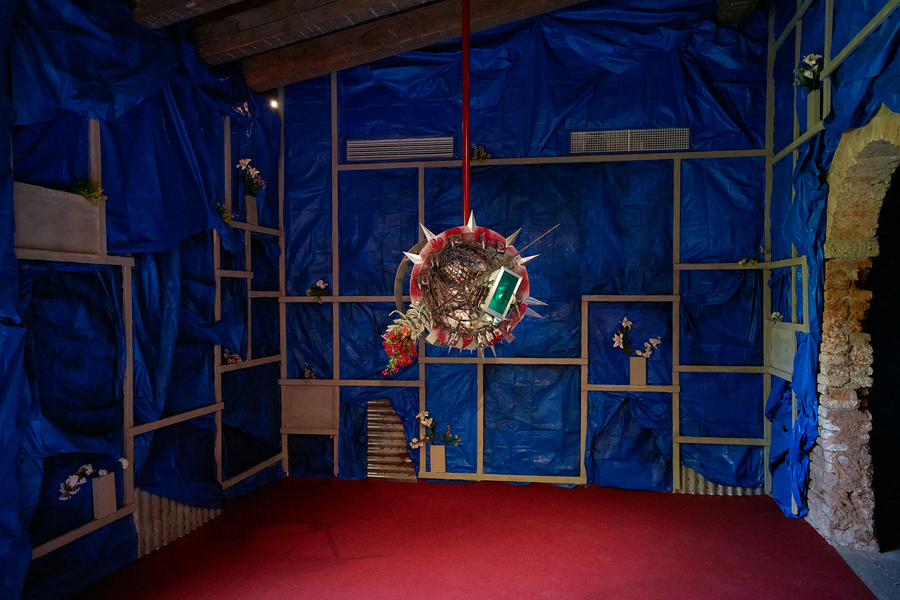
Bugarin + Castle, At Certayne Tymes, part of the exhibition Shame Parade curated by Mount Stuart Trust for Scotland + Venice at La Biennale di Venezia in 2026. Photo: Dimitri D’Ippolito, courtesy of the artists and Scotland + Venice
Suspended at the centre here is At Certayne Tymes, a clock-like metal sculpture, somewhat resembling a murex seashell. Covered in sharp lines, encrusted spikes, grips and grids, the work embodies time, its central vortex pulling one unto itself. Resembling public clocks, the piece reflects on time as a structure of control, as well as decorative symbols of authority, while reinterpreting the word 'clock' through a queer and trans lens: to be 'clocked' meaning to be recognised as trans, often involuntarily. The work further reflects on mortality, memory and self-determination, exploring how queer and trans lives often experience time differently, through delayed transitions, chosen timelines and alternative forms of becoming.
On the opposite end of the room, a large structure acts as one of the clearest cultural anchors within the space, drawing on Bugarin’s Filipino background. Nocturnal Amusements is a jeepney-inspired façade, assembled in bright colours and layered with painted text, graphics and anime visuals that echo the excess of ornamentation, slogans and graffiti found on Manila’s public transport. Complete with handles, rearview mirrors, number plates, headlights and a tyre, the structure features the phrase 'Are You Discreet?', and a central viewing window that draws the gaze through a tunnel-like perspective; yet another portal moving from the interior to exterior. At its end, curiously, sits a miniature diorama of an unkempt domestic backyard space – comprising scenes from the Manila North Cemetery and medieval charivari imagery. With the installation physically cutting across two rooms, spatial movement becomes part of the work requiring multiple viewpoints to understand it, suggesting that identities, histories, and experiences cannot be fully grasped from a single perspective.
In a corner of the room sits an easily missable pile of what appears to be discarded waste. Titled Pride Debris, the material was collected over the course of a summer from what was left behind after Pride parades across Scotland: fragments of banners, decorations, plastic and paper waste, tin cans, and other remnants of celebration. Acting as an archive, these objects from the parade trace queer public life through joy, exhaustion, political struggle and disappearance.
The second room opens onto a single print on metal, lined at the bottom right with shiny embellished acrylic nails, alongside a five-channel film titled Submit to Sound, both of which explore the concept of the trapdoor, referencing 'trap' as a slur historically directed at trans people. Originating in anime subcultures, the term frames trans and gender non-conforming people as deceptive, carrying deeply violent implications.
The film, presented as a 20-minute loop and staged like a pantomime with Bugarin and Castle as lead actors, depicts voice feminisation therapy sessions through arresting visuals and sound, where a trans woman instructed to raise her larynx is mirrored by a more exaggerated, 'draggified' double who lip-syncs and gradually overtakes her, ultimately causing her to fall through a trapdoor. It interrogates the pressures surrounding vocal performance and authenticity, asking what it means to 'shape' a feminine voice, who defines femininity, and how ideas of 'passing' or being 'clocked' operate under conditions of increasing scrutiny, which can force people into a kind of 'defensive crouch', leaving little space for introspection within queer and trans experience.
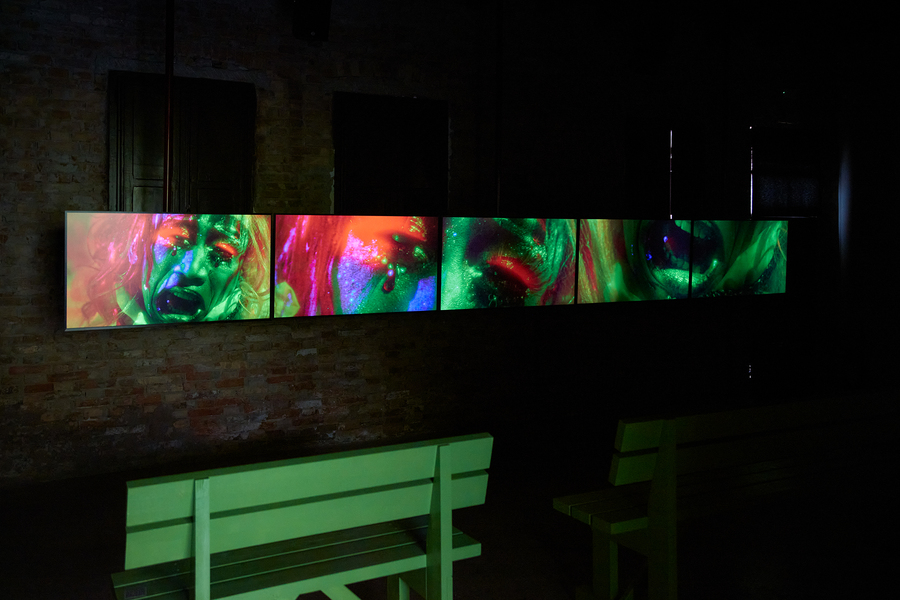
Bugarin + Castle, Submit to Sound, part of the exhibition Shame Parade curated by Mount Stuart Trust for Scotland + Venice at La Biennale di Venezia in 2026. Film curated by Mount Stuart and produced by Forma. Photo: Dimitri D’Ippolito, courtesy of the artists and Scotland + Venice
The research spans both Scottish and Filipino contexts. Bugarin, whose background is in architecture, was conducting architectural and sound-mapping work around Manila North Cemetery, a vast cemetery that also functions as a densely inhabited neighbourhood. Despite the intensity of the city, the area would be unusually quiet at night, as a result of increasing sound restrictions, including limitations on karaoke that is an important part of everyday social life in the Philippines. The artists first encountered the term 'charivari' in Article 155 of the Revised Penal Code of the Philippines; a public disturbance offence, but a colonial remnant inherited from Spanish rule. Originating in French and largely surviving within academic and legal contexts, this unexpected appearance of a European term within contemporary Philippine law indicated a link between colonial histories of shame, sound, movement, surveillance and public regulation.
The project further draws on other archival and historical references, from the 17th century satirical poem Hudibras by Samuel Butler, to William Hogarth’s 18th century prints that Castle studied at London’s Warburg Institute, both linked to charivari traditions. Hogarth’s prints influenced the film’s imagery and scenes in the diorama, alongside research tracing objects that were historically used to create noise and enact public humiliation in charivari processions. The artists also reference Robert Burns, who was made to sit on a cutty stool and responded to public shaming with poetry that celebrated the very behaviour for which he had been condemned.
This year’s Biennale In Minor Keys, posthumously curated by Koyo Kouoh (1967–2025), invites attention to meditation on quieter, peripheral, and often overlooked forms of expression, and alternative ways of sensing and inhabiting the world: 'The songs of those producing beauty in spite of tragedy. The tunes of the fugitives recovering from the ruins. The harmonies of those repairing wounds and worlds…'
Within this framework, Shame Parade emerges in response to an increasingly hostile climate for trans people in Scotland and across the United Kingdom. The Pavilion engages with the complexities of trans experience through the presentation of minoritarian voices and identities that cut through the contemporary political climate. By situating these within histories shaped by Scotland, the Philippines, and their overlapping colonial pasts, it takes on an outward-facing perspective and works across wider historical timelines.
Bugarin + Castle: Shame Parade, Scotland + Venice, Olivolo Castello 59, Venice, until 22 Nov, part of La Biennale di Venezia 2026