GSA Degree Show 2026: Fine Art
Students from the School of Fine Art have explored perception and scale across all degree programmes. Their installations invite immersion across diverse ideas, intentions and forms
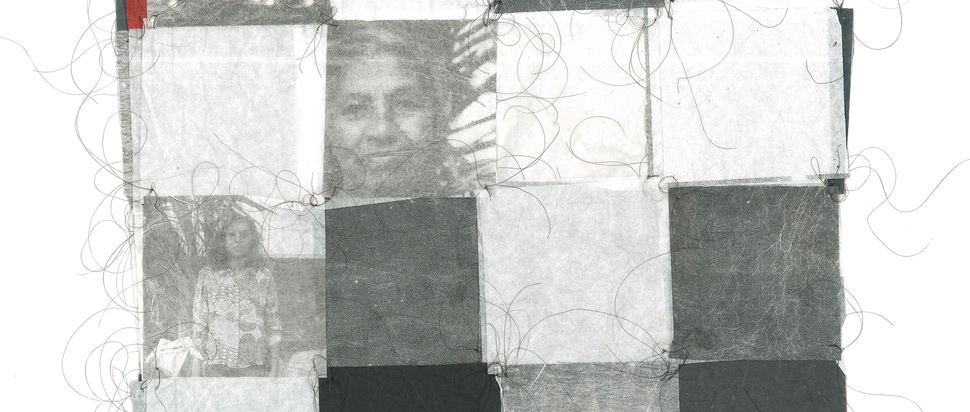
This year’s Painting & Printmaking students show a departure from traditional modes of abstraction and figuration, with interdisciplinary methods and unique material processes featuring prominently.
Malak Naseem’s work explores connections between material, heritage, craft and remembrance. Three tapestries on packing paper engulf the viewer, presenting archival images of Maldive newspapers, maternal affection and Dhivehi text. Assembled with strands of Naseem’s own hair, the fragility of these colonial histories is keenly emphasised.
In another departure from traditional painting, Joe Neil has constructed an installation featuring large-scale sculpture, ceramics and reclaimed AI video technology. Its centrepiece is a fossil-like centaur assembled from technological detritus. Suspended above water, the work is ironically framed as a 'fountain of youth,' critiquing Silicon Valley’s obsession with immortality.
Connor Draycott takes a similarly interdisciplinary approach, showcasing representational paintings alongside figurative wax sculpture. Draycott’s work investigates UFO sightings in his hometown of Falkirk, examining overlaps between conspiracy and local folklore. This instigates a personal examination of home and identity, wherein distinctions between the personal, archival, truth and superstition remain ambiguous. Lou Palmer also works figuratively, examining human reactions to loss. Palmer’s graphite drawings are interlaced with wood patterns, shifting her subjects between representational and graphic forms.
Returning to the medium of paint, Maj Olson engages with painting as a scientific and material process, investigating how substances react and transform autonomously. Layers of muted acrylic wash dissolve rabbit glue primer to produce intricate patterns. Olson’s works depict interiors devoid of human inhabitants, echoing her ceding of human control to her materials.
Finley Highton exhibits three works generated with a pen-plotter machine, opening the boundaries between printing, drawing, and photography. Small errors emerge organically, positioning Highton as a catalyst for autonomous technological processes. As image-making is increasingly shared between the human and non-human, Highton interrogates our definitions of agency and labour. In another use of technology, Angus Hamilton James creates 'conductive photographs': intricate systems that combineelectricity and light to produce photographic imagery. This work carries photography’s logics into a strange and mesmerising aesthetic territory.
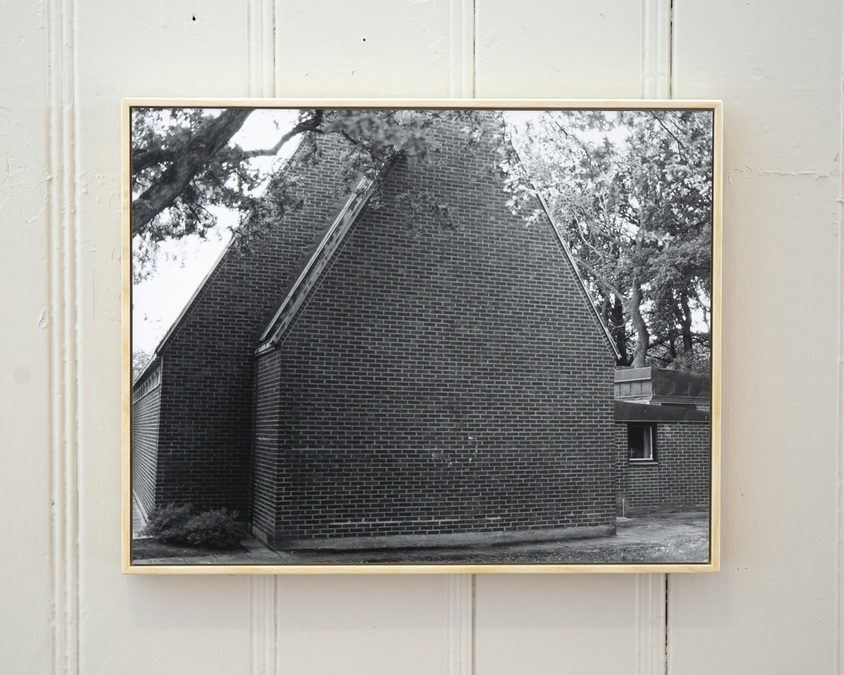
Cave, silver gelatin print, Isabel Bohlman, Fine Art Photography
This year’s Fine Art Photography students explore how the camera can alter and challenge perception, moving beyond traditional technical approaches. Jamie King reimagines perception through the layered materiality of his photographs and textual pieces, revealing alternative meanings that recontextualise the ordinary. It provides breathing space to reflect on throwaway phrases like “don’t worry” and the playful accidents of intersecting a banana with a circuit board, reflecting the natural and the absurd, as technology intrudes upon it.
There is a continuous perceptual flow within Isabel Bohlman’s installation that draws on a passage of consciousness in phenomenology. These ideas involve the experience of human perception as she technically modifies photographs, both by engaging with and rejecting traditional darkroom techniques, shifting the obvious focal point and mystifying the context.
Rita Rogers focuses on militarised landscapes that are hidden in plain sight. The camera becomes a counter-surveillance to the dystopian action of airsoft and the rehearsals of dramatised re-enactments, simulating the proximity of military operations. The photographs present the performance of a war that has not yet happened, and rooted in a similar research-based practice, Callum Harrison discovers the critical charge within spatial design. He explores the similar geopolitical power dynamics of the hidden and the apparent, woven into architecture originally designed for military strategy. The installation is materially layered, featuring double-exposed imagery of archival fireworks, thereby heightening the tension between militarised critical theory and its aesthetic reflection.
Betty O’Connell-Rogers’ project was shaped by the study of the innate human act of gossip, and its dismissal through the portrayal of a female-centred performance. The installation challenges idle stereotypes by embedding engraved acrylic sculptures with material and sound. These mixed media sculptures transform the space from human to material, building community through gossip that connects people by sharing perspectives. It reflects on why these acts have been negatively tainted and encourages acceptance of these relatable behaviours.
Jacob Flint Oliver also uses mixed media to transform their installation into an abandoned laboratory, built through a mania of self-created pseudo-scientific systems that reflect the unquantifiable research of a non-binary identity slipping through. The works derived from private performance have undergone systems to obscure readings, to be immersed in public viewing, and even to decode the measurement of 1000 wax spark plugs.
This year’s Sculpture and Environmental Art students have demonstrated a range of approaches to sculptural works, from initial sketches to transformations of large-scale construction.
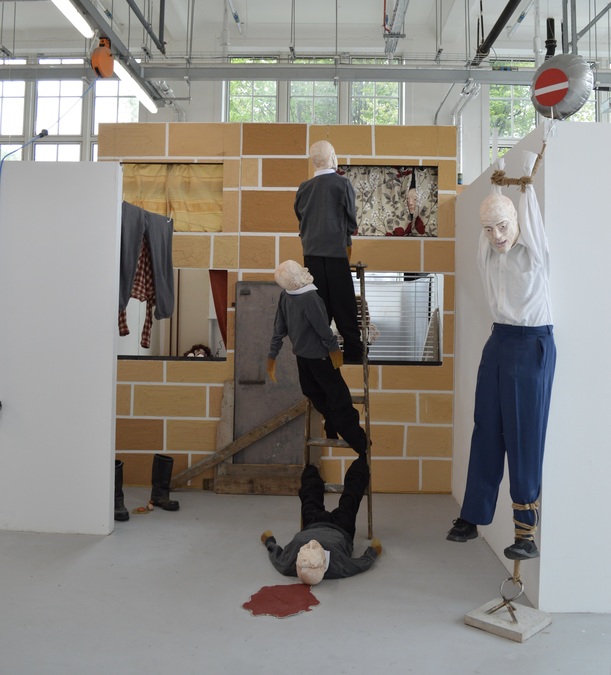
Tenement, Dylan Hope, Sculpture and Environmental Art
Eve Giltinan Allais’ project has spiralled from her obsession with the throbber – the loading symbol. She has installed vinyl reCAPTCHAs across the hoarding of the Stow car park, making it instantly recognisable as a space for transient experiences of waiting to load. Eve’s work embodies a throbbing through drawing, offloading information that is displayed alongside video. The projection of liminal time invites us to notice the absurdity of ignoring time's existence.
Also in video, Jordan MacRae is exhibiting a 16mm film examining the landscape of Orkney, the home of the poet George Mackay Brown. MacRae’s work engulfs the viewer in atmospheric narration and noise while fragmentary images of the island’s natural beauty circulate. Brown referred to life in Orkney as having a “marvellous simplicity”, and the film pays broader tribute to Orkney as a home for its contemporary and historic populations.
Robyn McCrae has manufactured a conveyor belt of eight cow heads, programmed via an Arduino-controlled motor to move continually back and forth, kissing the cow seated opposite, attached by a red seatbelt stitched into its mouth. Coward is a tongue-in-cheek political reflection on conformity in society, highlighting the behaviour of silence and inaction. The kinetic Mexican wave is a statement that life continues, and nothing changes in the same cycle. It visually performs a kick up the arse.
Jess Pickering is exhibiting a two-part installation engaging with the erasure and exposure of archival information. Archival text is stored in structures mimicking office shelves, then visibly corroded in acid over the course of the exhibition. Across the room, metal flooring is gradually shaped by the viewer’s footsteps to reveal fragmented text. Together, these works explore how history is uncovered, lost and preserved.
Celeste Knight sets five large ceramic pots on top of sculpted plinths that stage the act of interpreting subtle hints of jest embedded in their structural forms. Her practice is materially driven, with a focus on ceramics and clay. She uses coil building to create scale. The act of making emerges as if it were materially alive and unpredictable.
Scale grows within Dylan Hope’s constructed tenement dollhouse. Its inhabitants are hand-sculpted dolls who animate various human behaviours. The windows invite an onlooker into the absurdity of these recognisable and humorous intricacies. The dolls’ anatomy is built separately and pieced together, fashioned into a state of ‘not quite human’. Viewing them plays with our perception and prompts us to fill in the gaps.
Across the cohort, a shared interest in the esoteric and the reflective quietly emerges. Visitors are invited to slow their gaze and tune into the varied histories, processes, and perceptions that follow.
School of Fine Art, Stow Building, 29 May-7 Jun