Meet Agora, Glasgow's feminist creative collective
We meet AJ Duncan and Séania Strain of Agora, the collective building space and community for Glasgow’s creative feminists
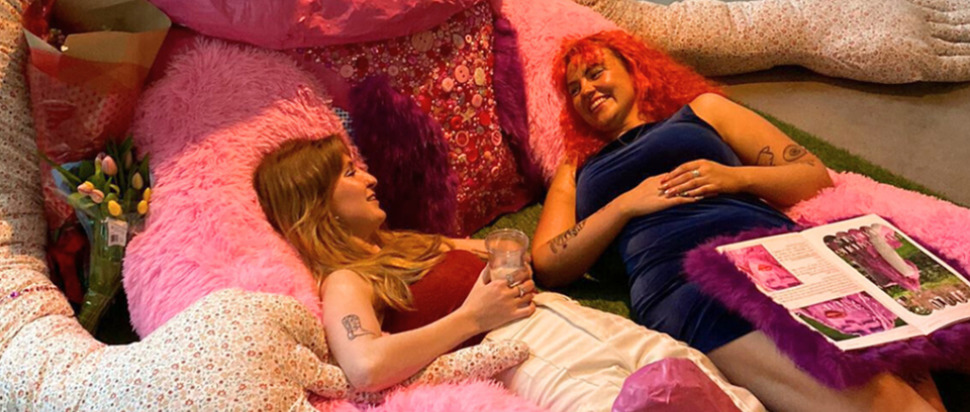
It’s a chilly morning on Victoria Road in Glasgow, but I spot AJ Duncan and Séania Strain across the road and immediately feel their warmth.
We’re here to discuss Agora, an intersectional feminist creative collective founded last year by Duncan and Strain. Named after the ancient Greek gathering space used for assemblies and markets, Agora hopes to remedy the lack of accessible, feminist spaces in the city. Duncan remembers a cafe in Houston where she went to school that was open until 2am – also named Agora. “You could go and have a tea, and everybody was playing chess, doing their homework. It was a proper shared space, which is what we're going for here, but using feminism and creativity as the medium to bring everybody together.” Defining a feminist space, she explains: “Our ethos as a whole is that it's a feminist project, and anybody who identifies as a feminist is welcome.”
Strain adds that ever since moving to Glasgow, she’s dreamt of “a huge warehouse where people can come and make art, and I can make art, and it can be as messy as it wants to be – there's stuff everywhere. You're being more creative by being in the space, and you're influenced by the space itself.” After crunching some numbers, Agora was born, with initial events raising money for a deposit on a centrally located unit, ensuring feminists from Glasgow and surrounding areas can easily access the space.
Both Duncan and Strain, who met online, have their own artistic practices, which they reached via different educational routes, studying Politics and Communication Design respectively. Studying at Glasgow School of Art gave Strain a taste of a creative network, but the impact of the pandemic left a hole in her arts education. “I feel like art school [used to be] more of a community. Back when there was a bigger drinking culture, people were in each other's houses all the time. But with people doing uni from home, we’ve lost some human interaction. Even the university experience suffered – it would have been good to have an open dialogue about your art, or even peer criticism about your art.”
“Art can be quite intimidating too”, she adds. “That’s why we try to make all of our events as inclusive as possible – it's like, come in, draw and have a yap.”
“Yeah, to enjoy being bad at drawing!” chimes in Duncan. “It's gonna look like absolute shit, and we're gonna have fun with it – that's kind of the point of it.”
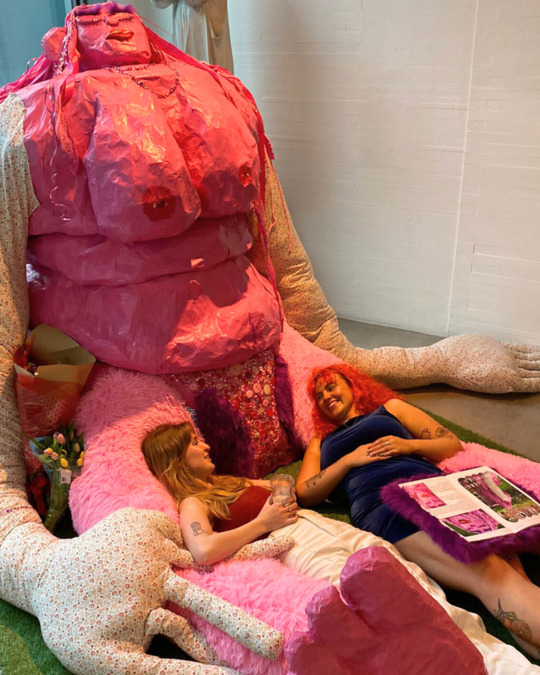
Image courtesy of Agora.
Since founding, Agora have organised markets, thrift stores, workshops in linoprinting and sketching, a club night and most recently a Valentine’s Day Cupid’s Cabaret at Glasgow’s Stereo. Looking to ensure Agora includes all types of creative practice, not just visual arts, the pair didn’t let a lack of personal experience stop them from attempting the ambitious event. “We have no sound knowledge, no performance knowledge – we have no idea,” Strain confessed, “but we have great organisational skills and we've done a bunch of events already.” Of course, they pulled it off, filling Stereo with drag performers, belly dancers, comedians, poets and singers. “Someone made a muppet and sang Man or Muppet [from The Muppets soundtrack] – like, they built their own little muppet! It was so good.”
“The energy in the room was so lovely,” Strain attests. “And that's exactly what every single Agora event is like. We had a thrift the week before, and it was the same – the people that come out to be part of Agora are always genuinely nice people. And that's what we're trying to build – that community.”
Next on the horizon is an exhibition for International Women’s Day, which Duncan has been running since 2024. She speaks passionately about the previous years’ events, which began from a starting point of “let’s have a massive party, but go mental with it.” The first iteration, a fundraiser at Strange Field, featured workshops and events supporting the core exhibition of 33 female and gender non-conforming artists. “We had a clothing swap shop that Clique ran, a painting workshop where you could just join in – everything was free. There was tarot reading, our friend Aylee was DJing. You could buy the art, and everybody just stayed in the space,” Duncan gushes. “It was just a big party of people that didn't know each other, sitting doing crafts together. And I was like, this is fucking magical, actually. This is what I want every day to be like.”
This year’s event is being organised together with artist Anna Burgess, and is set to be their biggest event yet. “We've got four days at Burns Street Studios – we've made it a mini festival where every single day has different events. Anna's gonna do feminist informed life drawing, we’ve got collage workshops, yoga, still life,” lists Duncan.
Empowering, welcoming events like this help build Agora’s network while they wait to acquire the perfect space. And with the rise of right-wing populism, the pair feel that community is needed more than ever. “If we're going to come together, we need to stop being divisive, and we need to make space for one another,” she adds. “We want it to be open to everybody, a space where you can build community with people that you might not normally speak to.” In this cold political climate, Agora’s passion and ambition is a welcome warmth.
Agora’s International Women’s Day Exhibition, Burns Street Studios, Glasgow, 7-10 Mar
Free tickets for the opening party on 7 Mar can be found @agora.gla on instagram